 Life & Style

Việt Nam, Switzerland to turn education, sci-tech, innovation into cooperation focus
1.
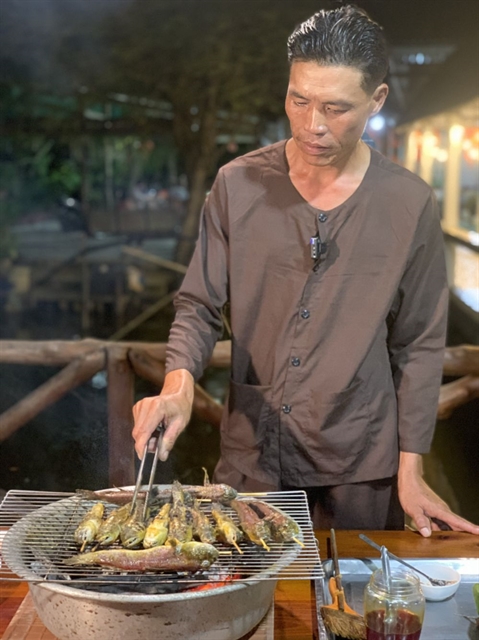 |
| Mudskippers are a famous specialty from Cà Mau, known for its enticing flavour. — Photo laodong.vn |
HÀ NỘI — Mudskippers are a unique and versatile amphibious fish that can walk on land, hop on mud, climb mangrove roots and breathe air. They are one of strangest animals on earth, and may seem cute to some and ugly to others.
In Cà Mau Province, they are known as cá thòi lòi, and are well known as an ingredient in a range of delicious dishes.
Part of the goby family, mudskippers live in tropical and subtropical mangrove forests and tidal flats across Africa, Asia and Australia. In Việt Nam, they are found in coastal mudflats, mangrove forests and riverbanks throughout the southwestern provinces – but the southernmost, Cà Mau, known as the kingdom of mudskippers.
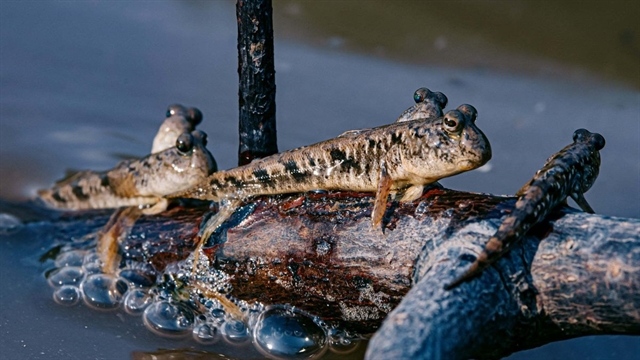 |
| Found in muddy tropical mangrove forests and tidal flats, mudskippers have firm and tender white meat. — Photo dienmayxanh.vn |
They use strong, muscular pectoral fins like crutches to hop and 'walk' over mudflats to feed and defend territory during low tide.
And if having a strange-looking body with two bulging eyes perched on top of a mud-slicked head for a 360-degree view to watch for danger wasn’t enough, these fish also possess the ability to jump in the air to attract a mate.
They are considered a rustic and nutritious delicacy, with a flavour that isn't fishy at all. Despite their unusual look, they have tender meat that lacks a muddy taste when cleaned properly.
According to Phạm Hải Yên, owner of a restaurant in Cà Mau, the fish was long shunned for its unsightly appearance and because it lives in a brackish habitat teeming with fish and shrimp. Only very poor people caught mudskippers for food, and often cooked them in a cheap and simple preparation, just braising them with pepper and serving them with rice.
Nowadays, however, mudskippers have become the queens of mangrove cuisine. Once cleaned, with the slime removed from their skin, scales taken off and entrails discarded, and prepared by skilled chefs, they transform into a delicious meal that is impossible to resist.
She said mudskippers are available all year round, but are most commonly found from January to May in the lunar calendar, when they are in peak season and their meat is firmer and tastier.
In the past, these fish could only be caught in the wild, but recently local people have successfully farmed them, allowing them to become more widely available as an ingredient for local restaurants.
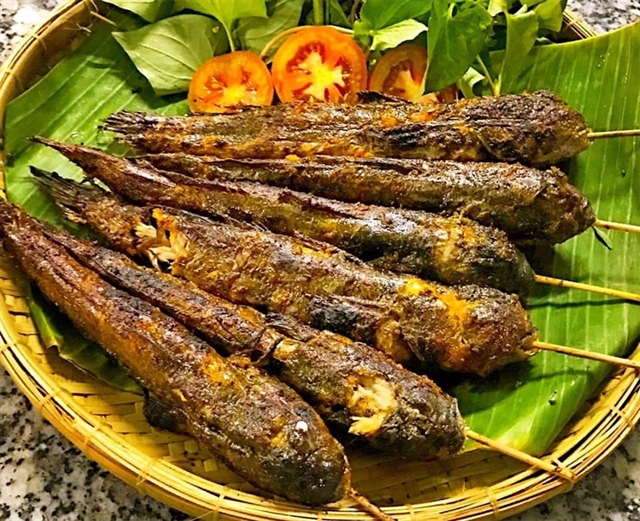 |
| Mudskippers can be cooked in a variety of ways, but the most popular is grilled with chilli salt. — Photo laodong.vn |
One of the most popular ways to eat mudskipper is as a simple snack: grilled with chilli salt, giving it a bold, spicy and salty flavour that is addictive.
The mudskippers are skewered on bamboo sticks and grilled over charcoal. While grilling, they are continuously basted with a mixture of crushed coarse salt, smashed chilli and annatto oil, allowing the flavours to penetrate evenly and giving the fish an attractive colour.
Once fully cooked, the fish’s crispy golden skin gives way to firm, juicy white meat. It is traditionally served with a dipping sauce made of salt, pepper and lime, accompanied by fresh herbs.
Satay grilled mudskipper is another great version with a rich, mildly spicy aroma. It is suitable as a snack or to change up the family meal.
Braised mudskippers cooked in a clay pot are a regular pick for southern Vietnamese family meals, featuring a harmonious sweet and savoury flavour, tender meat and a thick, rich sauce that goes perfectly with rice.
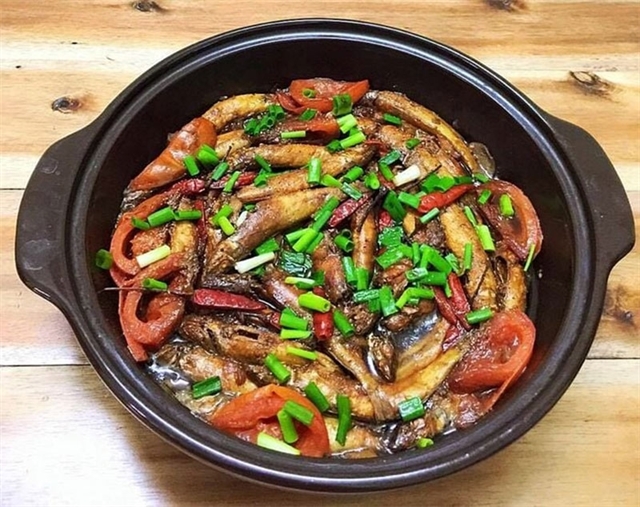 |
| Braised mudskipper in a clay pot is one of the most popular dishes in many restaurants in Cà Mau. — Photo fptshop.com.vn |
Another, more rustic dish is lightly braised mudskipper, which has a mildly salty taste. It pairs well with steamed rice and boiled vegetables. As it uses few spices, the dish retains the subtle but distinctive mudskipper flavour.
Mudskipper can also be braised with either Vietnamese coriander or white radish. With coriander, it has a mouthwatering aroma and is typically eaten with steamed rice. The coriander helps reduce the fishy smell, while adding freshness to the dish.
When braised with white radish, it makes a hearty dish with a clear, light sauce that makes it easy to eat and well suited to family meals.
Another local favourite is deep-fried mudskipper, offering a crispy texture that pairs perfectly with vermicelli and fresh vegetables.
Crispy fried mudskipper is a simple yet appetising dish, with golden, crunchy skin encasing the tender meat. It is best enjoyed with fresh greens and a dip of sweet and sour fish sauce.
For a richer variation, sesame-fried mudskipper is coated in a light, crispy batter and fragrant sesame seeds, which help retain the moisture in the meat, keeping it juicy and tender. The combination creates a satisfying crunch and a savoury, aromatic flavour.
.jpg) |
| Mudskipper hotpot is not only delicious, but also features a delicate, sweet broth. — Photo dacsanmuicamau.com |
Other dishes include mudskipper hotpot with vegetables or fragrant herbs, and sweet and sour mudskipper soup.
Yên said that dried mudskippers make a great gift for family and friends.
It is traditionally soaked in lye water, sun-dried for one or two days, then pan-fried, resulting in a mild salty taste. It is also very convenient to store and easy to process into many delicious dishes.
Dried mudskippers go perfectly as a snack with rice wine at a party or even just at family meals, she said. — VNS
Life & Style
 Life & Style
 Life & Style
 Life & Style
 Life & Style
 Life & Style
 Life & Style
 Life & Style
 Life & Style
 Life & Style
 Life & Style
 Life & Style
 Life & Style
 Life & Style
 Life & Style