 Life & Style
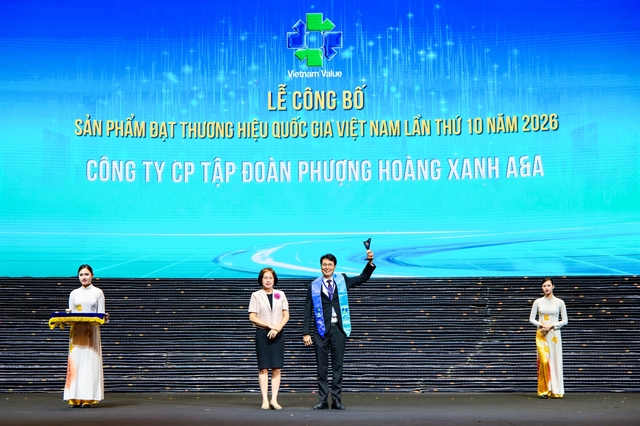
Phenikaa wins fifth consecutive Vietnam National Brand title
1.
|
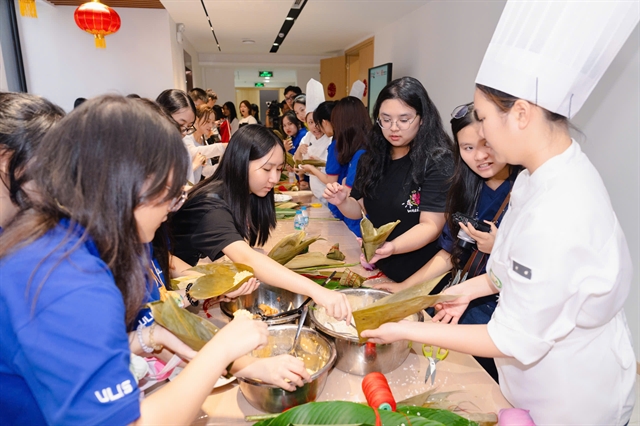
| Visitors try on wrappling rice dumplings at the Dragon Boat Festival which is held at the Chinese Cultural Centre in Hà Nội on June 18. — Photos courtesy of Chinese Cultural Centre |
HÀ NỘI — China's traditional Dragon Boat Festival was recreated at the Chinese Cultural Centre in Hà Nội on June 18, as a way to spread awareness of this unique celebration in Việt Nam.
Also known as the Double Fifth Festival, it falls on the fifth day of the fifth lunar month, which typically corresponds to late May or June in the Gregorian calendar.
One of the most traditional festivals in China, the celebration has over 2,000 years of history and is a way to express aspirations for health, peace, family reunion and the preservation of ancient cultural values.
During the festival Chinese people typically hang bundles of mugwort leaves to purify their living spaces, clean their houses to ward off evil spirits and express the philosophy of maintaining health in harmony with nature.
The custom of wrapping and releasing rice dumplings into the river commemorates virtuous people, fostering family affection and patriotism.
Other festival practices include wearing five-coloured strings and carrying fragrant sachets to pray for peace and good fortune, and holding dragon boat races to demonstrate unity and aspiration.
Also known as zongzi, rice dumplings are the most iconic food associated with the festival. They contain traditional ingredients and flavours and carry deep historical roots and profound cultural symbolism. They also vary greatly in flavour, depending on the region.
In Việt Nam, this time of year is known as Tết Đoan Ngọ, or the insect-killing festival. It is a unique Vietnamese holiday when people catch insects, destroy pests that harm crops and pray for a bountiful harvest. People also believe that eating sour fruit in the morning can help chase away intestinal parasites.
One of the Vietnamese festival's signature dishes is bánh tro, a kind of cone-shaped alkaline dumpling made with glutinous rice soaked in the water run through the ashes of various herbs and fruits.
The festival is not simply a holiday, but also an opportunity for people to get together to help preserve the nation's cultural values.
|
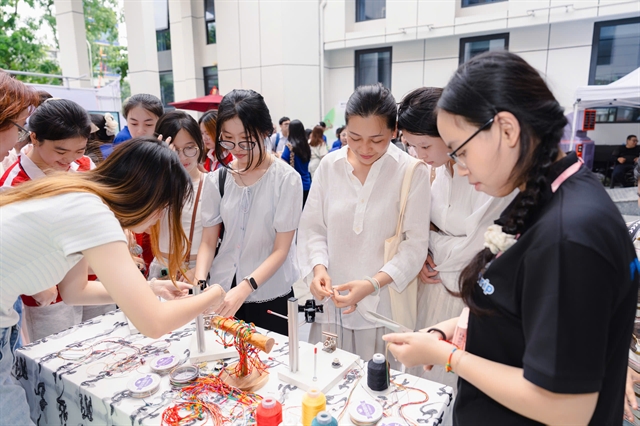
| Visitors learn to weave colourful bracelets at the event. |
During the event at the Chinese centre, attendees took part in a variety of activities steeped in Chinese culture, such as enjoying traditional cuisine, weaving colourful bracelets, making fragrant sachets, participating in folk games, watching Hanfu performances and other artistic shows, and even making zongzi.
Centre director Zhang Deshan said the festival is a longstanding traditional event embodying patriotism, benevolent humanistic values and a philosophy of living in harmony with nature and the community.
"Today, its significance transcends the boundaries of a traditional festival to become a symbol of the exchange of Eastern civilisation with the world, reflecting the spirit of global civic initiatives," he said.
Tian Qiru, a counsellor at the Chinese Embassy in Việt Nam, said: "China and Việt Nam share many cultural similarities and traditional customs. Folk festivals have thus become bridges, strengthening the bonds between the two peoples.
“Today, building on the foundation of comprehensive cooperation between the two countries, the peoples of Việt Nam and China have increasing opportunities to deepen mutual understanding and strengthen friendship through cultural exchanges, tourism, study programmes and economic and trade cooperation. Of these, cultural exchange is seen as a vital bridge, helping to reinforce the social foundation of bilateral relations.”
According to Trần Nhật Hoàng, deputy director of the International Cooperation Department under Việt Nam's Ministry of Culture, Sports and Tourism, the festival is a unique cultural feature of East Asia, cherished and preserved by the people of both Việt Nam and China.
Although each country has its own customs and ways of celebrating, it is an occasion for people to express gratitude to heaven and earth, remember their ancestors and pray for health and peace for their families and communities.
These shared values of gratitude and family bonds are cultural similarities that contribute to strengthening understanding and close ties between the people of the two countries. — VNS
Life & Style
 Life & Style
 Life & Style
 Life & Style
 Life & Style
 Life & Style
 Life & Style
.jpg) Life & Style
Life & Style
 Life & Style
 Life & Style
 Life & Style
 Life & Style
 Life & Style
 Life & Style
 Life & Style