 |
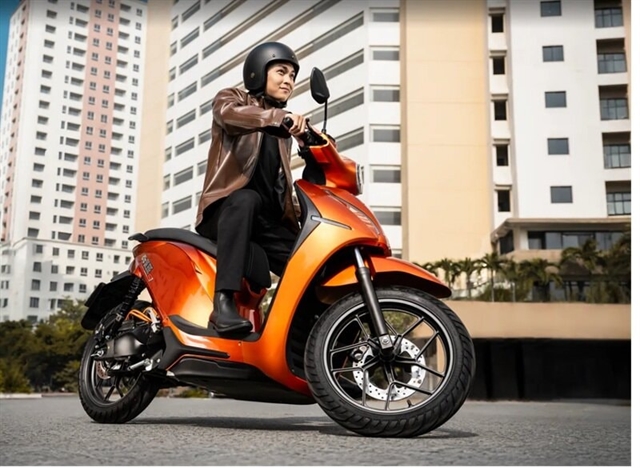
| Dat Bike targets Việt Nam’s mass electric motorcycle market. Photo courtesy of Dat Bike |
HCM CITY – Vietnamese electric motorcycle maker Dat Bike has launched its new ERA model, marking what the company describes as a strategic shift from serving early adopters to making electric mobility a more practical and accessible choice for mainstream consumers.
Priced from VND29.9 million (US$1,150), ERA is designed around everyday family use, with a range of up to 200km, a 50-litre storage compartment and a 5kW motor. The model is Dat Bike’s first motorcycle priced below VND30 million, positioning the company more directly in the highly competitive mass-market segment.
For Dat Bike founder and CEO Nguyễn Bá Cảnh Sơn, however, ERA is more than a new product.
“ERA represents an important step in that journey. We want to make high-performance electric motorcycles accessible to more consumers, beyond our core community of technology enthusiasts,” Sơn told Việt Nam News.
He said the company’s ultimate goal had never been limited to a niche market, but was to accelerate the transition from petrol-powered motorcycles to electric ones. ERA, he added, reflects a change in Dat Bike’s approach – from convincing consumers that electric motorcycles are an interesting option to demonstrating that they can be a better choice for everyday mobility.
From early adopters to everyday riders
Dat Bike initially focused on technology enthusiasts and early adopters who were willing to experiment with new products. According to Sơn, that period allowed the company to test the market, validate key assumptions and continuously improve its products.
 |
| Dat Bike founder and CEO Nguyễn Bá Cảnh Sơn. Photo courtesy of Dat Bike |
The next challenge is considerably larger: persuading ordinary households to make an electric motorcycle their primary means of transport.
As electric motorcycles move towards mass adoption, consumers’ priorities are also changing. Rather than focusing mainly on technology or headline performance figures, families increasingly value convenience, storage capacity, reliability, range and daily running costs.
ERA was therefore developed around practical use cases such as commuting, taking family members to school or work, shopping and navigating urban streets.
“We believe that for electric motorcycles to achieve mass adoption, the product must be designed around people’s lives, and should not require people to change their lives to accommodate the vehicle,” Sơn said.
The approach is reflected in ERA’s specifications. The scooter has a 4.3kWh battery, a claimed range of up to 200km, 50 litres of storage and a top speed of 82km/h. Its integrated charging system eliminates the need for a separate external charger, while the higher-end ERA E1 supports standard, fast and boost charging modes.
Dat Bike said the integrated charger combines the charging system with key components of the powertrain, reducing the need for additional hardware and allowing users to charge from a standard household outlet. ERA also comes with features such as hill-start assist, cruise control, anti-theft protection, mobile connectivity and over-the-air software updates.
Building an advantage beyond price
The sub-VND30 million starting price puts ERA into one of the most competitive parts of Việt Nam’s electric motorcycle market. But Sơn said price alone would not determine Dat Bike’s ability to compete.
Instead, the company is focusing on what it calls the performance-to-price ratio – the ability of an electric motorcycle to match or exceed petrol motorcycles in power, range, speed, durability and convenience while maintaining reasonable ownership costs.
 |
| Rishab Malik, Managing Partner at Jungle Ventures. Photo courtesy of Dat Bike |
Dat Bike’s longer-term competitive strategy is based on three pillars: vertical integration, a rapid feedback loop with customers, and an exclusive focus on electric two-wheelers.
The company develops a range of core technologies in-house, including motors, battery packs, battery management systems, controllers, software and vehicle frames. Sơn said this gives Dat Bike greater control over quality, costs and product development speed.
The strategy does not mean the company intends to develop every component itself. In areas where Việt Nam does not yet have sufficient scale, such as battery cells, Dat Bike continues to work with international partners, while seeking to retain control over technologies that define the product experience and its competitive advantage.
Investor sees ERA as an inflection point
For Jungle Ventures, which invested in Dat Bike at seed stage in 2021 and has participated in every subsequent funding round, ERA represents a significant turning point in the company’s development.
“Every great company reaches an inflection point where it shifts from proving a product to scaling a category. We believe ERA represents that moment for Dat Bike,” said Rishab Malik, Managing Partner at Jungle Ventures.
“It’s not simply a new model, it’s a deliberate move to make electric mobility accessible, practical and compelling for mainstream Vietnamese consumers.”
Malik said Dat Bike’s investment case was not based simply on the fact that it was an electric vehicle company. Rather, Jungle Ventures saw a combination of a technically capable founder, a huge motorcycle market and a product designed to challenge consumer expectations.
According to Malik, Dat Bike has also demonstrated that Vietnamese companies can develop competitive mobility technology rather than simply import and assemble products.
“The biggest change isn’t that Dat Bike has grown, it’s that the market has caught up with the conviction Son had from day one,” he said, adding that the company had patiently built its technology, manufacturing capabilities and brand rather than chasing short-term trends.
He sees this ability to build a defensible advantage across hardware, software, manufacturing, supply chains, customer experience and distribution as increasingly important for EV companies.
“The real question is: what advantage is this company building that becomes stronger with scale,” Malik said.
Expanding the network, then the region
The launch of ERA comes as Dat Bike prepares for its next stage of expansion.
The company has raised a total of more than US$51 million and plans to focus over the next three to five years on three priorities: expanding access to high-performance electric motorcycles in Việt Nam, investing further in core technology and manufacturing capabilities, and entering Southeast Asian markets.
Dat Bike plans to expand its nationwide 3S network – sales, service and spare parts – so customers can more easily purchase, maintain and upgrade their vehicles. The company has identified Thailand as its first international market.
The strategy reflects a broader ambition to build a Vietnamese electric motorcycle brand with regional reach.
Sơn said Dat Bike wanted not only to sell more vehicles, but also to develop the technological and manufacturing capabilities needed to compete at regional scale.
“Our long-term vision is to build a Made-in-Vietnam electric motorcycle brand with regional reach,” he said. “We want to demonstrate that Việt Nam can be more than a consumer market for EVs. It can develop its own technology and become a manufacturing and R&D hub for the region.”
Betting on the next decade of electrification
Jungle Ventures also remains bullish on the long-term outlook for electric mobility in Southeast Asia, despite periods of slower investment and greater scrutiny of EV businesses globally.
Malik said Southeast Asia remained in the early stages of electrification and that the next decade would favour companies combining engineering capabilities, local manufacturing and products that consumers genuinely prefer over conventional alternatives.
For Dat Bike, the opportunity is particularly significant given the scale of Việt Nam’s two-wheeler market.
Sơn believes the transition from petrol to electric motorcycles should not be viewed simply as a change in vehicle technology, but as a broader transformation involving products, infrastructure, policy, financing and consumer behaviour.
He remains confident that within the next decade new petrol motorcycles could cease to be produced and electric motorcycles could become the new standard for two-wheel mobility.
“Consumers no longer have to choose between a ‘good motorcycle’ and an ‘electric motorcycle’. The electric motorcycle will simply be the better motorcycle,” Sơn said.
For Dat Bike, ERA is therefore both a product launch and a test of whether its technology-first strategy can translate into mass-market adoption.
If successful, the company’s next phase will be measured not simply by how many motorcycles it sells, but by whether it can turn electric mobility from an alternative into a mainstream choice for Vietnamese households – and eventually take a Vietnamese-developed electric motorcycle proposition into the wider ASEAN market.-VNS
 Economy