 Life & Style
Youth-led initiative opens up opportunities for disadvantaged children
1.
|
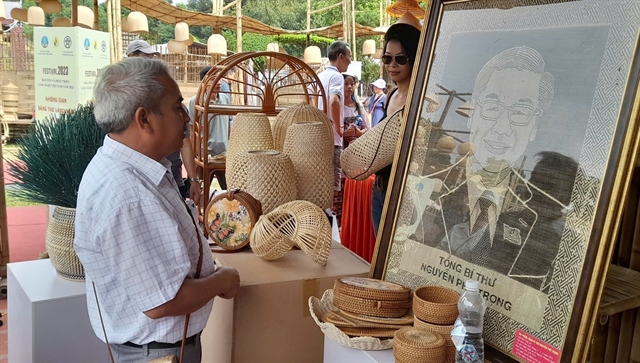
| Bamboo and rattan products from Phú Vinh craft village in Phú Nghĩa Commune, Hà Nội are showcased and attract customers at trade fairs throughout the country. — VNS Photo Thanh Nga |
HÀ NỘI — Resolution No 80-NQ/TƯ positions culture as a key resource for sustainable development.
In Phú Nghĩa Commune, Hà Nội, the plan is being put into action with targets to upgrade cultural institutions, revive craft villages through tourism, grow the cultural industry, speed up digital transformation, and raise residents’ quality of life.
“Phú Nghĩa is rich in history and cultural traditions, with a long revolutionary past and strong community solidarity,” said Nguyễn Thị Phượng, Deputy Head of the commune’s Culture and Social Affairs Department.
“We have a network of relics, preserved village spaces, and 21 typical craft villages - from Phú Vinh rattan weaving to Phù Yên carpentry. Folk arts like ca trù (ceremonial singing), chèo (traditional opera) and quan họ (love duet) singing remain alive here, forming a distinctive local identity.”
Phượng acknowledged the hard work ahead, adding: “To meet new development demands, we must strengthen cultural and sports facilities, raise human-resource capacity, and link cultural industries more closely to craft-village tourism so the commune can fully exploit its potential.”
The commune is pursuing a people-centred vision that places culture at the heart of sustainable economic growth. Each year Phú Nghĩa organises at least five large cultural and sports events and maintains clubs for traditional singing, quan họ, and community health exercises.
Plans include creating two stable handicraft-village tourism models, establishing two community tourism routes with neighbouring areas, and supporting three new OCOP products annually. Professionally run experiential tours - rattan and bamboo weaving, carpentry, organic farming and visits to historic houses and wells - will be linked to ecotourism and experiential education.
Digital transformation is also a priority. The commune is applying science and technology across administration and public services, promoting the digital economy, and introducing ISO-quality management in government operations to build a service-oriented, transparent system. Heritage records will be digitised and a cultural-tourism database created to support digital product development.
Phượng summarised the strategy simply that to implement Resolution 80 effectively, Phú Nghĩa must leverage its cultural assets as drivers of sustainable development. By preserving relics, strengthening institutions, branding local handicrafts, encouraging e-commerce, and forming value chains that tie heritage preservation to economic activity, the commune aims for balanced, modern growth.
With coordinated state support and community consensus, Phú Nghĩa is positioning itself as a locality with a vibrant culture and clear identity - a safe, harmonious place where tradition and modernity reinforce each other and contribute to Hà Nội’s sustainable development in the new era. — VNS
Life & Style
 Life & Style
 Life & Style
 Life & Style
 Life & Style
 Life & Style
 Life & Style
 Life & Style
 Life & Style
 Life & Style
 Life & Style
 Life & Style
 Life & Style
 Life & Style
 Life & Style


.jpg)



