 Life & Style

Shorter Trips, Familiar Ways to Pay: How Airpaz Supports Flexible Booking with 100+ Payment Methods
1.
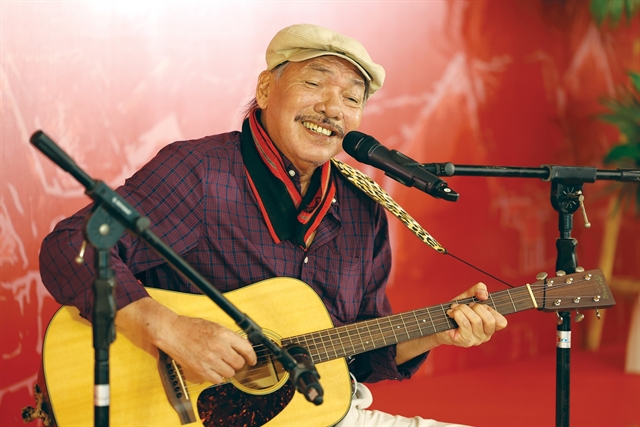 |
| Composer Trần Tiến at the Bùi Xuân Phái Award ceremony. Photo thethaovanhoa.vn |
Composer Trần Tiến, born in 1947, has written songs to chronicle real life, marked by dust and blood, by smiles and tears. His songs about Hà Nội are very much part of that reality.
Last year, he was honoured with the Grand Prize at the 18th Bùi Xuân Phái: For Love of Hà Nội Awards by Vietnam News Agency's Thể Thao Văn Hóa (Sports & Culture) newspaper.
Trần Tiến spoke to the media about the honour of receiving the award and his love for his home, Hà Nội.
You were born and raised in Hà Nội before moving to HCM City, where you've been living for the past 45 years. Were you surprised to be honoured with the Bùi Xuân Phái Award?
I am deeply moved and truly happy. I have written only a handful of modest songs about memories and things I love, yet they have been sung by so many people. The greatest happiness of all is being able to return to my hometown, embraced by such affection, and to receive an award bearing the name of someone I deeply admire – the great painter Bùi Xuân Phái.
To be honest, I began learning to paint at the age of seven, so I have some grounding in fine arts. Bùi Xuân Phái, with his iconic paintings of Hà Nội’s streets, along with many artists of earlier generations such as poet Phan Vũ, instilled in me a love for Hà Nội. I carried that love with me to the battlefield, across the world, to every place I wandered. Everything I have achieved comes from lessons passed down by those who came before me.
What does Hà Nội represent in your heart? Could you talk more about your longing for the city?
I am someone who has lived far from home, away from Hà Nội for 45 years. Yet throughout all that time, my soul, like those of my friends – some still living, others gone – has always hovered around the Turtle Tower, around the streets of Hà Nội.
Whenever I hear someone speaking with the accent of my hometown, the original Hà Nội accent, I feel my eyes fill with tears. I cannot explain why the city evokes such an overwhelming sense of longing for those who live far away. And this is not unique to Hà Nội – wherever your hometown may be, hearing its voice stirs the same emotions, just as I feel when I hear the accent of Hanoians.
To me, Hà Nội is my mother, my sister and my friends. It is joy and sorrow, childhood and dreams. All my longing, I pour into my songs. I am fortunate that these songs have been loved and sung by so many.
After more than four decades away from Hà Nội, do you think the city has changed much?
Hà Nội has changed a great deal. As the world changes, it must change too, with taller buildings and wider streets. There are many new roads I have never known. That is something to celebrate. Young people see Hà Nội through young eyes. I, however, always see it through the eyes of old age, through memories that never fade, still bearing the image of old Hà Nội, like a Bùi Xuân Phái painting.
Do you write songs on commission?
I never set out to write about anything through reason alone. Whatever moves my heart, I write. When I miss Hà Nội, I write. In HCM City, when I met a street vendor caring for her disabled husband and saw how beautiful their love was, I wrote. When I encountered an orphaned child, a legless war veteran, a prostitute – if I was moved, I wrote.
In short, whatever makes my heart move becomes a song. Of course, there was one time I accepted a commissioned work. The chairman of Hoa Sen Group gave me VNĐ200 million to write a song about his company. But I could not write it, and returned the money. He said: "Consider it a gift. You don’t have to write anything." That gesture deeply moved me, and I asked to visit the company once more to find inspiration.
Seeing employees meditate and read Buddhist scriptures for 15 minutes before work every morning, I realised that the soul of this business leader was profoundly Buddhist. And suddenly, the song came to me. The song Sen Hồng Hư Không (The Pink Lotus of Emptiness) was immediately embraced by the public. I both repaid my debt and gained renewed recognition.
The song, powerfully performed by Tùng Dương, became so successful that in Buddhist Nepal it has been adopted as a song of Buddhism. At major ceremonies there, Tùng Dương is invited to perform it on large stages.
Do you usually compose when you are happy or sad?
That is something I cannot really say. Every person comes into this world with a path already laid out – one that cannot be resisted or avoided. Life has no right or wrong; it simply is.
Sadness and happiness are merely names we give to things; in essence, it all simply is. My task is to write. Sometimes I finish a piece and then forget it, even throw it away without a second thought. Songs like Chuyện Tình Thảo Nguyên (A Grassland Love Story) and Dòng Sông Mùa Thu (The Autumn River) were rescued from obscurity by my niece, singer Hà Trần, who brought them to the stage, where they were warmly received. I wrote them and then put them in the trash.
What brings you the greatest happiness in life?
What makes me happiest is being able to think, to dream, and to write about dreams. It may sound odd, completely detached from the material world. I like immersing myself in dreams to write. When it comes to everything else I am rather clueless.
I do not know how to make money, nor do I chase likes or views, even though I have written more songs than I can remember. Once, a major business owner even proposed giving me VNĐ100 billion (US$3.8 million) in exchange for the full rights to all my songs.
Of course, I refused. I need money, but not that much, and I cannot hand my ‘children’ to a stranger. I am happy when speaking of dreams, and art itself is a dream. Dreams are the language of the heart. You must live deeply with your heart so that your days do not become barren. In today’s technological world, dreams are gradually disappearing, and that is not good for humanity.
Do you like being called a ‘warrior’ for having battled cancer for five years and survived?
There is a song that has become my personal prayer, which I recite every day as I fight cancer. I have undergone 30 rounds of radiation therapy. Doctors were astonished that I am still alive, when many others collapsed by the 15th session. I fought death head-on, advancing millimetre by millimetre, refusing to accept fate. I still work six hours a day.
If I simply basked in the glory and fame I already have, perhaps I would not need to work anymore. I am nearly 80 years old. But I work hard because I need to work. Working is how I fight death. — VNS
Life & Style
 Life & Style
 Life & Style
 Life & Style
 Life & Style
 Life & Style
 Life & Style
 Life & Style
 Life & Style
 Life & Style
 Life & Style
 Life & Style
 Life & Style
 Life & Style
 Life & Style