 Life & Style

Scenic Group Marks 40 Years with Global River & Yacht Expansion
1.
|
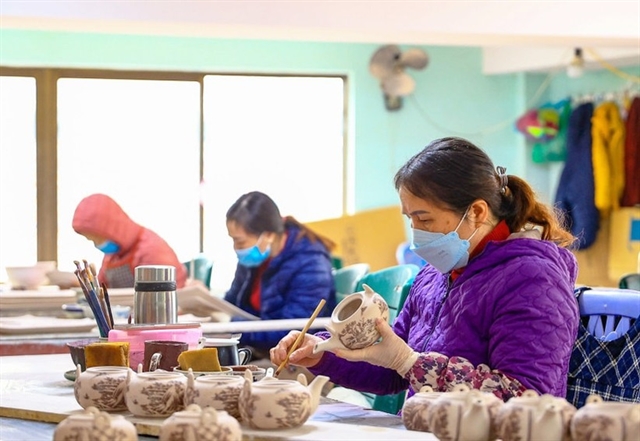
| Workers make products for the Lunar New Year (Tết) in Hà Nội's Bát Tràng Commune. Photo hanoimoi.vn |
HÀ NỘI — As Tết (Lunar New Year) approaches, traditional craft villages across Hà Nội are entering their busiest production season.
Hà Nội is home to the largest number of craft villages nationwide, with about 1,350 villages and craft-based communities, accounting for roughly 56 per cent of rural villages in the capital. Of these, 318 are officially recognised as traditional craft villages.
They not only enrich the market with a wide range of products but also provide stable jobs and incomes for tens of thousands of suburban workers, contributing significantly to sustainable rural economic development.
Iconic villages such as Bát Tràng ceramics village, Vạn Phúc silk village, Quất Động and Vân Tảo ornamental kumquat and peach blossoms villages, Sơn Động wood carving village, Quảng Phú Cầu incense-making village, and Tranh Khúc chưng cake-making village are especially vibrant in the run-up to Tết.
At this time of year, ceramics establishments in Bát Tràng Commune are stockpiling raw materials, mobilising labour and running extended shifts to meet Lunar New Year demand. Popular products include prosperity jars, feng shui tableware, worship items and zodiac-themed ceramics for the new year, produced in large quantities for domestic consumers and distributors.
Nguyễn Văn Ky, a ceramics producer in Bát Tràng, said his family workshop remains as busy as ever this Tết season.
“Despite market fluctuations, orders are still coming in steadily. By the end of the Lunar New Year, our output is usually two to three times higher than normal,” he noted.
Similarly, Vân Tảo peach village in Hồng Vân Commune is a hive of activity. Known as one of northern Việt Nam’s traditional Tết flowers, Vân Tảo peaches are cultivated across dozens of hectares. These days, growers are busy pruning, shaping and caring for trees, while also selling directly to customers.
According to Chairman of the Hồng Vân Communal People’s Committee Lê Tuấn Dũng, the commune has more than 1,200 households cultivating peach blossoms on 82.5ha in villages such as Nội Thôn and Đông Thái, generating an average income of around VNĐ1.5 billion (US$56,967) per hectare per year. Many families also rent an additional 30 hectares of farmland elsewhere in the commune to expand production. From late December, care for ornamental kumquat trees also enters its peak phase.
Meanwhile, in Tranh Khúc Village, famed for traditional chưng cakes, households are busy preparing ingredients ahead of the peak production period. Weeks before Tết, about 70 per cent of local households - around 300 families -take part in production, making 300–500 cakes per household per day. As Tết draws nearer, output can surge to 1,000–3,000 cakes per household daily.
According to the Hà Nội Department of Agriculture and Environment, during Tết, production capacity at craft villages typically doubles or even triples compared to normal months. Many agro-processing villages producing items such as glass noodles, rice noodles, phở and spring rolls see a constant flow of trucks transporting goods nationwide. These villages make substantial contributions to the capital’s socio-economic output.
Many craft villages record annual revenues of VNĐ10 – 20 billion, around 70 villages earn 20 – 50 billion, and about 20 villages post revenues exceeding 50 billion đồng each year.
Deputy Director of the department Tạ Văn Tường said that while traditional craft villages offer significant opportunities, they also face challenges, including outdated machinery, limited investment and low mechanisation levels. To remain competitive, artisans need to adopt new techniques and diversify products, while authorities should strengthen support policies, promote OCOP (One Commune, One Product) items, and enhance trade promotion and market connectivity.
As 2025 draws to a close, the bustling rhythm in Hà Nội’s craft villages reflects readiness, confidence and optimism for the Tết season ahead. Beyond being goods for sale, each product embodies generations of craftsmanship, tradition and cultural heritage, enriching the spirit of the Lunar New Year. — VNA/VNS
Life & Style
 Life & Style
 Life & Style
 Life & Style
 Life & Style
 Life & Style
 Life & Style
 Life & Style
 Life & Style
 Life & Style
 Life & Style
 Life & Style
 Life & Style
 Life & Style
 Life & Style