 Life & Style
LOAN Foundation awards scholarships to disadvantaged students on 10th anniversary
1.
.jpg) |
| Students attend a literature talk at Nguyễn Thị Minh Khai High School, where literature is gradually reclaiming its place in schools. VNA/VNS Photo |
HCM CITY As digital life increasingly dominates young people’s daily routines, literature is quietly but steadily reclaiming its place in schools, through emotionally engaging and human-centred educational experiences.
No longer confined to textbooks or curricula, literature is being “lived” rather than merely studied, in humane educational spaces, where poetry, music and sincere encounters open up a natural and sustainable reading journey for the younger generation.
Capacity for appreciation
Literature, first and foremost, is the capacity to perceive beauty and to be deeply moved by people, memory and history.
When approached through art, literature moves beyond abstraction and becomes part of one’s inner life.
The programme Khúc hát từ những vần thơ (Songs from Poetry) at HCM City University of Education is one such example.
More than 800 students entered a space where poetry was not only read on the page but also expressed through music, stage performance and urban memory.
Through songs adapted from poems, the programme retraced historical journeys, emotional depth and the spirit of HCM City — a city retold and remembered through the language of art.
Within the flow of Vietnamese popular music, poetry set to music has long been a durable aesthetic current in the cultural life of the southern metropolis.
Composers such as Phan Huỳnh Điểu, Hoàng Hiệp, Thuận Yến, Phạm Minh Tuấn, Trương Quang Lục and Phú Quang have demonstrated the profound connection between words and music, between poetic thinking and collective emotion.
Songs like Dấu chân phía trước (Footsteps Ahead), Vàm Cỏ Đông or Con đường có lá me bay (The Street with Falling Tamarind Leaves) are not only artistic works but also repositories of of shared memory and emotional geography.
Writer Trịnh Bích Ngân, chairwoman of the HCM City Writers’ Association, noted that the publication Poetry Set to Music – 50 Years of HCM City, introduced at the programme, is the result of the sustained creative efforts of many generations of artists.
“More importantly, through these poetic songs and performances, young people in general and students in particular can more deeply appreciate the beauty of the city’s soul and its humane vitality — something literature alone, if confined to the written text, may struggle to fully convey,” she said.
Poet Hoài Vũ, author of well-known works such as Vàm Cỏ Đông and Đi trong hương tràm (Walking through the Scent of Cajeput), said that it is precisely the stories of his life and poetry that create a bridge between wartime memories and today’s younger generation, demonstrating that poetry, when placed in the right context, still has the power to move hearts profoundly.
Professor Huỳnh Văn Sơn, president of HCM City University of Education, emphasised that education is not merely the transmission of knowledge, but also the cultivation of the soul.
For pedagogy students — the future teachers — the ability to appreciate beauty and emotional intelligence forms the foundation for truly reaching their pupils.
.jpg) |
| Striking choreography in a dance performance from the programme 'Khúc hát từ những vần thơ' (Songs from Poetry). VNA/VNS Photo |
Natural reading journey
At the university level, literature should be approached as a capacity for appreciation. At the school level, however, the challenge lies in ensuring that reading does not become an obligation devoid of joy.
Well-designed exchanges between writers and students can open a different gateway into reading culture, one rooted in empathy and lived experience.
A recent book-signing and talk by writer Nguyễn Nhật Ánh at Nguyễn Thị Minh Khai High School attracted more than 600 readers, who came not only for autographs but also to converse and listen to reflections on characters that have accompanied their childhood.
Reader Hằng Đinh, though unable to reach the signing queue in time, said she was still delighted to meet the author and talk with him in a peaceful space where literature lovers shared meaningful memories.
Ánh explained that revisiting characters often arises spontaneously during the writing process, rarely as a premeditated plan.
Open endings, he said, allow readers greater imaginative freedom rather than imposing fixed destinies on characters.
In the case of Mùa hè không tên (The Nameless Summer), he chose to continue the story because he felt it was unfinished, even though he later received many letters suggesting it be expanded into another book.
The venue of the book-signing itself carried special significance, as it took place at Nguyễn Thị Minh Khai High School, the main setting of his novel Ngôi trường mọi khi (The School as Always).
The writer said that this was also where his daughter once studied, and that the school’s architecture and atmosphere inspired him to incorporate it into his work.
The playful way he reimagined the school’s name in the novel reflects how literature, from another perspective, often begins with everyday life.
Encouraging students to create alongside literary works is another way to nurture reading culture.
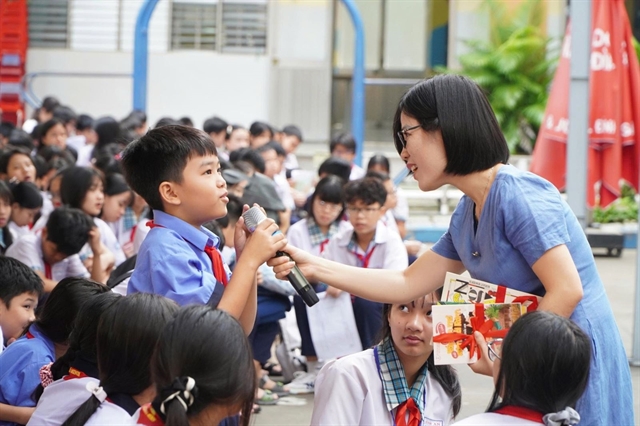 |
| Writer Võ Thu Hương interacts with pupils at Bình An Secondary School, sharing everyday stories about reading and imagination. VNA/VNS Photo |
'Travelling far through books'
A book-cover design competition themed around Ánh’s works, organised by the school’s Literature Department and Art Club, attracted more than 30 entries.
The winning cover for Có hai con mèo ngồi bên cửa sổ (Two Cats Sitting by the Window), designed by 12th grader Hoàng Phương Vy was recognised not only for its technique but also for its subtle empathy with the work’s gentle spirit.
In his role as a reading culture ambassador for HCM City, Ánh stressed that fostering reading habits cannot rest solely with schools. Parents and teachers alike must become reading role models at home and in the classroom.
“When children grow up in an environment filled with books, reading happens naturally, without coercion,” he said.
Alongside Ánh, female writer Võ Thu Hương has also chosen a close, conversational approach with pupils and students to spread a love of reading.
In school exchanges, she shared everyday stories about “travelling far through books”, where reading becomes a pathway to a wider world, even when material conditions are limited.
Lecturer Nguyễn Tiến Dũng from the Faculty of Primary Education at HCM City University of Education observed that such encounters create an enthusiastic learning atmosphere, offering students fond memories and renewed inspiration for studying literature.
Amid the rapid development of digital technology, reading remains irreplaceable in shaping children’s character and cognitive abilities.
As shared by teacher Lê Vĩnh Phúc at Lương Thế Vinh Primary School, books open vast horizons of knowledge, and when a love of reading is nurtured early, it becomes a lifelong habit.
From poetry set to music, to exchanges with writers and creative school-based activities, literature is quietly sowing seeds — nurturing reading culture, not merely to form reading habits, but individuals who live deeply, humanely and with emotional richness. VNS
Life & Style
 Life & Style
 Life & Style
 Life & Style
 Life & Style
 Life & Style
 Life & Style
 Life & Style
 Life & Style
 Life & Style
 Life & Style
 Life & Style
 Life & Style
 Life & Style
 Life & Style

.jpg)