 Life & Style

"Thai Night Busan 2026" Makes a Grand Return, Connecting Thai Content with Global Partners to Create Business Opportunities and Strengthen Industry Collaboration
1.
|
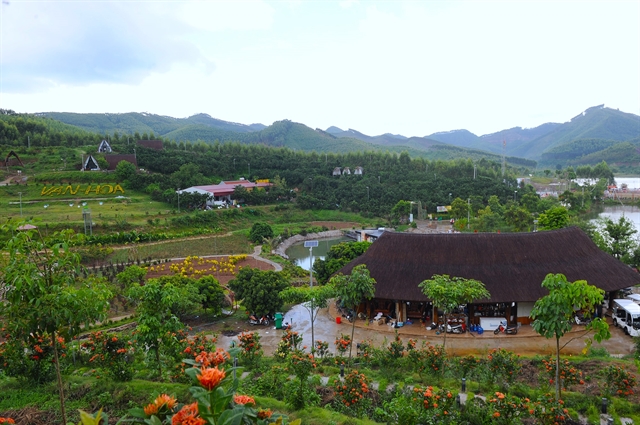
| Vibrant floral displays are a highlight at the Vạn Hoa Hồ Va community-based ecotourism site in Đông Phú Commune, the northern province of Bắc Ninh. — Photos courtesy of Bắc Ninh Province |
BẮC NINH — Following the merger of the former Bắc Giang Province into Bắc Ninh, the northern province has identified tourism as a spearhead sector in its local economic structure.
The province aims to welcome at least three million visitors and generate VNĐ3 trillion (US$113.8 million) in tourism revenue during the 2026–2027 period.
The targets were announced by Đỗ Tuấn Khoa, Deputy Director of the provincial Department of Culture, Sports and Tourism, at the 2025 Tourism Destination Promotion Conference held in Chũ Ward. The event sought to assess the province’s tourism potential, shape development orientations, and strengthen linkages to propel Bắc Ninh’s tourism sector forward in the new phase.
According to Khoa, Bắc Ninh’s tourism resources are exceptionally rich and diverse, often likened to a multi-faceted treasure trove. The unification of the two former provinces has created a highly complementary and interconnected pool of assets, spanning cultural and spiritual heritage as well as ecological and resort tourism.
Bắc Ninh is now home to nearly 4,000 historical and cultural relics, including 1,415 officially ranked sites. Among them are 11 special national relics and 24 national treasures.
The province boasts seven UNESCO-recognised intangible cultural heritages, ranging from the lyrical Quan họ folk songs and the ancient art of Ca trù, to the sacred spiritual landscape of Tây Yên Tử, closely associated with the Trúc Lâm Zen Buddhist tradition.
The province also features diverse natural landscapes such as Suối Mỡ Ecotourism Area, Khuôn Thần, Cấm Sơn Lake, the primeval forest of Khe Rỗ, Tây Yên Tử Nature Reserve and Ba Tia Waterfall, forming a comprehensive tourism ecosystem.
The Lục Ngạn area (formerly Lục Ngạn District), famed for its lychee brand and citrus orchards of pomelo and orange, also holds strong appeal. Together with the multi-ethnic culture of eight ethnic groups living in the area, and a wealth of relics, cultural heritage sites and scenic attractions, Lục Ngạn is well positioned to become a compelling destination for experiential tourism among both domestic and international visitors.
|
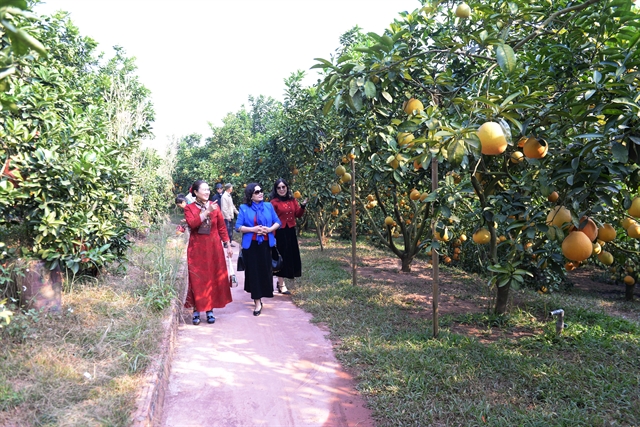
| Tourists visit the pomelo orchard of Nguyễn Văn Hữu in Chũ Ward, Bắc Ninh Province. |
For 2026–2027, Bắc Ninh aims to attract at least three million tourists and earn VNĐ3 trillion in tourism revenue. By 2030, the province targets one nationally recognised tourist area, two additional provincial-level tourist areas, and ten officially designated tourist sites. Visitor numbers are expected to reach 10 million, with total tourism revenue rising to VNĐ10 trillion ($379.5 million).
The current development strategy focuses on four key product groups: cultural and heritage tourism; ecological and rural tourism; urban and MICE tourism; and community-based and craft village tourism.
At the conference, delegates watched promotional documentaries on Bắc Ninh tourism, along with videos introducing local attractions, intra-provincial tour routes and inter-regional tourism linkages. Representatives from destinations such as Bầu Tiên, Neo Garden, Đông Đô Village, and Senna Wellness Retreat presented their distinctive tourism products and services.
While recognising the province’s strong potential, several participants noted that to accelerate tourism growth and retain visitors, Bắc Ninh must address shortcomings in infrastructure, accommodation, and food services, while developing reasonably priced tourism products with assured quality.
Nguyễn Thị Thùy Dung from Sunny Vietnam Joint Stock Company in Hà Nội observed that Bắc Ninh has recently introduced innovative tourism offerings, such as the 'Five-Gate Train Journey', which have attracted visitors.
She suggested that the province continue expanding high-end accommodation and entertainment facilities, invest in professionally managed tourism sites with high-quality services, and move away from free but low-experience models.
At the same time, she emphasised the need to improve services at key destinations such as Đông Hồ folk painting village, Đền Đô and Vĩnh Nghiêm Pagoda, particularly parking facilities, dining services and experiential activities, to encourage longer stays.
To establish Bắc Ninh as an attractive tourism destination in northern Việt Nam by 2030, participants proposed that the province implement comprehensive and decisive measures.
These include refining mechanisms and policies to attract investment and support community-based tourism, prioritising the development and upgrading of transport infrastructure linking tourist sites and especially focusing on night-time tourism products such as the 'Quan họ Night Boat Performance', alongside the development of standardised OCOP product outlets.
In addition, Bắc Ninh should intensify digital promotion through technologies such as AR and VR, and strengthen regional linkages with Hà Nội, Hải Phòng, Lạng Sơn and Quảng Ninh to position itself as a key node on the northern tourism map.
The province is also encouraged to attract strategic investors to develop high-quality tourism infrastructure and services, creating a breakthrough for the sustainable growth of Bắc Ninh’s tourism sector. — VNS
Life & Style
 Life & Style
 Life & Style
 Life & Style
 Life & Style
 Life & Style
 Life & Style
 Life & Style
 Life & Style
 Life & Style
 Life & Style
 Life & Style
 Life & Style
 Life & Style
 Life & Style