 Life & Style
Vietnamese NA President’s China visit facilitates bilateral cooperation: Chinese researcher
1.
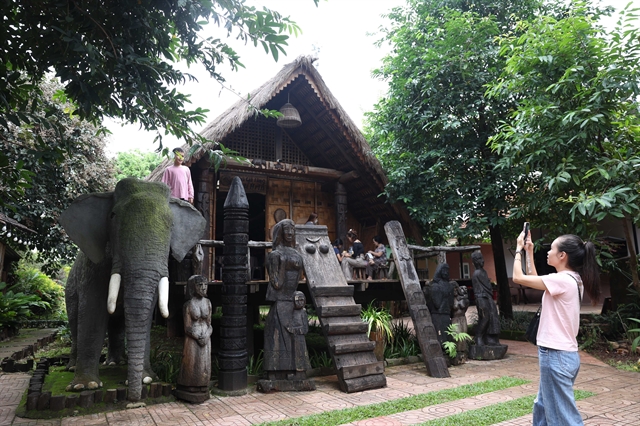 |
| The traditional long houses of the Ê Đê ethnic group in Đắk Lắk represent a unique architecture that preserves the quintessence of matriarchal culture and community spirit. — VNA/VNS Photo Tuấn Anh |
ĐẮK LẮK — Đắk Lắk Province has implemented policies to support the Ê Đê ethnic group in preserving and restoring their traditional long houses.
Võ Thị Phượng, director of the Đắk Lắk Museum, said that the long house of the Ê Đê is a place for family and community activities, ranging from worshipping and ritual ceremonies to performances of gong and epic storytelling. It is also a sacred symbol of a unique matriarchy society and the “soul” of the village.
The house has a dugout canoe shape and lies on stilts made of wood, bamboo and rattan, expressing harmony with nature. Its standout is the main staircase carved with the shape of women's breasts and a crescent moon, representing the power of women in the family.
Traditionally, the house was around tens of metres long and could be extended whenever a female family member married, reflecting a long-standing matriarchy. Today, the house has become smaller as each family is a nuclear unit of society.
Nguyễn Thụy Phương Hiếu, deputy director of the province’s Department of Culture, Sports and Tourism, said Đắk Lắk is home to many ethnic groups such as the Ê Đê and the M’Nông, forming a rich and diverse culture in speaking, writing, fine art, architecture, music, cuisine and festivals. The long house of the Ê Đê has also become a unique architectural symbol that attracts visitors.
Đắk Lắk now has around 5,600 traditional long houses, many of which have been degraded. It has earned achievements in the preservation and restoration of these houses since 2021, but has still faced difficulties in maintaining them due to the increasing costs of materials.
The province has implemented a resolution on developing community-based tourism in ethnic minority villages that is beneficial to local livelihoods and contributes to conserving ethnic cultural values.
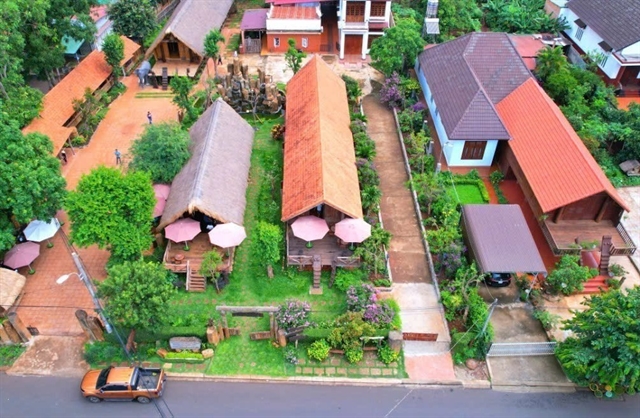 |
| The Ako Dhong Village in Buôn Ma Thuột Ward rises as one of the most favourite community-based tourism villages in the province. — VNA/VNS Photo Tuấn Anh |
Among them, Ako Dhong Village in Buôn Ma Thuột Ward has risen as the most favourite community-based tourism village in the province, featuring traditional long houses, gong cultural space, brocade weaving and cuisine.
The houses in the village are displayed with full ancient gong sets, kpan (the Ê Đê’s bench made of a wood trunk), a lot of jars of rượu cần (wine stored in a big jar and drunk with long bamboo straws), working tools and home utensils that recreate a lively space of the Ê Đê as well as the ethnic minority villages in Central Highlands.
Village chief H’Wit Bya said the village now has 40 traditional long houses, which are living spaces for generations of the Ê Đê families.
She added that local government has issued policies to support them in preserving the house’s original architecture and the village’s landscapes. Many of them have been renovated to serve as accommodation and cultural experiences to welcome tourists and help residents boost their incomes.
Mai Thanh Tâm, a tourist from Hà Nội, expressed her interest in traditional long houses and signature staircases symbolising the crucial role of women in the family and matriarchal society.
She hoped local government and relevant agencies would continue to support the preservation and promotion of the traditional long house of the Ê Đê as the province's unique tourism product.
According to the department, local authorities and relevant sectors will continue to implement policies to support the villages in developing community-based tourism development.
They will build, upgrade and renovate public facilities to serve tourists, invest in infrastructure, give financial support for the restoration of the long houses, purchase equipment for traditional art performance and gong groups. — VNS
Life & Style
 Life & Style
 Life & Style
 Life & Style
 Life & Style
 Life & Style
 Life & Style
 Life & Style
 Life & Style
 Life & Style
 Life & Style
 Life & Style
 Life & Style
 Life & Style
 Life & Style