 Life & Style
Israeli agricultural know-how takes root in Việt Nam
1.
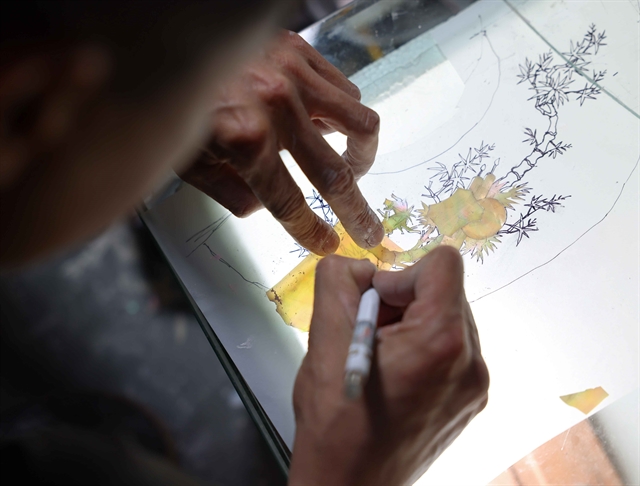 |
| The beauty of Chuyen My’s mother-of-pearl inlay lies in the uniqueness of each piece, which reflects the artisan’s soul. Photos courtesy of Hanoi Department of Agricutlure and Environment |
The nomination of Chuyen My mother-of-pearl inlay village (Chuyen My Commune, Hanoi) to join the UNESCO Creative Cities Network in the field of Crafts and Folk Art marks a new opportunity to showcase the essence of Vietnam’s traditional craftsmanship to the world. Built upon a heritage that spans over a thousand years, Chuyen My artisans continue to innovate and create, bridging Vietnamese cultural craftsmanship with the aesthetics of the modern world.
Located just over 20km south of central Hanoi, Chuyen My has long been known as the cradle of Vietnam’s mother-of-pearl inlay art. Nestled by the gentle Nhue River, the village gathers some of the country’s most skillful artisans-those whose hands have shaped the distinctive artistic identity of one of Thang Long-Hanoi’s oldest crafts.
At the ancestral temple of Chuyen My’s inlay craft, artisan Nguyen Dac Luyen recounts the story of this thousand-year-old village. According to historical records, the craft of mother-of-pearl inlay originated during the Ly Dynasty (1010–1225), linked to the legend of royal artisans sent to teach the local people their skills. Over dozens of generations, this artistry has been carefully passed down-its spirit embodied in each iridescent shell fragment, each delicate carving on wood, lacquer, or traditional worship items. Works such as horizontal lacquered boards, parallel sentences, carved beds, cabinets, and inlaid paintings have become symbols of Vietnamese aesthetic beauty-elegant yet deeply rooted in national heritage.
Behind each exquisite piece lies the quiet dedication of thousands of artisans. Many families in Chuyen My have kept the craft alive for three or even four generations. In every small workshop, the rhythmic sounds of saws and chisels echo day and night-the living pulse of tradition, carried forward by passion and pride.
More than skilled inlaying, Chuyen My artisans embody creativity in every step: from selecting shells-mother-of-pearl, oyster, or abalone-to the techniques of cutting, grinding, assembling, and pattern making. Each creation represents hundreds of hours of meticulous labour, where the craftsman’s hand and heart merge with nature’s raw beauty to produce works of timeless grace.
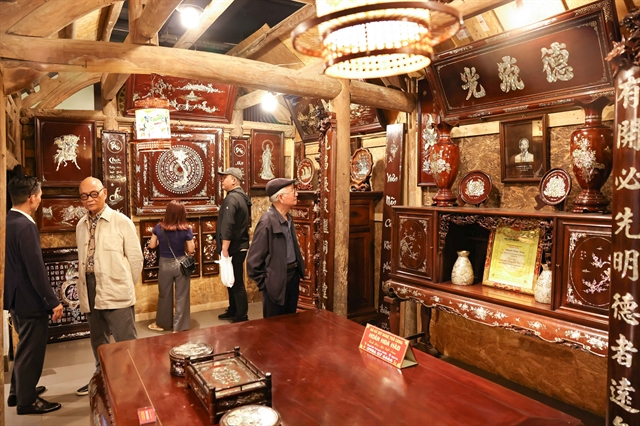 |
| Display of Chuyen My mother-of-pearl inlay products. |
In the face of modernisation-when many traditional craft villages struggle with challenges in workforce and markets-Chuyen My stands out for its commitment to “preserve the craft, renew the art.” Its mother-of-pearl inlay products are no longer limited to furniture or ritual objects, but have expanded into home décor, gifts, and applied fine arts-breathing new life into an ancient Vietnamese heritage as it reaches out to the global stage.
Beyond technical mastery, creativity defines Chuyen My’s artisans-from selecting shells of pearl, oyster, or abalone, to cutting, grinding, assembling, and designing intricate patterns. Each product is the result of hundreds of hours of meticulous labor, where the craftsman’s hand and heart merge with nature’s beauty to create timeless art.
Today, many local enterprises and cooperatives have registered trademarks and joined e-commerce platforms, bringing Chuyen My’s inlaid products to markets in Japan, South Korea, Europe, and the United States. The craft not only provides stable livelihoods but also contributes to the local economy.
According to Vu Van Dinh, Chairman and Director of Phu Chuyen Agricultural Cooperative, about 99 per cent of households in the commune are engaged in traditional production, with inlaying as the main occupation. “We aim to build a collective brand, linking mother-of-pearl inlay products with cultural tourism for sustainable development,” he said.
The village’s product showroom has become a highlight on Hanoi’s craft tourism map, promoting OCOP (One Commune, One Product) items alongside cultural experiences. Phu Chuyen Cooperative now has eight OCOP-certified products, including three city-level third-prize winners: the “Lotus and Pheasant” inlaid painting, an inlaid vase, and a jewelry box-each a fine example of craftsmanship and artistic value loved by domestic and international consumers alike.
For Vu Van Vinh, a Meritorious Artisan with more than 40 years of experience, beauty in inlay art lies in its uniqueness.
“Products like carved beds, cabinets, and decorative panels remain the most sought-after. Every motif and line is the artisan’s own creation. The charm of this craft is that every piece has its own soul-reflecting the craftsman’s spirit. The key is to preserve the Vietnamese essence while appealing to global tastes,” said Vinh.
Amid rapid industrialization, many young people in Chuyen My continue to pursue the craft as a way to preserve their cultural roots. They not only learn the traditional techniques from their elders but also adopt modern skills-design, marketing, and foreign languages-to bring their products further afield.
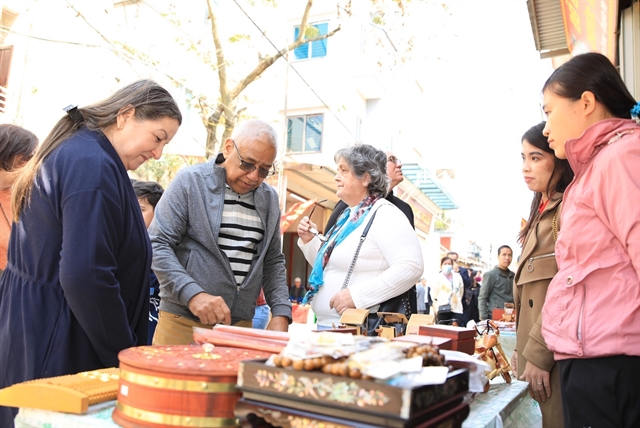 |
| An international delegation visits Chuyen My mother-of-pearl inlay craft village. |
Artisan Nguyen Huu Dung said, “When foreigners see Vietnamese inlay products, they don’t just see a handicraft; they see the spirit of our nation-diligent, meticulous, and endlessly creative.”
The younger generation is now leading Chuyen My into a new era-one of creativity, connection, and global integration.
According to Nguyen Dinh Hoa, Deputy Director of the Hanoi Department of Agriculture and Environment, Chuyen My inlay village is currently a candidate for the UNESCO Creative Cities Network in the field of Crafts and Folk Art-one of seven categories of the global network.
“This initiative not only honors the heritage of traditional crafts but also establishes a foundation for international cooperation, expanding development opportunities for the craft village community,” Hoa said.
As a member of the UNESCO Creative Cities Network in Design, Hanoi is home to the largest number of creative and cultural spaces in Vietnam. The nomination of Chuyen My contributes to the city’s vision of building a “Creative City - Heritage City,” where tradition and modernity coexist. Once officially recognised, Chuyen My will have the opportunity to participate in international programs, artisan exchanges, design collaborations, and global exhibitions-helping spread the “Handmade in Vietnam” brand to the world.
Chuyen My’s mother-of-pearl inlay is a living testament to the enduring vitality of Vietnamese heritage-a traditional craft that not only withstands the passage of time but continues to shine in the global creative arena. With support from city authorities, the devotion of artisans, and growing international partnerships, Chuyen My is embarking on a new journey-one that carries Vietnam’s thousand-year-old artistry into the heart of the modern world. VNS
* This story was developed in cooperation with the Hanoi Department of Agriculture and Environment.
Life & Style
 Life & Style
 Life & Style
 Life & Style
 Life & Style
 Life & Style
 Life & Style
 Life & Style
 Life & Style
 Life & Style
 Life & Style
 Life & Style
 Life & Style
 Life & Style
 Life & Style