 Life & Style

Wuzhen Summit Puts Spotlight on Tongxiang’s Expanding AI Industry
1.
Dr Magdalena Ida Cavalieri*
Osteoporosis is often called a silent disease. Bone loss progresses slowly and without symptoms, and many people only become aware of the problem after suffering a fracture. Among these, vertebral fractures, fractures of the spine, are particularly common, frequently under-diagnosed and can occur even without a clear traumatic event.
Early detection of osteoporosis through bone density testing allows timely intervention, significantly reducing the risk of fractures, chronic pain, disability and loss of independence. This is especially important for women of Asian ethnicity, who have a higher risk of vertebral fractures due to specific biological and structural factors.
What is osteoporosis?
Osteoporosis is a condition characterised by reduced bone strength, making bones more fragile and prone to fractures. Bone strength depends not only on bone density, but also on bone microarchitecture and quality.
Fractures related to osteoporosis typically occur after minimal trauma, such as a fall from standing height or sometimes without any noticeable injury at all.
Who should be screened for osteoporosis?
1. Women older than 64 years and men older than 69
2. Women aged 50-65 years with risk factors:
History of fragility fracture (hip, wrist, humerus, pelvis, vertebral in the context of low impact trauma)
Low body weight (BMI < 20–21) or history of malnutrition or anorexia-bulimia
Chronic glucocorticoid use (≥ 5 mg prednisone daily for ≥ 3 months)
Current smoking
Alcohol intake of more than three drinks per day
Medical conditions that increase bone loss: rheumatoid arthritis, lupus, type 1 diabetes, hyperthyroidism, hyperparathyroidism, chronic liver disease, malabsorption syndromes, inflammatory bowel disease, COPD, chronic kidney disease, HIV, history of long-term amenorrhea (current or past)
Parental history of hip fracture (or first-grade relative)
Chronic use of: aromatase inhibitors (breast cancer drugs), anticonvulsants, PPI, IRSS, Tiazolidinediones, high prolactin related antipsicotics, calcineurine inhibitors, tenofovir
|
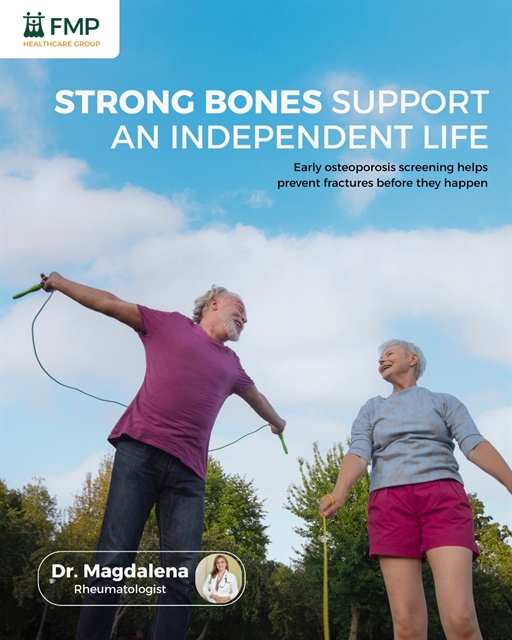
| Early osteoporosis screening helps prevent fractures before they happen. — Photo courtesy of Family Medical Practice |
3. Women with premature ovarian insufficiency
4. Men 50-69 years with risk factors similar to women
How do we screen for osteoporosis?
1. Bone densitometry
Dual-energy X-ray absorptiometry (DXA) is the gold standard test for diagnosing osteoporosis. It is painless, fast and uses very low radiation (10 times lower compared with an X-ray).
2. Laboratory evaluation
Blood and urine tests may be used to rule out secondary causes of bone loss, including vitamin D deficiency, thyroid dysfunction, calcium imbalance or inflammatory disease.
Why do early diagnosis and treatment matter?
The benefits of early detection are substantial:
• Fracture prevention: Medications approved for osteoporosis have been shown in large clinical trials to reduce vertebral, hip and non-vertebral fractures.
• Preservation of independence: Preventing fractures means maintaining mobility, posture and quality of life.
• A critical window of opportunity: The risk of a second fracture is highest in the first 1–2 years after an initial fracture. Early treatment during this period significantly lowers future fracture risk.
Asian women are at higher risk of vertebral fractures
Research consistently shows that women of Asian ethnicity experience a higher prevalence of vertebral fractures, even when bone density measurements appear similar or only mildly reduced compared to other populations.
This increased risk is explained by several factors:
1. Lower body size and bone geometry: Asian women tend to have a smaller skeletal size, a lower body mass index and different vertebral shape and bone geometry. Smaller vertebrae may tolerate less mechanical stress, increasing fracture susceptibility.
2. Bone micro architecture differences: Bone strength is not determined by density alone. Studies using advanced imaging show that differences in trabecular structure and cortical thickness may contribute to increased fragility, even when standard bone density values appear reassuring.
3. Nutritional and lifestyle factors: Lower lifetime intake of calcium, vitamin D deficiency, reduced sun exposure and lower engagement in weight-bearing exercise may further impact bone health.
4. Underestimation of risk by standard tools: Common risk calculators and bone density thresholds may underestimate fracture risk in Asian populations, particularly for vertebral fractures. This highlights the importance of individualised assessment rather than relying on bone density numbers alone.
Treatment is more than medication
While medications are effective, comprehensive bone care also includes:
Weight-bearing and muscle-strengthening exercise
Adequate calcium and vitamin D intake
Fall prevention strategies
Avoidance of smoking and excessive alcohol
Regular follow-up and monitoring
Osteoporosis is preventable, detectable and treatable. Vertebral fractures do not have to be an inevitable consequence of ageing.
For both women and men, a proactive bone health assessment can make a meaningful difference. A simple bone density test can help identify silent risk and open the door to effective prevention.
Strong bones support an active, independent life, and it’s never too early to start protecting them.

|
| Dr Magdalena Ida Cavalieri — Photo courtesy of Family Medical Practice |
*Dr Magdalena Ida Cavalieri is a rheumatologist specialising in the diagnosis and treatment of joint, muscle and autoimmune conditions. With over 10 years of clinical experience in Rheumatology, she provides comprehensive care for patients with arthritis, osteoporosis, connective-tissue disorders and other musculoskeletal concerns. Dr Cavalieri is fluent in English and Spanish, offering patient-centred consultations and personalised treatment plans to support long-term bone and joint health.
FMP Healthcare Group operates medical centres in major cities including HCM City, Hà Nội and Đà Nẵng, offering consultations with international doctors, check-up centres and emergency ambulance services.
Visit FMP Thảo Điền in HCM City to consult with Dr Magdalena Ida Cavalieri.
To book an appointment, please call (028) 3744 2000 (FMP - Thảo Điền), or email d2.reception@vietnammedicalpractice.com.
Life & Style
 Life & Style
 Life & Style
 Life & Style
 Life & Style
 Life & Style
 Life & Style
 Life & Style
 Life & Style
.jpg) Life & Style
Life & Style
 Life & Style
 Life & Style
 Life & Style
 Life & Style
 Life & Style

.jpg)




