 Environment
Thầy Thím Temple Festival honours coastal heritage
1.
|
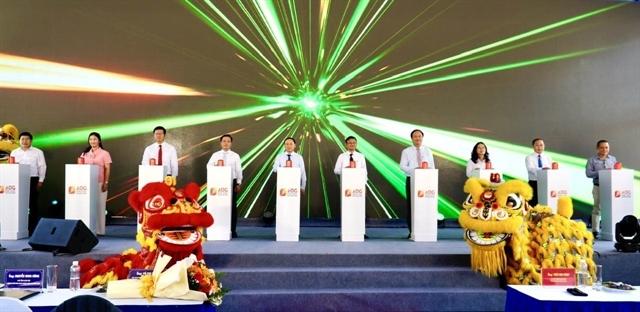
| Local officials at the groundbreaking ceremony of the Long Mỹ Domestic Solid Waste Treatment Plant in Gia Lai Province on Wednesday. — VNA/VNS Photo Sỹ Thắng |
GIA LAI — The construction of a waste-to-energy plant in Quy Nhơn Tây Ward of Gia Lai Province began on Wednesday, marking an important milestone in the central province’s environmental infrastructure development strategy, creating momentum for green growth and the circular economy, and addressing urban waste treatment needs.
With a total investment of nearly VNĐ1.6 trillion (over US$60.7 million), the Long Mỹ Domestic Solid Waste Treatment Plant will cover about 10ha, and have a waste treatment capacity of 800 tonnes per day and a power generation capacity of 15MW.
Scheduled to begin operations in 2028, the facility is expected to provide a long-term solution to household waste in the eastern part of the province. At the same time, it will generate clean energy from waste, reduce pressure on landfills, save land resources, cut greenhouse gas emissions, and improve resource efficiency in line with the circular economy model.
Vice Chairman of the provincial People’s Committee Nguyễn Tự Công Hoàng said that along with socio-economic development, urbanisation and population growth, household waste treatment has become an increasingly urgent requirement for all localities nationwide.
He stressed that waste management is not merely a matter of waste disposal, but also related to environmental quality, public health, urban aesthetics and sustainable development.
According to the official, Gia Lai has invested in and gradually improved its waste collection, transportation and treatment systems in recent years. However, amid new development requirements, traditional treatment methods are no longer able to fully meet demands in terms of capacity, environmental efficiency and the green and circular economy development as set by the Party and State.
Hoàng said the investment in a modern waste treatment facility at this stage will not only meet immediate needs but also establish an environmental infrastructure foundation for future green, smart and sustainable urban development.
|
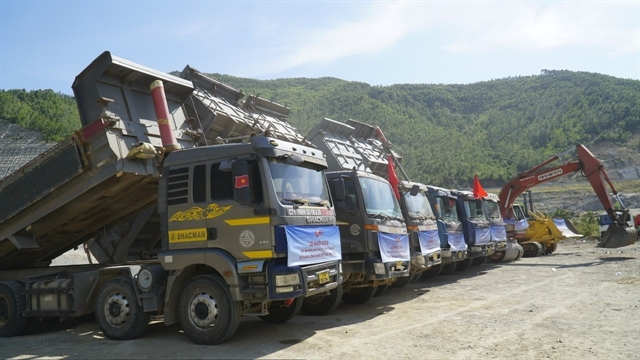
| Heavy machinery is positioned at the groundbreaking site ahead of the start of construction. — VNA/VNS Photo Sỹ Thắng |
The project is being developed at the Long Mỹ Waste Treatment Complex, an area that plays an important role in the development orientation of the expanded Quy Nhơn urban area, envisioned as the province’s political-administrative, service, tourism, science-technology, artificial intelligence and innovation centre.
The plant will employ MARTIN waste-to-energy incineration technology from Germany, one of the world’s leading technologies in waste treatment and energy recovery.
Under the project design, emissions generated during the incineration process will be treated to meet Việt Nam’s stringent environmental regulations and the EU 2010 standards. All leachate and industrial wastewater will be treated to meet Category A standards under current regulations before being fully reused.
Notably, ash and slag generated during incineration will be further processed and recycled to recover metals and produce filling materials. This approach is expected to minimise the amount of waste requiring landfill disposal and enhance resource utilisation efficiency in accordance with circular economy principles. — VNA/VNS
Environment
 Environment
 Environment
 Environment
 Environment
 Environment
 Environment
 Environment
 Environment
 Environment
 Environment
 Environment
 Environment
 Environment
 Environment