 Environment

LANDMARK Launches ‘Destination CENTRAL’: A District-Wide Invitation to Explore the Dynamism, Luxury, and Soul of Central
1.
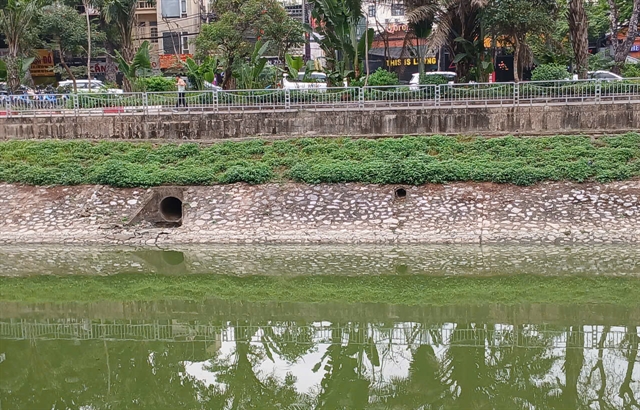 |
| Wastewater outfalls along the Tô Lịch River at Láng Street have stopped discharging after a new underground sewer system begins diverting sewage to the Yên Xá wastewater treatment plant. — VNS Photos Minh Hằng |
Minh Hằng
HÀ NỘI — For years, Đặng Quang Lộc avoided the Tô Lịch River, driven away by the stench and sludge that turned one of Hà Nội’s best-known waterways into an open sewer, but now the 77-year-old has returned to his morning walks, drawn back by a quiet transformation unfolding beneath the city’s streets.
Living on Quan Nhân Street in Thanh Xuân Ward, Lộc said the change was noticeable.
The smell has eased and the water is less stagnant. But what has brought him back is not immediately visible.
It lies beneath his feet.
Across Hà Nội, a network of underground tunnels, interceptor sewers and remotely operated machines is being deployed to redirect wastewater away from rivers, part of a technology-driven overhaul aimed at tackling one of the city’s most persistent environmental problems.
Engineering a hidden system
At the core of the effort is a shift in wastewater management, with sewage intercepted and routed through large underground sewers to treatment plants instead of being discharged directly into rivers.
Making that system work in a densely populated city relies on pipe jacking, a trenchless tunnelling method that allows engineers to install pipelines deep underground without tearing up entire streets.
On projects along the Tô Lịch and Lừ rivers, tunnel-boring machines are being used to push pipe sections through the soil at depths of 10 to 15 metres, operating within sealed systems designed to contain mud and debris.
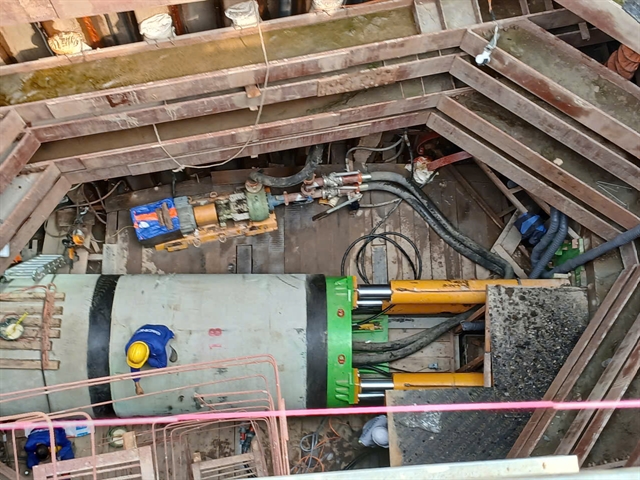 |
| Trenchless pipe‑jacking cutter head used on the Lừ River clean‑up project. |
“Basically, we use a tunnel-boring machine, a kind of robot, at the front, combined with jacking force from behind to push pipe sections through the ground at depths of around 10 to 15 metres,” said Trần Duy Tuấn, a construction supervisor on the Lừ River project at Dacinco Construction Investment Ltd Co.
“The whole process is a closed loop: water, soil, sand and sludge are all captured and processed. What remains is solid waste that can be reused in civil construction. The advantage is that we do not release mud or spoil into the environment during construction.”
The method marks a clear departure from traditional open-cut construction, which involves excavating roads and often causes widespread disruption.
“We build in segments, on average 100 to 150 metres long. Each jacking shaft is only about 5 to 6 metres wide, 7 to 8 at most. All the rest between two shafts is done entirely underground, so it does not interfere with traffic or with the operation of surrounding facilities,” Tuấn said.
Instead of sending workers into confined underground spaces, much of the tunnelling process is controlled remotely.
“Operators stand in a control cabin on the surface and control the robot; no one has to crawl into the cutting head. All operations are performed from the surface, which increases safety and accuracy,” he said.
Engineers say the systems improve precision and reduce risk, particularly in dense urban areas with complex and unpredictable underground conditions.
The adoption of such technology reflects a broader shift in Việt Nam’s infrastructure development, as cities seek to modernise construction methods while minimising disruption to daily life.
Redirecting wastewater flows
The underground network is designed to channel wastewater to centralised treatment facilities, with the Yên Xá wastewater treatment plant serving as the system’s core.
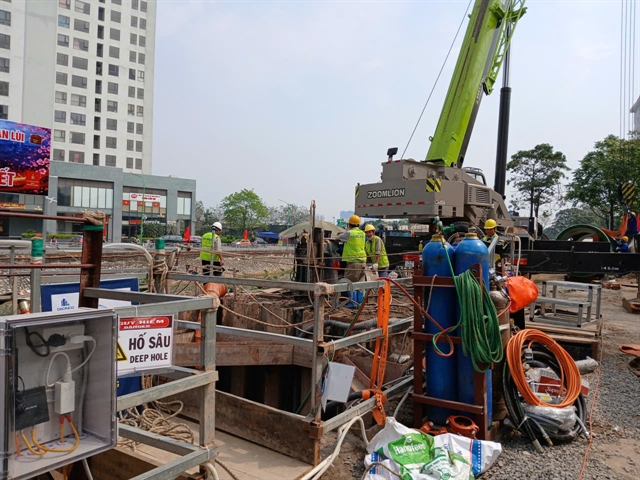 |
| Workers at the Sông Lừ river construction site in Định Công ward. |
With a design capacity of 270,000 cubic metres per day, the largest wastewater treatment plant in the northern region is intended to process wastewater collected from the Tô Lịch and Lừ river basins and the surrounding areas of Hà Đông and Từ Liêm.
“The project is responsible for collecting wastewater in basin S2, including 12 wards of Hà Nội. Once this dedicated collection system is in place, the rivers will no longer have to receive domestic wastewater and that will help improve water quality and restore the landscape,” said Trần Quốc Bảo, an official of the Management Board for Infrastructure and Agriculture Investment Projects of Hà Nội.
According to Bảo, the system began to show results as soon as key components came online.
“Yên Xá wastewater treatment plant was inaugurated in August last year. When the interceptor system along the Tô Lịch River came into operation, all wastewater from the river’s catchment was conveyed to the plant for treatment without interruption. At present, there is no longer any direct discharge of wastewater into the Tô Lịch River,” he said.
Rapid urbanisation in recent decades, combined with limited wastewater treatment capacity, led to the widespread discharge of untreated sewage into rivers.
The Tô Lịch and Lừ gradually became conduits for domestic waste, marked by blackened water, sediment build-up and persistent odours.
Previous efforts to improve conditions, including dredging riverbeds and applying biological treatments, offered only temporary relief.
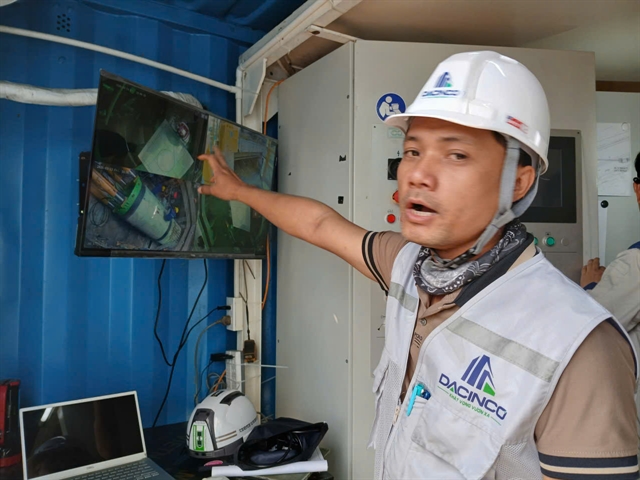 |
Trần Duy Tuấn, construction supervisor on the Lừ River project, works from the remote control room operating the pipe‑jacking system. |
As long as wastewater continued to flow directly into rivers, officials say those measures could not deliver lasting results.
“The fact that there is no direct discharge does not mean the river is already clean,” Bảo said.
“The city is still implementing complementary measures such as constructing regulating structures, building trunk sewers from the western areas and bringing clean water from the Red River into the Tô Lịch River. Those are the solutions that will truly bring the river back to life.”
Beyond tackling pollution, the underground system is also designed to improve efficiency.
“In the past, with open-cut methods, we could only safely build sewers at depths shallower than five metres,” Bảo said. “Any deeper and it became unsafe and uneconomical, so we had to build a series of pumping or drop structures.”
With pipe jacking, he said, pipelines can be installed at far greater depths, in some cases up to around 14 metres, allowing wastewater to flow by gravity directly to treatment plants.
This reduces reliance on pumping stations, improves system continuity and lowers long-term operating costs.
Adapting global technology
According to Bảo, while pipe-jacking technology is widely used around the world, it remains relatively new in Việt Nam, having so far been adopted only in a limited number of projects in the southern region.
In the north, Japanese pipe-jacking technology was first introduced in a project to install a wastewater pipeline linking the Tô Lịch River to the Yên Xá wastewater treatment plant. The method is now being applied to the Lừ River project, this time using German technology.
“Hà Nội has worked with Japan to develop an initial set of standards for some specific projects. But to scale it up, we need a full technical standard set, with associated norms and unit prices, so that it can be widely adopted,” said Bảo.
Engineers say developing such standards will be key to expanding the use of trenchless technologies in other cities across the country.
“Dacinco is the first Vietnamese firm to receive the technology transfer from Germany and now fully masters it. I think the pipe jacking model should be expanded because it’s safer for workers and reduces impacts on the environment and nearby residents," Tuấn said.
"Once domestic contractors master the technology, costs will go down and we can apply it to many other projects in Hà Nội and across the country."
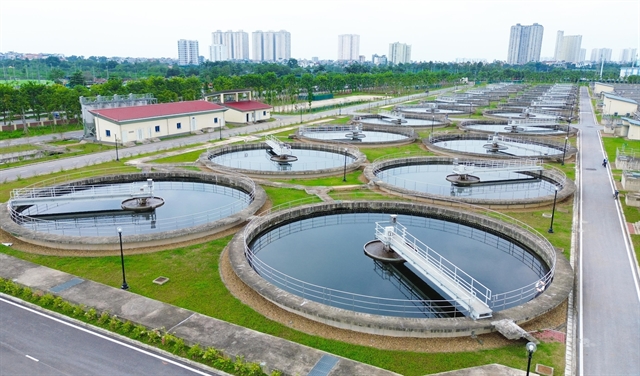 |
| Yên Xá, the largest wastewater treatment plant in northern region, located in Thanh Liệt Ward with a capacity of 270,000 cubic metres of wastewater per day, came into operation in August last year. — VNA/VNS Photo Thành Phương |
For residents living along the rivers, the benefits are beginning to emerge, even if the systems driving the change remain largely out of sight.
Lê Thị Thảo, who has lived near the Lừ River for more than 20 years, said the stench was once overwhelming, particularly during the summer months.
“I’ve lived here for 20 years and the stench from the drains was unbearable, especially in summer,” she said.
“I don’t understand the technical details, but this time the digging hasn’t disrupted daily life as much because they’re not opening up the whole stretch like previous projects. I hope that when the work is finished, the river will return to its natural state.”
Along some sections of the Tô Lịch, residents have begun returning to the riverbanks for morning exercise and evening walks, a shift that would have been unlikely just a few years ago.
Urban planners say that, if sustained, improvements in water quality could help transform the rivers into public spaces, linking neighbourhoods and supporting local economic activity.
Đào Ngọc Nghiêm, vice-chair of the Vietnam Urban Planning and Development Association, praised the city’s efforts, saying the Tô Lịch revival not only addresses sanitation but also helps restore the river’s cultural and historical value.
A cleaner river, he added, could become a central landscape axis, link urban spaces and support growth in services and tourism.
Officials caution that the recovery of Hà Nội’s rivers will take time.
For Lộc, the transformation is measured in simple terms: he no longer avoids the river.
Instead, he walks alongside it, above a hidden network of technology that is slowly bringing Hà Nội’s rivers back to life. — VNS
Environment
 Environment
 Environment
 Environment
 Environment
 Environment
 Environment
 Environment
 Environment
 Environment
 Environment
 Environment
 Environment
 Environment
 Environment