|
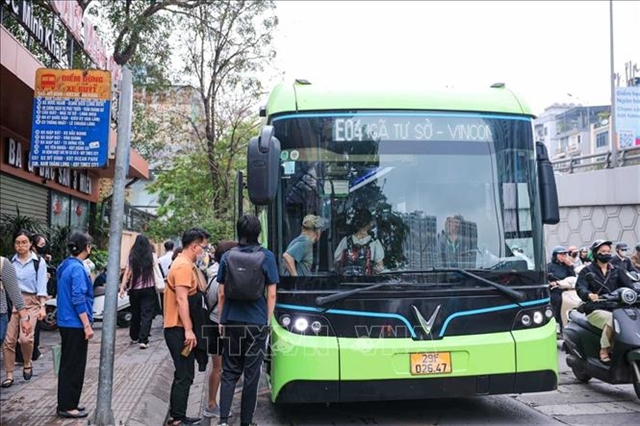
| Passengers board an electric bus on Minh Khai Street in Hà Nội. — VNA/VNS Photo Hoàng Hiếu |
HÀ NỘI — Hà Nội Traffic Management and Operation Centre has submitted a report on adjusting public bus services to support the transition to green vehicles, the Hà Nội Department of Construction said on Monday.
The plan forms part of the implementation of the Prime Minister’s Directive No. 20/CT-TTg dated July 12, 2025, on addressing pollution issues.
Hà Nội’s proposal aims to ensure that the share of electric and green-energy buses meets the green transport roadmap within ring roads No.1, 2 and 3, in line with the directive and the city’s low-emission zone implementation schedule.
By July 1, all buses operating within Ring Road 1 must use green energy, including compressed natural gas or electricity. The transition will expand to Ring Road 2 by January 1, 2028, and to Ring Road 3 from 2030.
The proposed shift is also intended to support Hà Nội’s broader transport policy under Directive No. 20, which stipulates that from July 1 this year, fossil-fuelled motorcycles and mopeds will no longer be allowed to operate within Ring Road 1.
City authorities say strengthening the green bus network will be essential to meeting travel demand as the restriction takes effect.
In the route numbering system, services prefixed with “E” denote electric buses, while those without the prefix are conventional services, most of which currently run on diesel. A small proportion of the network uses compressed natural gas, which is less polluting than petrol.
From July 1 this year, the city plans to launch 12 new bus routes, some linking key transport hubs in the city centre, such as Hà Nội Station, Thống Nhất Park and Hào Nam Station on the Cát Linh–Hà Đông metro line.
Six more routes are expected to be added from January 1, 2028, with several connecting to interprovincial coach terminals such as Giáp Bát, Nước Ngầm, and Yên Nghĩa.
The transition to green vehicles is expected to be completed across Hà Nội’s public transport network by 2030.
Current state
According to the Hà Nội Traffic Management and Operation Centre, as of March 2026, the city’s bus network consists of 155 routes, including 128 subsidised and 11 non-subsidised services, alongside 13 adjacent routes serving nearby localities and three city tour routes.
The network now reaches all 126 wards and communes, achieving full coverage, and connects Hà Nội with five neighbouring localities: Hải Phòng, Bắc Ninh, Hưng Yên, Ninh Bình, and Phú Thọ.
In terms of infrastructure, the system includes 5,024 bus stops, 354 shelters, five transfer points, 133 terminals and 12.9km of dedicated lanes.
A total of 11 operators run the 128 subsidised routes, with Hà Nội Transport Corporation holding the largest share, operating 68 routes or 53.1 per cent of the total.
The city’s bus fleet totals 2,239 vehicles, of which 1,925 are subsidised. More than 1,500 meet Euro IV emission standards or higher.
Ticketing and incentives
Hà Nội currently has three main types of bus tickets: single-trip tickets, monthly passes, and free travel cards for certain groups.
Single-trip fares are based on route length, while monthly pass prices vary depending on whether they cover a single route, multiple routes or group purchases.
Passengers entitled to free travel include people with meritorious service, persons with disabilities, those aged over 60, children under six and members of poor households.
Students, university students, and workers in industrial parks receive a 50 per cent discount on monthly passes, while office workers and employees of businesses outside industrial parks are eligible for a 30 per cent discount when purchasing passes collectively.
Within Ring Road 1, there are currently 45 operating bus routes, including 14 electric, four CNG and 27 diesel. Fifteen of these have terminals located within Ring Road 1.
Inside Ring Road 2, 74 routes are in operation, comprising 21 electric, five CNG and 48 diesel.
The network within Ring Road 3 consists of 106 routes, including 30 electric, six CNG and 70 diesel.
Strengthening capacity
Buses are one of the core forms of public transport in Hà Nội alongside its two operational metro lines (Cát Linh–Hà Đông and Nhổn–Hà Nội Station).
The capital city has introduced a range of incentives and support policies to encourage public transport use. Ticket options are diverse, catering to different passenger groups, while green buses are being deployed more widely.
The bus fleet has also improved in quality, with a wider range of vehicles better suited to local infrastructure conditions.
According to Thái Hồ Phương, director of the Hà Nội Traffic Management and Operation Centre, there are currently 44 subsidised bus routes and branches operating within Ring Road 1, with more than half still diesel-powered.
Most of these are inner-city and cross-city routes linking central districts and connecting outlying areas beyond Ring Road 3 to the city centre.
To support the green transport roadmap, restructuring and strengthening bus services is considered necessary to meet travel demand during the transition. — VNS
 Environment


.jpg)