 Environment

LANDMARK Launches ‘Destination CENTRAL’: A District-Wide Invitation to Explore the Dynamism, Luxury, and Soul of Central
1.
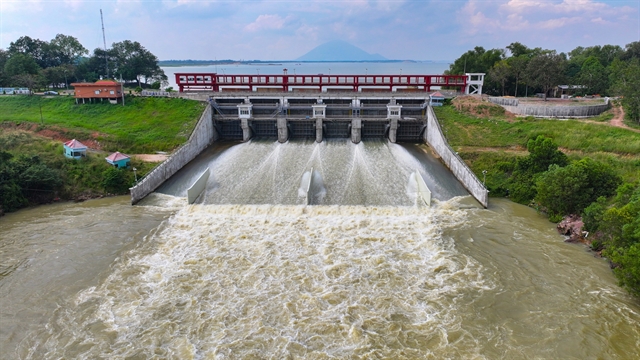 |
| The Dầu Tiếng Reservoir in Tây Ninh Province maintains stable water levels, ensuring supply for farming and household use during the dry season. — VNA/VNS Photo Minh Phú |
TÂY NINH — Tây Ninh Province is stepping up water-saving measures to safeguard agricultural production and daily supply as climate change heightens drought and saline intrusion risks.
Authorities are improving irrigation operations and adjusting farming practices to strengthen resilience and support more sustainable agricultural development.
Flexible irrigation and adaptive farming are helping secure water supplies amid rising climate pressures.
According to the Ministry of Agriculture and Environment, upstream flows in the Mekong Delta are forecast to decline between now and May, while saltwater intrusion from the sea is expected to increase, peaking in late March.
The province's Department of Agriculture and Environment has directed local authorities to closely monitor water levels and speed up dredging and freshwater storage.
Dầu Tiếng Reservoir, the largest in the southeastern region, continues to play a crucial role in water regulation and supply.
According to Nguyễn Văn Lanh, deputy director of the Dầu Tiếng – Phước Hòa Branch of the Southern Irrigation Exploitation One Member Limited Liability Company, the reservoir’s water level is 21.72 metres, 0.2 metres lower than at the same period last year but 0.5 metres higher than average.
Useful storage, which refers to water above the dead level in a dam, meaning it is usable, stands at around 500 million cubic metres, ensuring supply for the entire system.
By the end of the dry season in May, that level is forecast to fall to 19.5 metres, still sufficient for agricultural, industrial and domestic needs downstream.
To optimise water use, the company has assessed demand across areas and developed supply plans. Weather conditions are monitored regularly, and rotational irrigation plans are prepared when necessary.
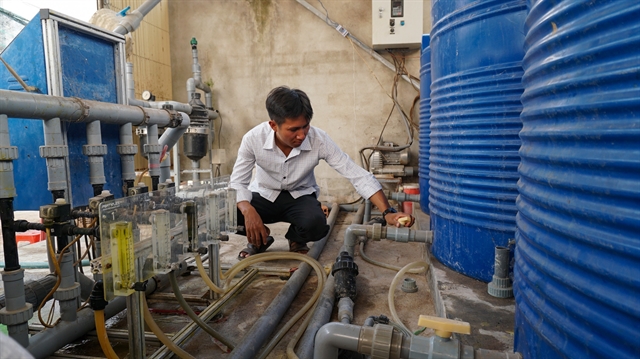 |
| An automatic irrigation system in Tây Ninh Province helps use water efficiently and stabilise agricultural production. — VNA/VNS Photo Minh Phú |
Local authorities have urged farmers to store freshwater and adopt water-saving methods such as drip irrigation and soil covering.
Crop structures are also being adjusted to suit drought and salinity conditions.
In early March salinity in the Vàm Cỏ Đông River reached 1.6 grammes per litre in Bến Lức Commune, higher than last year’s level but below the 2020 peak.
Salinity has also appeared early in the Vàm Cỏ Tây and Tra rivers, though not deeply up the river.
In the coming months saline intrusion may affect areas such as Tầm Vu, Vĩnh Công, Tân Trụ and Bình Đức communes, prompting authorities to further strengthen water storage and irrigation management.
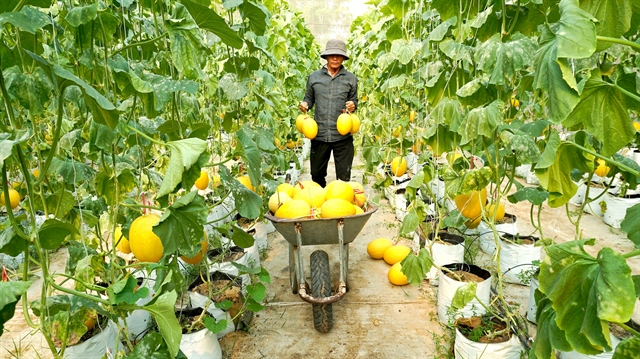 |
| A high-tech honeydew melon farming model using a drip irrigation system in Tây Ninh Province helps save water and adapt to dry conditions. — VNA/VNS Photo Minh Phú |
Alongside water management, farmers are also adapting production methods to reduce pressure on water resources.
In Bình Minh Ward, water-saving models have been widely adopted.
Nguyễn Tuấn Anh, who grows baby cucumber, said: “Cucumbers are highly sensitive to drought. In the past production faced difficulties due to water shortages. In recent years irrigation systems drawing from the Dầu Tiếng Reservoir and improved techniques have stabilised output and boosted farmers’ confidence.”
High-tech farming models are also proving effective.
At the Phúc Lợi Agricultural Service Trading Co-operative in Bình Minh Ward, crops continue to grow well even when temperatures reach 38–40 degrees Celsius, thanks to smart irrigation systems that maintain adequate moisture.
Lê Tấn Thành, its manager, said: “Drip irrigation saves 30–60 per cent of water and fertilisers while reducing pests, cutting labour costs and improving product quality.”
At the Tân Thành High-tech Agricultural Co-operative in Mỹ Thạnh Ward, some 50ha of lemon are cultivated using adaptive methods. Members are encouraged to store freshwater, limit off-season flowering during the dry period and increase the use of organic fertilisers and biological products to improve plant resilience.
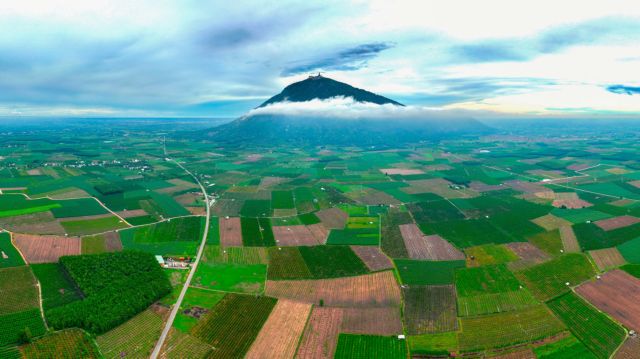 |
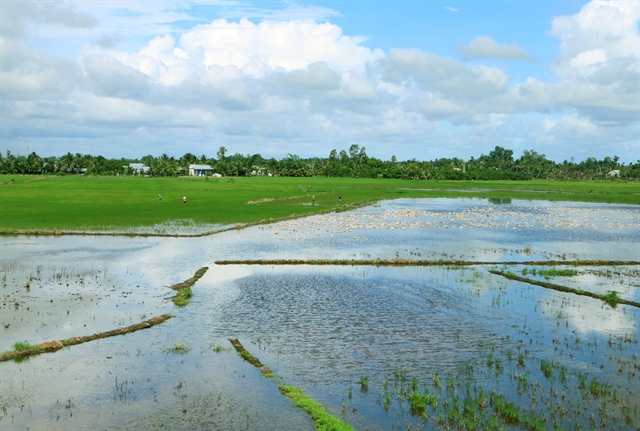
| Agricultural areas benefit from irrigation systems, helping improve farming efficiency in Tây Ninh Province. — VNA/VNS Photo Minh Phú |
According to Đinh Thị Phương Khanh, deputy director of the province Department of Agriculture and Environment, proactively securing water is key to ensuring agricultural production and livelihoods amid climate change.
The province now has more than 115,000ha, or 31 per cent of the total area, of farmland using water-saving irrigation methods.
Seasonal calendars have also been adjusted, with farmers advised not to grow a third rice crop in areas at risk of water shortages.
With its irrigation network of over 2,000km, the province can supply water to more than half of its farmlands.
Under its 2021–30 master plan, it aims to develop a multi-purpose irrigation system that serves agriculture, domestic use and disaster prevention. New reservoirs and salinity-control sluices are planned to enhance storage and strengthen climate resilience. — VNS
Environment
 Environment
 Environment
 Environment
 Environment
 Environment
 Environment
 Environment
 Environment
 Environment
 Environment
 Environment
 Environment
 Environment
 Environment