 Economy

SBV to curb property price inflation, enforce lending rate rules
1.
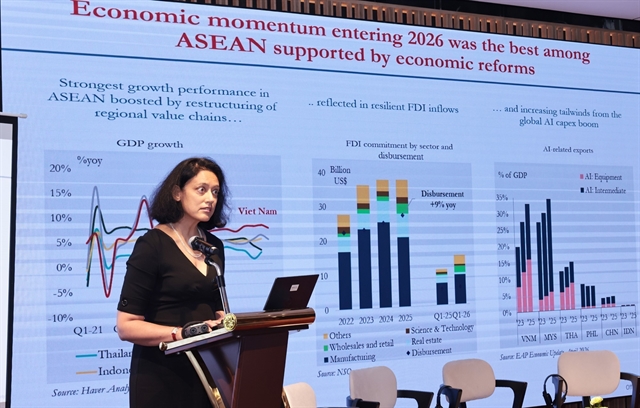 |
| Tehmina Khan, the World Bank's lead economist for Việt Nam, Cambodia and Lao PDR. — VNA/VNS Photo Trần Việt |
As the global economy faces successive shocks, trade-exposed economies like Việt Nam are coming under increasing pressure. With the Government now pursuing an ambitious double-digit growth target, accurately identifying the country's underlying strengths and addressing its structural constraints has become more important than ever.
Tehmina Khan, the World Bank's lead economist for Việt Nam, Cambodia and Laos, spoke with Việt Nam News Agency about the country's economic outlook amid rising global uncertainty.
The World Bank’s latest economic update states that Việt Nam has demonstrated remarkable resilience. What are the key factors behind this assessment?
Over the past few years, the global economy has been hit by a series of shocks, and Việt Nam has been no exception. Yet, Việt Nam’s ability to weather these shocks has steadily improved, translating into remarkably strong growth.
Last year, for example, the economy grew by 8 per cent, the highest of any ASEAN economy, despite a major headwind from global trade uncertainty and shifting tariff policies.
That resilience comes from certain fundamental strengths: low labour costs, an expanding middle class and strong infrastructure. These are the advantages that have positioned Việt Nam to benefit from the regional and global restructuring of value chains.
And as the AI boom continues to unfold, these same strengths have placed Việt Nam in a highly favourable position to benefit from trade in related sectors, such as data centres and semiconductors.
Việt Nam is also one of those few emerging market economies where an immense array of reforms is currently unfolding, generating considerable excitement and optimism.
The reforms that the Government has been pushing over the last two years are the most significant since the Đổi Mới (Renewal) era – a comprehensive, fast-paced reorganisation and restructuring of the state that could be potentially transformative if implemented well.
Việt Nam has set itself the ambitious target of becoming a high-income economy by 2045. But reaching that status requires a commensurate shift in the capacity of the public sector.
The reforms underway go well beyond administrative streamlining. They cover many spheres of economic life: slashing red tape, easing regulatory burdens on the private sector, modernising tax and customs systems, reforming corporate insolvency frameworks, opening capital markets and accelerating the energy transition.
Taken together, these are once-in-a-generation reforms, and this is a truly exciting moment for Việt Nam’s economy.
Beyond these bright spots, what are the key bottlenecks in Việt Nam’s growth model, and what should the Government prioritise?
It is important to note that Việt Nam's economy is in a strong position with relatively strong fundamentals. However, given the ambitions and aspirations of the Government and of the country's leadership and its people, there are some critical bottlenecks that do need attention.
The first is a growing divergence between FDI firms and the domestic private sector.
Foreign-invested firms account for only 5 per cent of all firms in the economy, yet they are a significant driver of exports. While the FDI sector has continued to strengthen, domestic firms, especially small- and medium-sized enterprises, are starting to struggle with access to capital and resources.
Second, while there remains considerable fiscal space, external buffers are somewhat thin. The economy is highly exposed to external demand and remains sensitive to shocks in its supply chains.
A third area of concern is the high credit intensity in the economy and elevated levels of corporate leverage – the highest amongst ASEAN countries. This is a source of risk in the event of a negative external shock.
The fourth area relates to public investment. The Government has recognised that there are infrastructure deficits that need to be addressed: to lower logistics costs, strengthen firm competitiveness and improve market connectivity, both domestically and internationally.
But implementation is critical. It will be important to make sure that going forward, public investment is executed well, projects are selected well, and that they address the right bottlenecks, so that the productive capacity of the economy is expanded.
Will reforms take a while to complete?
Yes, they always do and their benefits take time to materialise. The direction is good and clear. The ambition is high, and the key challenge going forward is execution.
Việt Nam needs to rebalance growth, support domestic firms to have the conditions to thrive, address financial sector vulnerabilities, and execute public investment plans effectively.
Overarching all of this are two foundational priorities: preserving macroeconomic stability, which anchors confidence; and strengthening risk management, which ensures that faster growth does not translate into new sources of vulnerability.
How does the World Bank assess Việt Nam’s growth outlook for 2026, particularly in relation to the country’s double-digit growth ambition during the 2026-30 period?
Over the medium term, Việt Nam’s prospects are strong. Near-term risks, however, are elevated, primarily because the global external environment is highly uncertain.
The World Bank projects that global growth may soften this year, which in turn could translate into slightly softer growth for Việt Nam as well.
That said, we project that Việt Nam's growth rate this year and in the next few years will remain in the range of 7 per cent to 8 per cent, which is considerably higher than any other ASEAN economy or major emerging market. That remains stellar growth by any measure.
On the double-digit target: the World Bank's view is that there is potential to reach that growth. It is a good target to have, and a good objective to aim for. But what fundamentally matters more is the quality of growth.
Even if growth is a little slower than the target, what matters is that growth is more inclusive, creates more and better jobs and strengthens resilience against future shocks. — VNA/VNS
Economy
 Economy
 Economy
 Economy
 Economy
 Economy
 Economy
 Economy
 Economy
 Economy
 Economy
 Economy
 Economy
 Economy
 Economy