 Sports
Israeli agricultural know-how takes root in Việt Nam
1.
.jpg) |
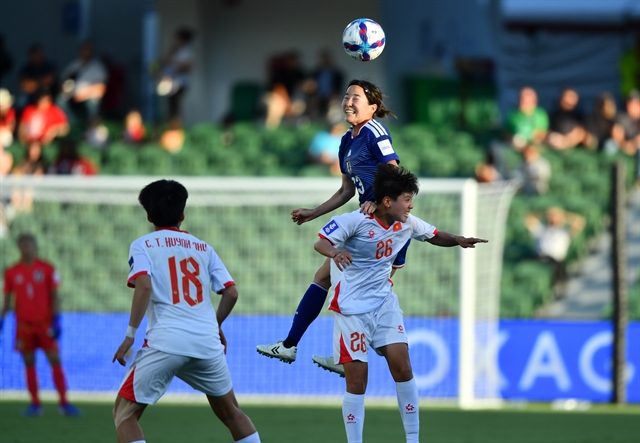
| Nguyễn Thị Thuý Hằng (24) and her teammates struggle as a huge gap between continental giants Japan and Việt Nam is evident in the 0-4 defeat on last Tuesday. —Photo courtesy of the AFC. |
Anh Đức
The early end to what many hoped would be a promising year has forced Vietnamese women’s football to confront a difficult reality after the national team was eliminated from the 2026 AFC Women's Asian Cup last Tuesday.
The elimination also meant that the Golden Star Women Warriors could not qualify for the 2027 FIFA Women's World Cup, leaving the team without a significant international tournament until the latter part of 2027.
It was a harsh exit, but a predictable one in my opinion, given the form of the team and the need to revitalise an ageing squad. Việt Nam holds two records in the tournament, one for the oldest average player age at 27.8 and the other for the oldest manager in Mai Đức Chung at 74.
While experienced players such as Trần Thị Kim Thanh and Huỳnh Như have already shown signs of age, the next generation of players has yet to live up to expectations or firmly secure their places.
As the competition heats up with contenders improving, Việt Nam found itself in a situation where a second-place finish could even be detrimental to its qualification path to the World Cup. Pundits even said that the team should try to finish third, a riskier move but one that would offer a better chance of going to the World Cup.
All of this meant that despite the hopes placed on the team, the harsher reality is that Việt Nam is not on par with continental contenders and that missing this World Cup, despite the disappointment, is perhaps better than making it and repeating what happened in 2023: merely participating.
Don't get me wrong, it was a historic feat for the Việt Nam women's team to become the first senior Vietnamese football team to qualify for a World Cup, but losing three games, conceding 12 goals and scoring none is a record that must be improved.
The 4-0 defeat to Japan in this tournament only confirmed that the gap remains vast. HTV commentator Huỳnh Sang put it bluntly after that match: missing the World Cup this time may be better for the team than qualifying, because a ticket to Brazil would not solve the fundamental problems the squad must confront.
Those problems run deep. The domestic women's league has just six to seven teams each season, meaning a Vietnamese player may only get 15 to 18 competitive matches a year.
Compare that to Japan's WE League, where clubs play 22 to 24 matches per season, and the gap in match fitness becomes obvious. Meanwhile, regional rivals are closing in.
The Philippines now draw from more than 120 players competing professionally abroad. Thailand, two-time World Cup participants, are targeting a return. The days of Việt Nam's comfortable regional dominance are numbered.
There is also a financial cost. Under FIFA's distribution model, every team at the Women's World Cup receives at least US$1.56 million. Missing Brazil means missing the funding, sponsorship and development programmes that come with the tournament.
But perhaps the most important consequence of this exit is the one that could prove most positive: it forces a reckoning. Coach Chung will likely step aside after decades of service. The veterans can bow out with dignity. And the young players who were not quite ready this time now have the stage to themselves, with room to grow.
Việt Nam's women do not need a consolation trip to another World Cup. They need a proper reset: a broader domestic league, a younger squad and a long-term plan that values development over sentiment. The road back will be longer, but it will be worth walking properly. — VNS
Sports
 Sports
 Sports
 Sports
 Sports
 Sports
 Sports
 Sports
 Sports
 Sports
.jpg) Sports
Sports
 Sports
 Sports
 Sports
 Sports