 Society

Sun PhuQuoc Airways expands Russian partner network ahead of Moscow route launch
1.
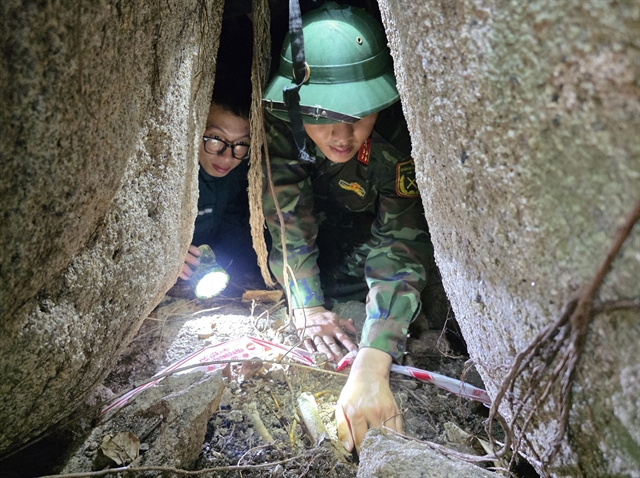 |
| A war martyrs’ remains search and recovery team from Nam Nha Trang Ward's Military Command discovers human remains at the Đồng Bò resistance base. — VNA/VNS Photo |
KHÁNH HÒA — His knee was injured and the mountain path was steep, but Nguyễn Khánh Trường kept walking through the forest.
The regular militiaman from Nam Nha Trang Ward in the south-central province of Khánh Hòa took part in a recent mission with the ward's Military Command’s team to search for and recover war martyrs’ remains in the Đồng Bò resistance base area.
On the way to Đồng Bò, he injured his knee while crossing steep slopes and large rocks. After receiving first aid, he continued with the team.
“While carrying out the mission, I was focused only on moving forward, so I did not feel the pain. I just hoped we could soon bring the remains of the fallen soldiers home,” he said.
Trường’s determination reflects the spirit of those taking part in Khánh Hòa’s efforts under the nationwide “500-Day Campaign to Accelerate the Search, Recovery and Identification of War Martyrs’ Remains”, launched in preparation for the 80th anniversary of War Invalids and Martyrs’ Day on July 27, 2027.
A solemn mission
Army Captain Phùng Nhật Hoàng, political affairs assistant at the ward's Military Command, said the search team faced difficult terrain, insects and dense forest covered with climbing plants as they cleared paths through the steep mountains.
However, the support of comrades and historical witnesses gave each member the motivation to complete the mission, he said.
“It is not only an assigned task but also a command from the heart, and a responsibility of today’s generation to those who fell,” he said.
After several days of searching, the team recovered two sets of fallen soldiers’ remains in the former resistance base.
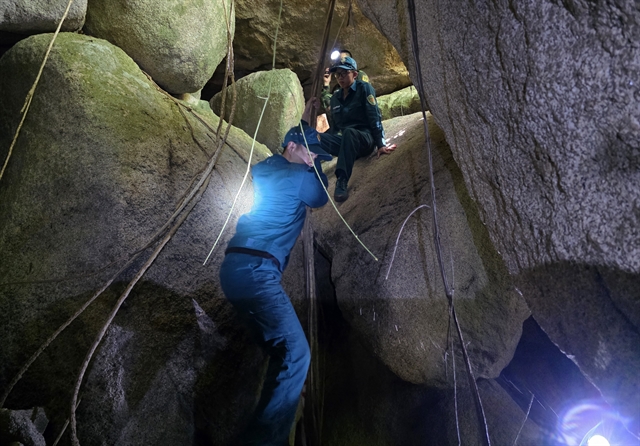 |
| Soldiers search for war martyrs’ remains across difficult terrain at the Đồng Bò resistance base. — VNA/VNS Photo |
In Khánh Hòa, the campaign is being accelerated through searches in former resistance bases, the excavation of unidentified graves for DNA sampling and the verification of information provided by local residents.
The case of war martyr Mai Văn Điệu is one example.
The Khánh Hòa Military Command received information from local witnesses about Điệu’s identity and the reported location of his burial site.
Điệu was born in 1911 in the former Bảo An Ward, Phan Rang, Ninh Thuận Province, now part of Khánh Hòa Province.
He served as a hamlet chief in Bảo An Ward and died on November 10, 1949. His reported burial site is now in Residential Area 12 in Bảo An Ward.
After the information was verified, the provincial Military Command coordinated with relevant agencies and local authorities to recover his remains.
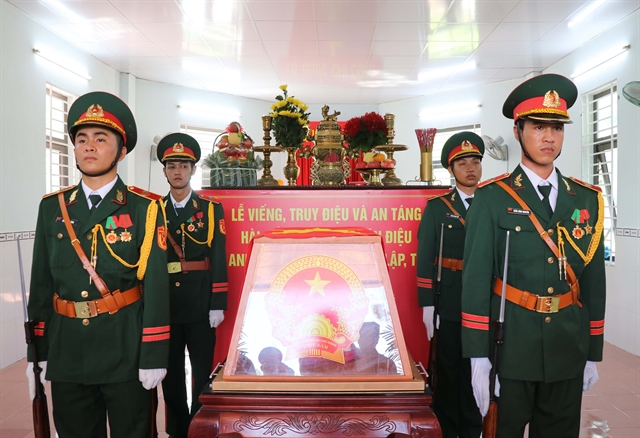 |
| A memorial and reburial ceremony is held for war martyr Mai Văn Điệu at Ninh Thuận War Martyrs’ Cemetery in Xuân Hải Commune on July 21. — VNA/VNS Photo |
Families give DNA
As part of the campaign, the provincial police launched a DNA collection drive from July 23 to 26 to collect biological samples from relatives of unidentified fallen soldiers.
On July 24, Nguyễn Văn Toàn arrived early at a DNA sample collection point in Nha Trang Ward.
Toàn is the maternal nephew of Phạm Bá Đô, who came from the former Thừa Thiên-Huế Province, now Huế City, and died in action.
For years, Toàn had followed the wishes of his late mother, returning several times to his uncle’s hometown to search for information about him and locate his burial place. None of those journeys had produced an answer.
Now he has given his own biological sample in the hope that it may help identify the remains of fallen soldiers whose identities are still unknown.
His wish is shared by Huỳnh Tấn Hùng, also from Nha Trang.
Hùng’s younger brother, Huỳnh Tấn Dũng, died in a battle in what was then Phú Yên Province, now part of Đắk Lắk Province.
Following the end of the war in 1975, the family returned to the former battlefield several times to search for their loved one's remains, but without success.
By providing a DNA sample, Hùng hopes his younger brother’s remains can eventually be found and reburied at Khánh Hòa War Martyrs’ Cemetery.
To make it easier for families to take part in DNA collection, the provincial police arranged mobile collection teams to visit the homes of Vietnamese Heroic Mothers and elderly, sick or immobile relatives.
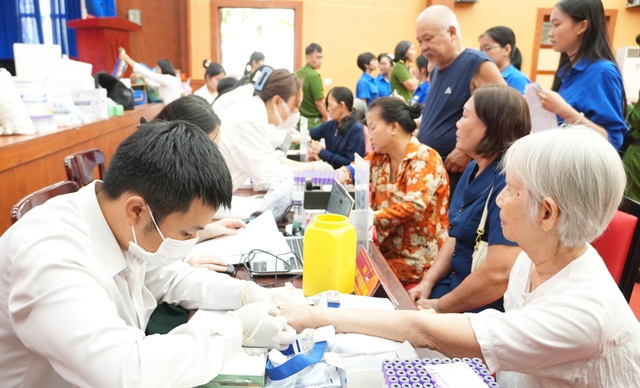 |
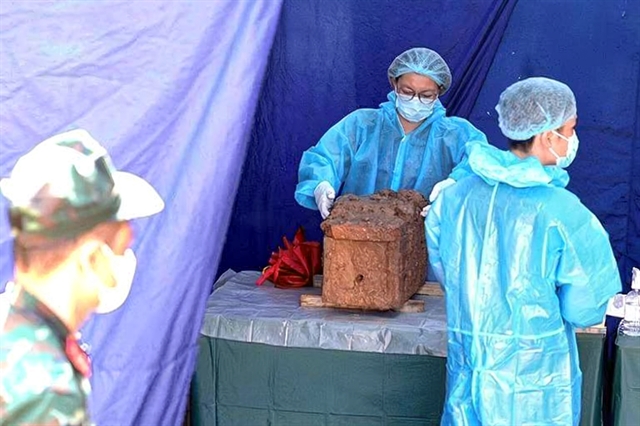
| Forensic technicians collect DNA samples from relatives of unidentified fallen soldiers in Khánh Hòa Province. — VNA/VNS Photo |
According to Police Colonel Trần Minh Trúc, deputy director of the province's Department of Public Security, advances in science and technology, particularly biotechnology and DNA testing, have provided more modern, accurate and effective methods for identifying the remains of fallen soldiers.
“Collecting DNA samples from martyrs’ relatives is a key step in building a DNA database for comparison.
“It will help gradually restore the names of those who made the ultimate sacrifice for the nation and help families fulfil a long-held wish after years of waiting,” Trúc said.
The province has collected 2,740 of the planned 3,018 DNA samples from relatives of unidentified fallen soldiers, reaching 90.7 per cent of the target.
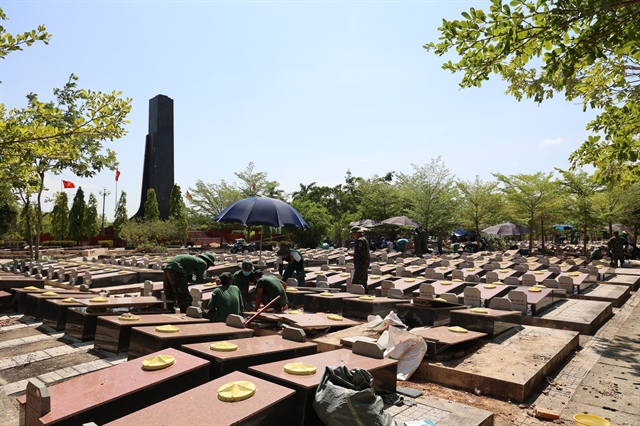 |
| Ninh Hòa–Vạn Ninh War Martyrs’ Cemetery is the final resting place of thousands of fallen soldiers in Khánh Hòa Province. — VNA/VNS Photo |
Bringing them home
From May 26 to August 13, the province completed the collection of samples from all 2,124 unidentified soldiers' graves at the province's seven martyrs' cemeteries, 17 days ahead of schedule.
From the early days of the campaign, Dr Trần Văn Thành of the Centre for Forensic Medicine under the province's Department of Health has taken part in collecting samples from unidentified soldiers' remains at cemeteries for DNA testing.
After completing that task, Thành and his colleagues continued to join teams searching for and recovering martyrs' remains, carrying out the sampling procedure on site.
During searches on Hòn Chảo Mountain in Vạn Ninh Commune, Thành faced difficult terrain and spent nights in the forest.
“Only after taking part did I realise that finding an unidentified soldier decades later is far from simple,” he said. “I only think about how to collect a good DNA sample to ensure it can be used for testing and identification.”
“But amid the vast mountains and forests, very little of the remains are left, and most have turned into soil,” he said.
The provincial Military Command’s War Martyrs’ Remains Search and Recovery Team has worked with localities and relevant forces to survey and verify information in 93 areas where about 69 unidentified graves are believed to be located as of September 10.
So far, these forces have searched for and recovered the remains of 59 fallen soldiers, reaching 39.33 per cent of the target of 150 sets of remains.
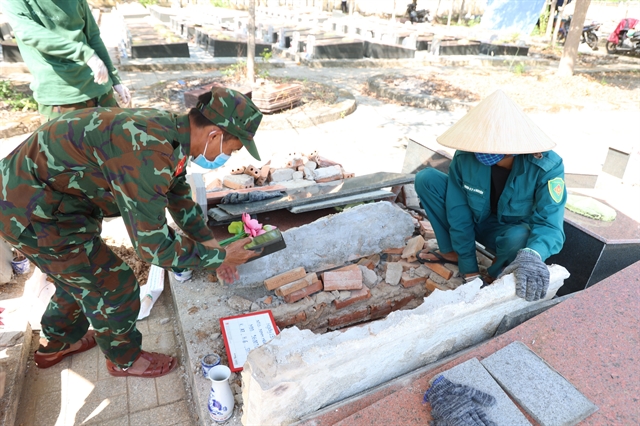 |
| Search team members exhume the remains of an unidentified soldier from a grave for DNA testing. — VNA/VNS Photo |
Authorities continue to call on veterans, witnesses and local residents to provide information that could help locate other fallen soldiers.
Colonel Võ Văn Viên, deputy political commissar of the provincial Military Command, said: “The 500-day campaign is not simply a mission to search for and recover war martyrs’ remains, but a journey rooted in comradeship and solidarity among the people.
“Despite the difficulties ahead, officers and soldiers will continue to carry out the mission with the highest sense of responsibility and the traditional principle of ‘when drinking water, remember its source’."
Across the mountains and forests of Khánh Hòa, the search continues.
For every soldier who keeps walking despite the hardship, every family that gives a DNA sample and every fragment of memory shared by a witness, there remains a quiet hope that one day, those who fell will no longer be known only as names on a list, but will finally be called by their names and brought home to rest in peace. — VNS
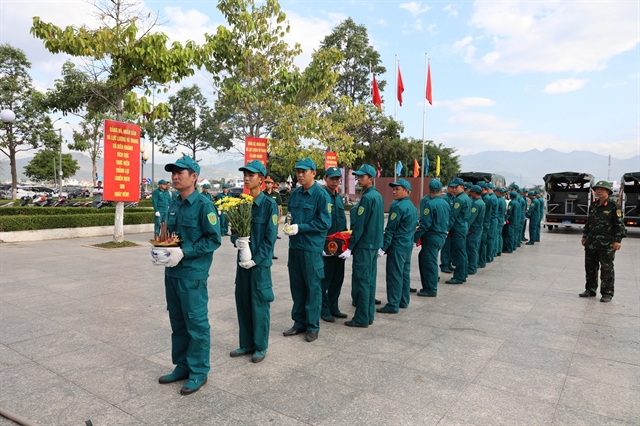 |
| Thirteen coffins containing fallen soldiers’ remains recovered from the former Thành Diên Khánh Prison are taken to Hòn Dung war Martyrs’ Cemetery for preservation and DNA sample collection on August 25. — VNA/VNS Photo |
Society
 Society
 Society
 Society
 Society
 Society
 Society
 Society
 Society
.jpg) Society
Society
 Society
 Society
 Society
 Society
 Society