 Society

Việt Nam unveils youthful squad for AIMAG 2026 futsal campaign
1.
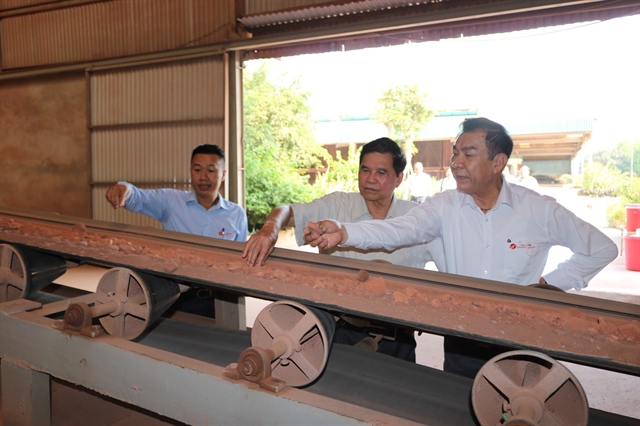 |
| Labour Hero Nguyễn Quang Mâu (first right) introduces his ultra-fine dry grinding line. — VNA/VNS Photo Diệu Thúy |
HÀ NỘI — Nguyễn Quang Mâu left school after Grade 7 to work in the fields. Decades later, he would rise to lead Viglacera Hạ Long and help take Vietnamese fired clay bricks and tiles to international markets.
Now 76 and a Labour Hero, Mâu started out as a production worker and taught himself the technology of the trade through years of study, research and experimentation. With his colleagues, he developed solutions that improved product quality, saved resources and cut emissions.
Self-taught, green-minded
Born into a farming family, Mâu grew up during some of the country's hardest years. Known from a young age for his hard work and eagerness to learn, he rose through a series of senior posts before becoming general director of Viglacera Hạ Long.
In 2009, Mâu was named a Labour Hero in the Đổi Mới (Renewal) period for his contributions to Việt Nam's construction materials industry.
After retiring from Viglacera Hạ Long in 2012, he and several colleagues set up Đất Việt Ceramics Group. From the start, Mâu saw science and technology as the key to upgrading traditional products.
The company's breakthrough came with a research project, led by Mâu, on ultra-fine dry grinding, greater automation and better thermal efficiency in premium tile production.
The traditional method of wet grinding and plastic extrusion used large amounts of water and energy and produced heavy dust. The new technology grinds clay into a fine, uniform mix, with particles below 0.425mm and some at micro- and nano-scale. As a result, fired products are denser and stronger, absorb less water, resist moss and mould, and last longer.
The process uses almost no water, cuts dust and exhaust emissions, and makes full use of raw materials, including rock and soil waste. In 2021, the project won the Hồ Chí Minh Prize for Science and Technology.
Lê Xuân Thảo, vice chairman of the Việt Nam Fund for Supporting Technological Creations (VIFOTEC), said Mâu's greatest achievement was turning research into practical production technology that makes the most of resources, saves energy and protects the environment.
Besides the Hồ Chí Minh Prize, the company has won dozens of VIFOTEC awards, and its products are now sold in 56 countries and territories, including demanding markets such as the US, the EU and Japan.
R&D on the factory floor
Mâu said the group has made Resolution 57-NQ/TW, the Politburo's resolution on breakthroughs in science, technology, innovation and digital transformation, the foundation of its long-term strategy, setting up research and development (R&D) centres right at its production facilities.
The approach has paid off. The group has become more competitive, brings new products to market faster, and has improved pay and working conditions for its staff.
Tax exemptions and reductions on corporate income have also freed up funds, which the group has reinvested in research and innovation.
Looking ahead, Mâu said the group will continue to pursue green transition and put more resources into research to make Vietnamese products more competitive.
At 76, the former farm boy remains an example of lifelong learning and dedication for younger generations. — VNS
Society
 Society
 Society
 Society
 Society
 Society
 Society
 Society
 Society
 Society
 Society
 Society
 Society
 Society
 Society