 Society
Việt Nam unveils youthful squad for AIMAG 2026 futsal campaign
1.
|
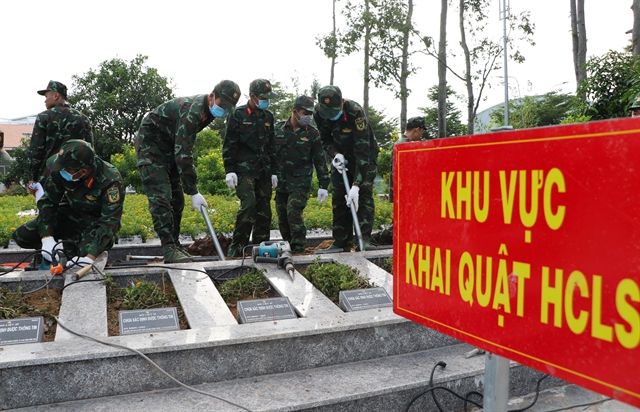
| Search team members collect DNA samples from the graves of unidentified martyrs at martyrs’ cemeteries in Đồng Tháp Province. — VNA/VNS Photo |
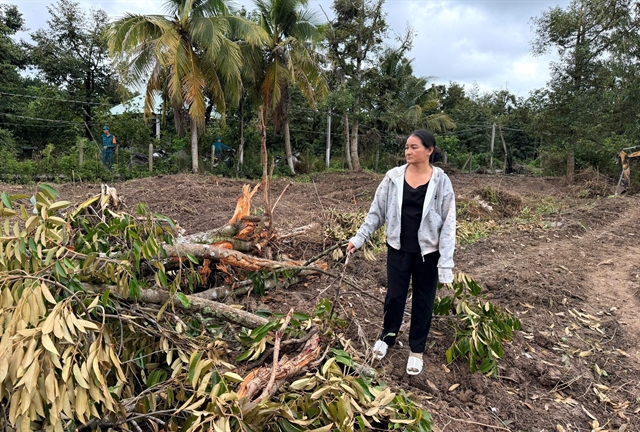
ĐỒNG THÁP — Chainsaws whined through Lê Thị Đón's durian orchard in Đồng Tháp Province as, one by one, trees that earned her family about VNĐ300 million (US$11,600) a year came crashing down – felled at her own request so searchers could look for the remains of fallen soldiers beneath.
The 2,700sq.m plot in Bình Hòa Hamlet, Ngũ Hiệp Commune, once served as a temporary cemetery for soldiers killed in the resistance wars. Over the years it had grown into a thriving orchard of about 120 durian trees, some 15 years old, others planted just four years ago.
Đón, born in 1972, had long suspected that not all of the dead had been recovered.
"My father discovered three sets of martyrs' remains while digging irrigation ditches in the orchard to plant trees. He reported them to the commune authorities so they could be taken to the district cemetery. From then on, my father believed there might still be remains in this land," she said.
So when the nationwide "500 Days and Nights Campaign to Accelerate the Search, Recovery and Identification of Martyrs' Remains" was launched ahead of the 80th anniversary of War Invalids and Martyrs' Day (July 27, 2027), she asked local authorities and relevant agencies to review the entire orchard.
|
| Lê Thị Đón stands in her cleared durian orchard. — VNA/VNS Photo |
From September 1, the K91 Team, under the Đồng Tháp Military Command, searched the site using both machinery and manual excavation.
By the time the search concluded on September 23, the team had recovered 77 sets of martyrs’ remains from the durian orchard.
The remains have not been identified. Some were wrapped and tied in ponchos or pieces of clothing. Biological samples were collected for DNA testing, while the remains were preserved in accordance with regulations.
Lieutenant Colonel Võ Thành Dẫn, head of the K91 Team, said Bình Hòa Hamlet had been the scene of fierce fighting during the two resistance wars.
Because of wartime conditions, fallen soldiers were often buried at night, without regular rows or paths. In some places, remains were buried on top of one another.
The work of recovering martyrs’ remains at the durian orchard therefore requires patience.
Dẫn said: “At first, we dig through thin layers of soil. When we find signs such as ponchos or tarpaulins used to wrap martyrs’ remains, we stop the excavator and switch to hand digging.
“Each tree root and piece of soil is carefully removed, and each part of the remains is lifted with the utmost respect.”
The K91 Team also recovered 16 sets of martyrs’ remains from a 1,000sq.m sapodilla orchard in Tây Hamlet, Kim Sơn Commune, after completing a search operation following a period of surveying and verification.
About 30 officers and soldiers took part in the operation, with most of the excavation carried out manually because the access road to the sapodilla orchard was too narrow for machinery.
Despite the impact of the excavation on his sapodilla trees, Võ Văn Vinh, 60, the orchard owner, agreed to support the search and did not request compensation.
|
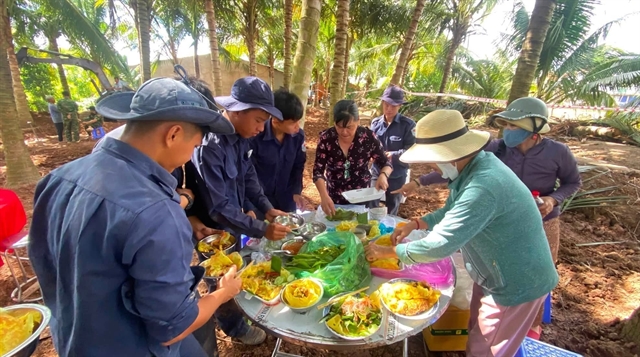
| Local residents provide food and drinking water to members of the K91 Team as they search for and recover the remains of fallen soldiers in Tân Thành Commune. — VNA/VNS Photo |
Local support
For the K91 Team, local residents are more than people who open their gardens to search teams. They are also keepers of memories.
Đặng Văn Hai, born in 1949 and living in the same hamlet as Đón, has lived in the area since childhood. After learning that the K91 Team had arrived at the durian orchard, he regularly came to support the soldiers.
He said the site was once the Bình Hòa A Temporary Martyrs’ Cemetery, located in what was formerly Tam Bình Commune, Cai Lậy District, Tiền Giang Province.
“Later, the State gathered the remains at the Cai Lậy District Martyrs’ Cemetery. Through many wars, many forces buried people here, so during the search and recovery of martyrs’ remains, it was difficult to avoid omissions.
“Around 1990, the State auctioned the land to local people. After people began farming here for some time, they discovered that martyrs’ remains were still buried beneath the land,” Hai said.
Such memories help search teams trace places where soldiers were buried decades ago.
|
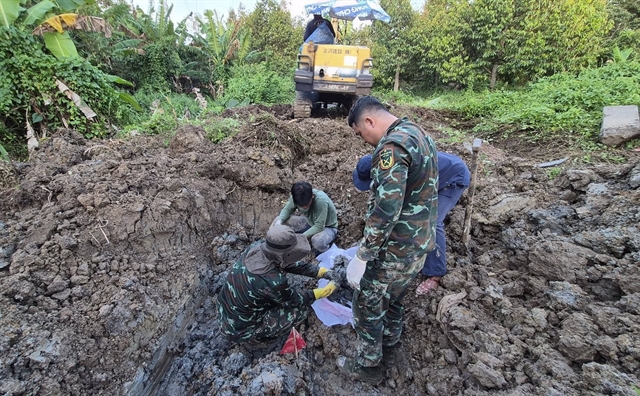
| The K91 Team searches for and recovers the remains of fallen soldiers from Lê Thị Đón’s durian orchard. — VNA/VNS Photo |
Dẫn said communication and coordination with local people are an important part of the search and recovery mission.
Increasingly, residents have approached the team themselves to provide information and clues that have survived for many years.
From these leads, officers and soldiers contact witnesses, inspect sites and organise searches when there are sufficient grounds.
The work does not end when a set of remains is found.
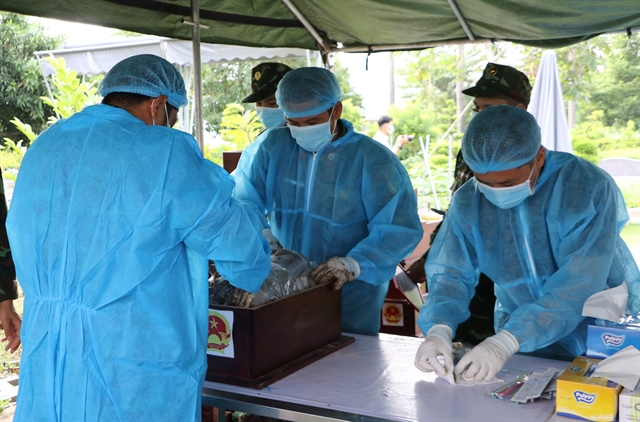
Each recovered set must be sampled for DNA testing. DNA samples from relatives of unidentified martyrs are also needed for comparison.
During a recent six-day campaign to collect DNA samples from martyrs’ relatives, the province collected nearly 5,000 samples at 25 locations across 102 communes and wards, while also visiting more than 160 elderly, sick or mobility-impaired people at their homes to collect DNA samples.
|
| Search team members collect DNA samples from the remains of unidentified martyrs at the Đồng Tháp Martyrs’ Cemetery in Mỹ Trà Ward. — VNA/VNS Photo |
As of October 4, the province had completed the exhumation of human remains and the collection of DNA samples from 12,290 unidentified martyrs’ graves across 30 cemeteries, marking a major step forward in efforts to identify fallen soldiers as part of the “500-Day-and-Night Campaign.”
Colonel Nguyễn Văn Hoa, political commissar of the Đồng Tháp Military Command and standing deputy head of the province Steering Committee for the Search, Recovery and Identification of Martyrs’ Remains (the province Steering Committee 515), said the main challenge in exhuming remains and collecting DNA samples was the passage of time.
“The remains have lain deep underground for decades, affected by soil conditions, humidity, groundwater and natural decomposition,” he said, noting that some graves were nearly three metres deep and that remains had sometimes been relocated over the years.
“Every procedure must be carried out accurately and in accordance with regulations, as even a single mistake could affect the chances of identifying a fallen soldier.”
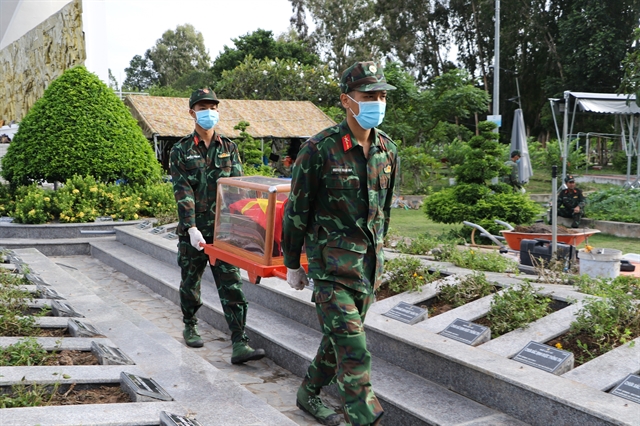
|
| Search team members collect DNA samples from the remains of unidentified martyrs at the Đồng Tháp Martyrs’ Cemetery. — VNA/VNS Photo |
Under the “500-Day and Night Campaign”, Đồng Tháp was assigned to search for and recover 370 martyrs’ remains in Việt Nam and in Cambodia’s Prey Veng and Pursat provinces.
Efforts to recover martyrs’ remains are continuing alongside the identification work.
As of October 3, the province Steering Committee 515 has recovered 202 sets of martyrs’ remains in Đồng Tháp.
The committee has also worked with local authorities and armed forces in Prey Veng and Pursat provinces to recover 47 sets of remains of Vietnamese volunteer soldiers and military experts who died in Cambodia during wartime operations.
Hoa said the K91 Team will continue searching for and recovering the remains of Vietnamese martyrs in Prey Veng and Pursat provinces.
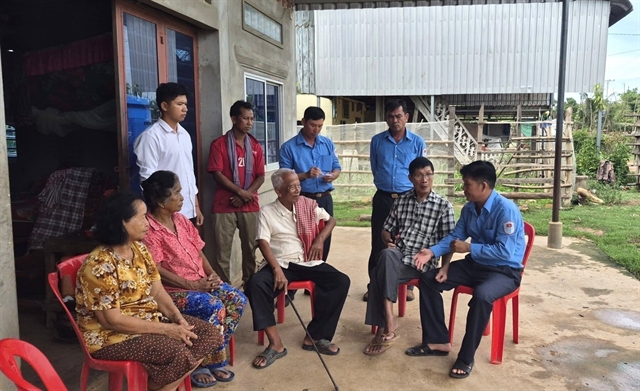
|
| Cambodian residents provide information and assistance to the K91 Team in its search for the remains of Vietnamese volunteer soldiers and military experts who died in Cambodia during different periods of war. — VNA/VNS Photo |
After decades beneath the soil, the search continues, driven by the hope that more fallen soldiers can finally be found and identified.
Talking about the decision to cut down her durian orchard, Đón said: “It breaks my heart to cut down the orchard I have worked so hard to grow. But these soldiers gave their lives for the Fatherland, and I am willing to give up the fruits of my labour.”
“Durian trees can be replanted. But if the remains of fallen soldiers are still buried underground, they must be found and brought home,” she said. — VNS
Society
 Society
 Society
 Society
 Society
 Society
 Society
 Society
 Society
 Society
 Society
 Society
 Society
 Society
 Society