 Society

Vietnamese leaders extend congratulations to Kazakhstan on Republic Day
1.
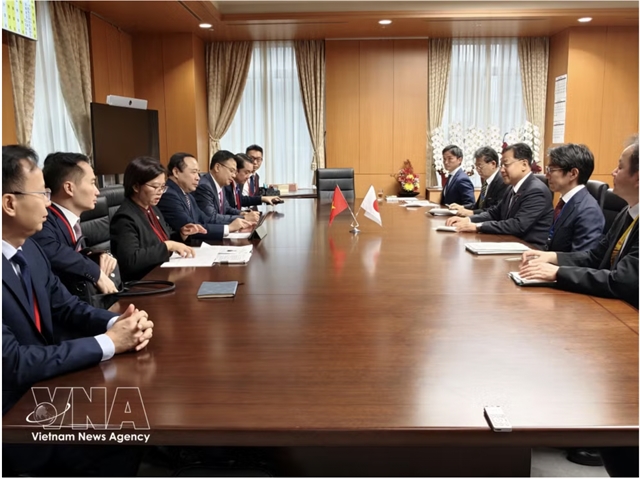 |
| At the working session between Minister of Science and Technology Vũ Hải Quân and Japanese Minister of Education, Culture, Sports, Science and Technology Seki Yoshihiro. VNA/VNS Photo |
TOKYO Việt Nam’s Ministry of Science and Technology and Japan’s Ministry of Education, Culture, Sports, Science and Technology pledged to enhance co-operation on education between the two countries.
In the framework of the visit of the delegation of the Vietnamese Ministry of Science and Technology in Japan, Minister Vũ Hải Quân had working sessions with the Japanese Ministry of Education, Culture, Sports, Science and Technology, the Ministry of Internal Affairs and Communications, and Tokyo University, and attended the Việt Nam-Japan Digital Technology Forum 2026 in Tokyo.
In the meeting with Japanese Minister of Education, Culture, Sports, Science and Technology Seki Yoshihiro on October 2, the two sides discussed expanding training and research programs for the Vietnamese workforce.
Quân proposed that the Japanese side continue providing postgraduate scholarships, particularly at master's and doctoral levels in strategic technological sectors, facilitate exchanges among students and researchers, and maintain support for the Việt Nam Japan University (VJU).
In the semiconductor sector, the two sides discussed strengthening the integration of education, research, and practical application. Based on this, the Vietnamese side proposed exploring the establishment of a "Mini Fab Lab" at the Việt Nam Japan University to support training, research, and small-scale chip pilot production.
The Japanese side suggested that relevant specialised agencies from both countries continue discussions to clarify the model, prerequisites, and implementation plans. The two ministers also discussed the "Nexus" programme –a Việt Nam-Japan co-operation framework focused on semiconductors and high-tech workforce development.
Việt Nam proposed expanding the programme to include artificial intelligence (AI), quantum technology, and healthcare, while also enhancing connections with Japanese research institutions.
Regarding healthcare, the two sides discussed the possibility of collaborating with the Japan Agency for Medical Research and Development (AMED).
Japan affirmed its commitment to continuing to host Vietnamese students and researchers and to fostering exchanges between research institutions. Additionally, Japan introduced several programmes offered by the Japan Society for the Promotion of Science (JSPS), including initiatives for joint research and the short-term hosting of foreign researchers and scientists.
The Vietnamese minister said that education, science and technology are sectors leaving signìicant imprint in the Việt Nam-Japan co-operation relations.
Japan has participated in training tens of thousands of PhD holders and high-level personnel for Việt Nam, alongside numerous research programmes implemented between universities and scientific institutions in both countries, Quân said.
On his side, the Japanese minister affirmed that Việt Nam is an important partner of Japan and expressed his wish to further expand scientific and technology co-operation between the two countries.
The two sides agreed to task relevant specialised units with continuing discussions to flesh out cooperation details regarding semiconductors, AI, quantum technology, and healthcare.
In the meeting with Minister of Internal Affairs and Communications Fujii Hisayuki, the two sides discussed the development of AI, digital infrastructure, and human resources, and co-operation mechanisms in information and communication.
The two ministers agreed to maintain the bilateral exchange mechanism established in 2017 and schedule for joint working group's next meeting in Việt Nam in late October that will focus on policy and legal issues within the information and communications sector.
Regarding AI, the Japanese side proposed enhancing exchanges between regulatory bodies and enterprises from both countries concerning AI safety, the development of domain-specific AI models, the creation of Vietnamese-language datasets, and workforce training.
Japan also plans to send representatives to participate in an AI seminar held as part of the International Digital Week in Việt Nam.
Quân proposed that the two sides explore the development of a cooperation programme for AI workforce training with specific objectives and scope. The Japanese side acknowledged the proposal and indicated that relevant specialised units would be tasked with further discussions.
The two sides also discussed potential cooperation on digital infrastructure, including 5G networks, Open RAN, and data centers. These topics will continue to be discussed by the two ministries and relevant agencies as cooperation activities are implemented in the near future.
Additionally, the two sides agreed to continue discussions on cooperation programs in semiconductors, AI, workforce training, and scientific research, while assigning specialized units to study specific details for future implementation.
On the same day, the Vietnamese minister attended the Việt Nam-Japan Digital Technology Forum that was jointly organised by the Việt Nam Software and IT Services Association (VINASA), the Department of Digital Technology Industry and Artificial Intelligence, and various Vietnamese and Japanese partners, drawing the participation of over 250 leaders from technology enterprises and organisations across both nations.
Centered on the theme "Việt Nam -Japan Digital Synergy: Co-creating the Future through AI and Deep Tech," the forum focused on elevating the bilateral technology partnership – shifting from mere outsourcing services toward research, development, and the co-development of technology products.
Speaking at the forum, Quân said Vietnamese technology companies operating in Japan had made significant progress in both scale and quality.
FPT Japan, for example, now has around 5,000 employees in Japan, with its information technology services revenue in the market reaching VNĐ15.452 trillion (US$600 million) in 2025.
This is seen as a foundation for businesses from the two countries to expand cooperation into higher value-added areas.
The minister outlined four directions for future cooperation: modernising core technology systems to improve productivity; jointly researching, designing and testing advanced technologies such as artificial intelligence (AI), robotics and unmanned aerial vehicles (UAVs); training AI engineers based on the practical needs of businesses; and bringing products jointly developed by companies from the two countries to the market and into global supply chains.
A representative of Japan's Ministry of Internal Affairs and Communications stressed the need to establish suitable testing environments and legal frameworks to enable businesses from the two countries to carry out joint research and development projects, particularly in AI and digital infrastructure. VNS
Society
 Society
 Society
 Society
 Society
 Society
 Society
 Society
 Society
 Society
 Society
 Society
 Society
 Society
 Society