 Society

Tây Ninh province seeks Japanese investment in high-value industries
1.
|
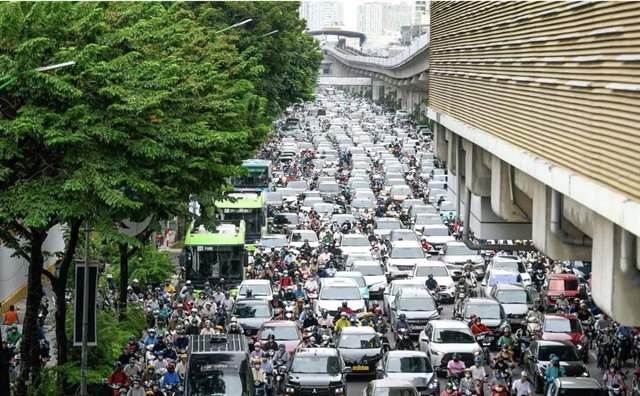
| The habit of using private vehicles is one of the reasons for traffic congestion in Hà Nội. VNA/VNS Photo |
HÀ NỘI — Average traffic speeds in central Hà Nội have fallen to just over 12km per hour on some major roads during peak hours, underscoring the need for a fundamental shift towards mass public transport under the capital’s proposed 100-year transport master plan, according to the Hà Nội Department of Construction.
The department has completed its review of the planning brief for the capital’s transport master plan with a 100-year vision and submitted it to the municipal People’s Committee for consideration and approval.
The documents submitted for review includes survey data showing a worrying decline in inner-city traffic speeds, providing a practical basis for the city to rethink its approach to infrastructure development.
Average travel speeds across the inner city stand at 21.02 km/h during off-peak hours but fall to 15.54 km/h during peak periods.
The sharpest declines have been recorded on major arterial roads such as Trần Duy Hưng, the Ring Road No. 3 - Phạm Hùng section, the Ring Road No. 2 - Láng section, and Giải Phóng.
Traffic congestion is largely driven by heavy reliance on road transport and private vehicles. Motorbikes account for 82.3 per cent of traffic volume and occupy 52.5 per cent of road space, while passenger cars make up 12.2 per cent of traffic volume and occupy 26 per cent of road space.
Meanwhile, the capital’s two urban railway lines and one bus rapid transit (BRT) line serve only around 4.8 per cent of travel demand. This suggests that simply widening roads is no longer sufficient to resolve congestion.
Against this backdrop, the proposed 100-year transport plan aims to translate the capital’s broader master plan, approved under Decision No. 2512/QĐ-UBND on May 13, 2026, into a long-term transport strategy.
The plan covers Hà Nội’s entire natural area of nearly 3,360 sq. km and takes into account regional transport links with neighbouring localities.
The proposed transport network will be closely integrated with a multi-tiered, multi-layered urban development model structured around nine economic corridor axes, nine growth poles and nine major centres.
According to Trương Việt Dũng, vice chairman of the Hà Nội People’s Committee, the plan goes beyond adding individual infrastructure projects and aims to reorganise the capital’s overall spatial development structure and the way people travel.
The central priority is to make urban rail the backbone of the public transport system, with radial, ring and cross-city lines linked directly to major interchange hubs, including airports and railway stations.
Bus services and feeder routes will connect passengers to the urban rail network, alongside coordinated measures to promote walking, cycling and shared transport, as well as park-and-ride facilities.
For road transport, the plan clearly defines the functions of different road classes. Ring roads will focus on diverting traffic and connecting growth poles, while radial routes will link these areas with the central urban core.
The municipal appraisal council approved the planning task, paving the way for detailed proposals for the transport network to be developed in the next phase. VNS
Society
 Society
 Society
 Society
 Society
 Society
 Society
 Society
 Society
 Society
 Society
 Society
 Society
 Society
 Society