 Society
Direct flights boost tourism links across central Việt Nam
1.
|
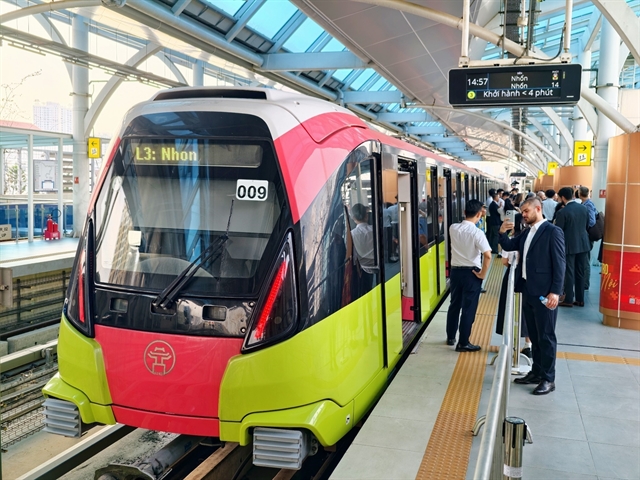
| Passengers on the Nhổn - Hà Nội Station metro line. — VNA/VNS Photo Trung Nguyên |
HÀ NỘI — Hà Nội is seeking public feedback on detailed 1:500-scale zoning plans for 22 priority stations along five urban railway lines of 1, 2, 8, 10 and 14.
The Hanoi Metropolitan Railway Management Board said on Thursday that it was working with the municipal People’s Committee Office, contractor consortia and consultants to hold consultations and gather residents’ views on the plans.
The proposed locations of the 22 priority stations, part of five metro lines launched on June 22, are now on public display in the 22 relevant communes and wards.
The consultation marks an important step towards finalising the plans, ensuring transparency and allowing residents to contribute before the documents are submitted to the competent authorities for appraisal and approval.
According to the management board, consultants have presented detailed plans for the 22 stations at consultation meetings.
Key issues include site clearance boundaries, station entrances and exits, ventilation shafts, and plans for transit-oriented development (TOD) in surrounding areas.
“The public consultation aims to help residents access planning information and understand how the proposals may affect their neighbourhoods, while giving them an opportunity to express their views and aspirations regarding urban space planning and transport infrastructure development,” the management board said.
To allow sufficient time for consideration and feedback, the 1:500-scale planning drawings will be displayed at the headquarters of the 22 relevant commune and ward People’s Committees for at least 20 days.
Residents can submit their opinions through survey forms or directly to the People’s Committee in their place of residence.
The management board will work with local authorities to compile, review and incorporate feedback into the plans.
The revised documents will then be submitted to the municipal Department of Construction for appraisal before being presented to the capital People’s Committee for consideration and approval in accordance with regulations.
Through this process, the city aims to improve planning quality and ensure that urban railway development reflects local conditions, travel demand and long-term urban development objectives.
Expand urban development space
On June 22, 2026, Hà Nội launched five urban railway projects with a combined length of approximately 253.5km.
The network is designed to connect the city centre with urban areas, industrial parks and major transport hubs, helping establish a high-capacity public transport system.
Line 1, approximately 59km long, will connect the Hùng Vương Stadium area, the railway industrial park, Ngọc Hồi, Hà Nội Railway Station, Yên Viên, Thư Lâm urban area and Nội Bài International Airport.
Line 2, spanning approximately 60km, will link, Nội Bài International Airport, Nam Thăng Long, Trần Hưng Đạo, Thượng Đình and the Thượng Phúc/Hùng Vương Stadium area.
Line 8, approximately 64km long, will pass through Hòa Lạc, Sơn Đồng, Mai Dịch, Ring Road 3, Lĩnh Nam và Thuận An.
Line 10, covering approximately 38.7km, will connect Võ Chí Công, Ring Road 2.5, the Times City/Vĩnh Tuy area and Cổ Loa/Đông Anh.
Line 14, approximately 31.8km long, will link Thăng Long Bridge, the Hồng Hà area and Ocean Park/Gia Lâm.
Under Decision No. 4765, issued by the Hà Nội People’s Committee on September 5, 2026, the projects will be funded by the municipal and central government budgets.
They will be implemented under turnkey contracts, with MRB serving as the project investor.
Implementation is scheduled for 2026-30, with completion targeted for 2030.
The five metro lines are to be delivered under turnkey contracts.
Technical plans presented at the signing ceremony indicate that they will use the standard 1,435mm track gauge and communications-based train control (CBTC), with a target of Grade of Automation 4 (GoA4), enabling fully automated train operation.
The projects are also expected to use building information modelling (BIM) and data management solutions to support design, construction and operation.
On October 12, the capital People’s Committee approved a consortium comprising Vinhomes JSC and SGC Investment and Construction JSC (the VHM-SGC consortium) as the designated contractor for contract negotiations and signing.
At the groundbreaking ceremony, Vũ Đại Thắng, member of the Party Central Committee, Deputy Secretary of the capital Party Committee and Chairman of the municipal People’s Committee, said the projects represented the city’s largest-ever urban railway investment programme and were among the major urban infrastructure programmes being launched nationwide at the same time.
Under the city’s development strategy, urban railways are intended not only to meet transport demand but also to re-organise urban space, promote transit-oriented development, make more effective use of land resources and strengthen regional connectivity.
Once developed as an integrated network, the urban railway system is expected to connect growth centres, expand development space and facilitate the movement of goods, services and knowledge. It is also expected to ease pressure on road transport, improve environmental quality and enhance residents’ quality of life. — VNS
Society
 Society
 Society
 Society
 Society
 Society
 Society
 Society
 Society
 Society
 Society
 Society
 Society
 Society
 Society