 Society
NA President sets June 2027 deadline for APEC projects, rules out delays, quality cuts and violations
1.
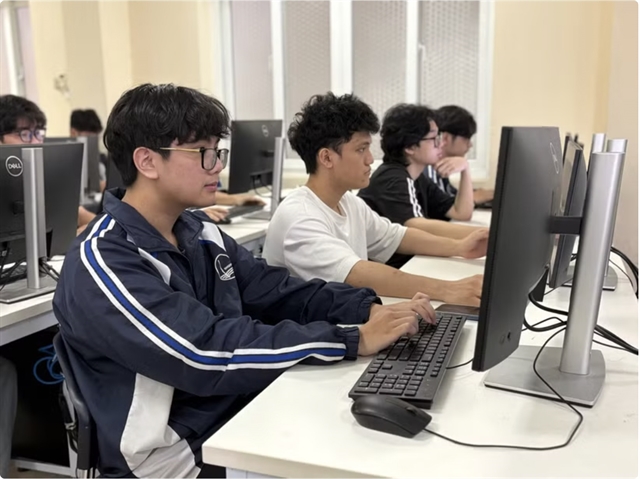 |
| Digital transformation will be accelerated in schools.— VNA/VNS Photo |
HÀ NỘI — The Ministry of Education and Training (MOET) plans to restructure the public higher education system and invest in developing at least three elite universities modelled on world-class research institutions.
The initiative is among the ministry’s key tasks for the 2026–27 academic year.
In line with Politburo Resolution 71-NQ/TW, the elite universities are expected to train skilled workers and help place Vietnamese universities among the world’s top 100 institutions.
The plan also supports the resolution’s goal of transforming Vietnamese higher education into a hub for research, innovation and technological development.
MOET is studying plans to develop higher education, science, technology and innovation ecosystems in Hà Nội, HCM City and other centres, drawing selectively on international experience.
The ministry aims to move from sole investments to ecosystem-based development, with institutions sharing infrastructure and taking on distinct missions to create knowledge-driven growth poles.
Higher education will be modernised to meet demand for highly skilled workers, while enrolment growth will be linked to quality assurance requirements. Priority will be given to STEM disciplines and strategic technologies while ensuring adequate teaching staff, laboratories and graduate employment opportunities.
Policies supporting post-graduate education, doctoral training and strong research groups will also be strengthened. Research evaluation will shift away from the number of publications towards patents, products, technology transfer and practical impact.
MOET also aims to build higher education into an English-language ecosystem that promotes international integration, knowledge transfer and innovation.
Universities will be encouraged to expand the use of English in teaching, learning and academic staff development.
Alongside higher education reforms, the ministry has outlined priorities for preschool, general and vocational education.
Preschool and general education are expected to make clear improvements in quality, discipline and school safety.
Schools will continue streamlining curricula, improving classroom teaching and expanding full-day learning where conditions permit.
Greater emphasis will be placed on practical learning, experiential activities, STEM education, foreign languages, digital skills, arts, physical education and selective use of AI. English will gradually become a second language in schools.
Education programmes and textbooks will be revised to meet new requirements. Schools will strengthen teaching of national history, culture, ethics, life skills, health and social responsibility, while promoting orderly and healthy learning environments.
The ministry also plans to strengthen measures against school violence, child abuse and social problems, while expanding psychological counselling, school healthcare and food safety measures.
Examinations and assessments will be further reformed to better reflect learners’ capabilities and progress. Upper secondary graduation exams and university admissions are expected to become more streamlined, transparent and cost-effective, while reducing pressure on students and preventing cheating.
MOET reaffirmed its commitment to tackling achievement-driven practices and strengthening discipline in teaching, examinations, admissions and the management of extra classes.
For vocational and continuing education, the ministry will reorganise the network of institutions, invest in leading vocational schools and increase business participation in training. Employment outcomes after graduation will be made public.
A national platform on labour, skills and employment is also planned to better connect education with job market demand, especially in STEM, strategic industries and emerging occupations.
Addressing shortages of teachers and facilities remains another priority. The ministry aims to ensure sufficient schools, classrooms and teachers, while guaranteeing that no student is denied access to education because of financial hardship.
Measures include attracting teachers to disadvantaged areas, easing overcrowding in urban schools, improving teacher deployment and reducing unnecessary paperwork and meetings so that teachers can focus on professional work.
Digital transformation and international cooperation will also be accelerated. — VNS
Society
 Society
 Society
 Society
 Society
 Society
 Society
 Society
 Society
 Society
 Society
 Society
 Society
 Society
 phát biểu tại buổi hội thảo.jpg) Society
Society