 Society

SBV to curb property price inflation, enforce lending rate rules
1.
|
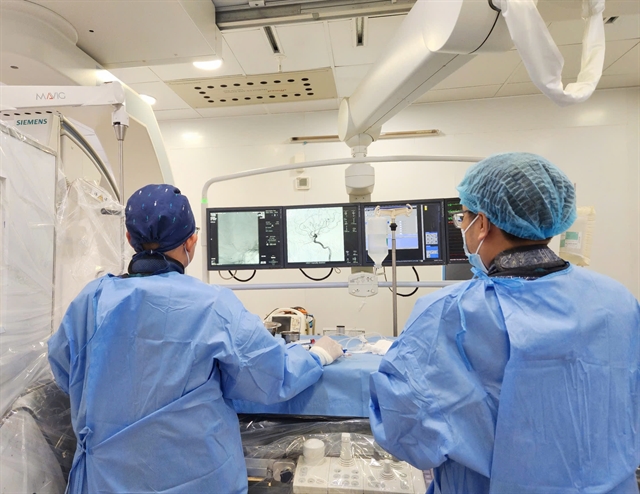
| Specialists at Thủ Đức General Hospital perform a minimally invasive endovascular procedure to deploy a flow-diverter stent for the patient. — Photos courtesy of Thủ Đức General Hospital |
HCM CITY — Doctors at Thủ Đức General Hospital in coordination with Thuận An Regional Medical Centre in HCM City have successfully treated a 73-year-old patient suffering from a subarachnoid haemorrhage caused by a ruptured internal carotid artery aneurysm.
The patient, N.V.H., a resident in the city’s Bình Hòa Ward, was transferred from the Thuận An Regional Medical Centre on August 26 after suffering sudden, excruciating headaches accompanied by vomiting.
Upon admission, the patient was conscious but lethargic, experiencing severe head pain, nausea, neck stiffness, and limb weakness rated at 4/5.
Doctors immediately ordered brain CT and CT angiography scans, which confirmed a subarachnoid haemorrhage across both hemispheres (World Federation of Neurosurgical Societies grade 1) caused by a ruptured dissecting aneurysm in the left internal carotid artery.
The medical team performed initial emergency care, strictly controlling blood pressure, administering pain relief, managing intracranial pressure, and preventing vasospasms.
Because the dissecting aneurysm had a fusiform shape, standard coil embolisation was unsuitable. Specialists opted to place a flow-diverter stent across the affected segment to reconstruct the vessel and eliminate the bleeding source.
Dr Lê Công Trí, head of Stroke Unit at the Thủ Đức General Hospital, said a ruptured brain aneurysm is a critical neurological emergency carrying a high risk of re-bleeding.
Due to the unusual morphology of the aneurysm, conventional coiling was not feasible. Deploying a flow-diverter stent effectively secured the site and minimised the danger of secondary haemorrhage, he said.
“Rapid intervention was vital to controlling the bleed and preventing severe complications.”
|
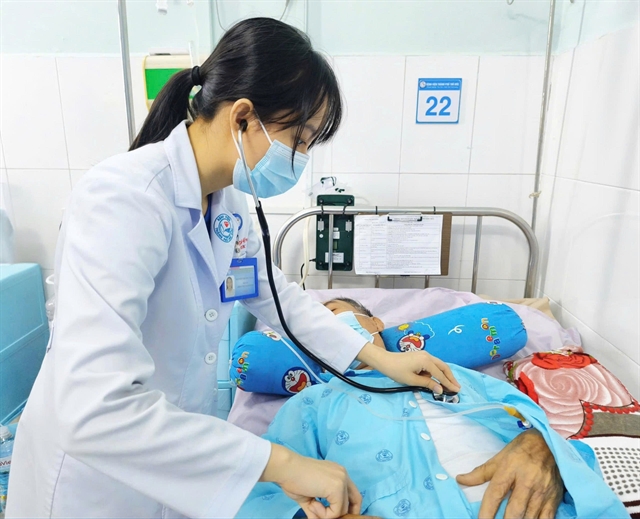
| A doctor examines the 73-year-old patient during his recovery at Thủ Đức General Hospital in HCM City. |
Following the endovascular intervention and post-operative care, the patient recovered remarkably.
He became fully alert, experienced a significant reduction in headaches, regained full motor function in his limbs, and has since been discharged.
Physicians advise the public not to ignore sudden, severe headaches, often described as the "worst headache of one's life", particularly when accompanied by nausea, neck stiffness, weakness, altered consciousness, or visual disturbances.
Patients displaying these red-flag symptoms should be rushed to a specialized medical facility immediately.
Managing hypertension, avoiding smoking, and limiting alcohol intake are also crucial preventive measures.
The case highlights the crucial role of seamless inter-hospital coordination between healthcare facilities from early recognition and consultation at the primary level to timely transfer and advanced neurovascular treatment. — VNS
Society
 Society
 Society
 Society
 Society
 Society
 phát biểu tại buổi hội thảo.jpg) Society
Society
 Society
 Society
 Society
 Society
 Society
 Society
 Society
 Society