 Society

SBV to curb property price inflation, enforce lending rate rules
1.
|
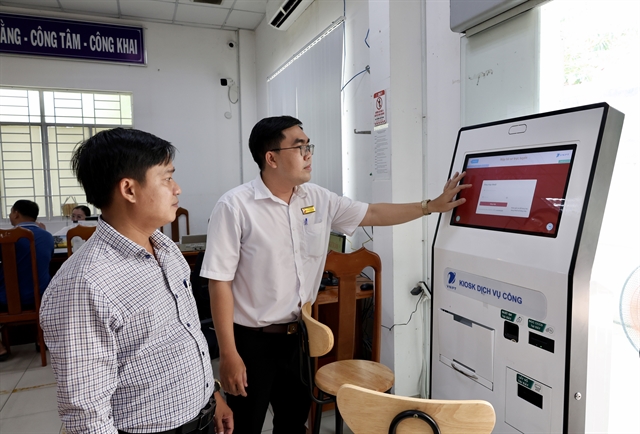
| A staff member of the Long Xuyên Ward Public Administrative Service Centre in An Giang Province guides a resident through an online procedure on the National Public Service Portal. — VNA/VNS Photo |
AN GIANG — An Giang Province has set a target of making science, technology and innovation a major driver of economic growth during 2026–30, while strengthening digital transformation and developing strategic technology sectors under the Politburo’s Resolution No 57 issued in December 2024.
The Cửu Long (Mekong) Delta province aims for total factor productivity to contribute more than 55 per cent of local economic growth by 2030, while high-tech products are expected to account for at least 50 per cent of the total value of exports.
Total social investment in research and development is targeted at a minimum of 2 per cent of GDP, with non-State funding accounting for more than 60 per cent.
At least 3 per cent of annual State budget expenditure will be allocated to science, technology and innovation.
Nguyễn Thanh Phong, deputy chairman of the An Giang People’s Committee, said the province will focus on the marine economy, border trade, biotechnology, deep processing of agricultural products, medicinal materials, high-tech agriculture, aquatic seed production and AI-enabled software.
The province also plans to pilot regulatory sandboxes for businesses using open data to develop digital services, while promoting Digital Twin and Internet of Things (IoT) technologies in agricultural value chains.
New technologies will also be applied in healthcare, tourism, forest management and border surveillance.
The province aims to place its Provincial Innovation Index among the top 10 nationwide, with more than 20 per cent of local businesses engaging in innovation activities.
Applications for patents and granted patents are targeted to increase by more than 10 per cent annually.
At least 30 per cent of research results from universities and research institutes are expected to be applied and commercialised.
|
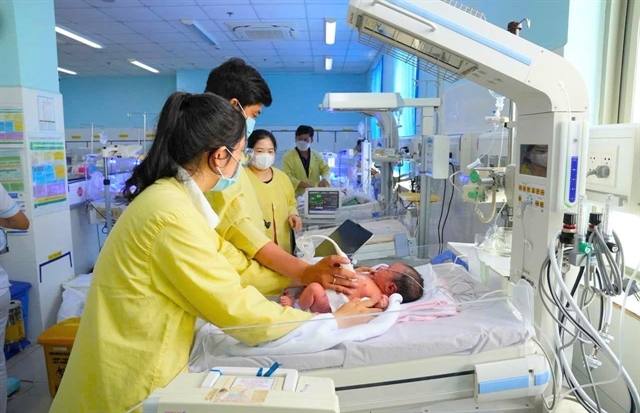
| Doctors at An Giang Obstetrics and Children's Hospital examine and screen a newborn for heart disease using modern medical equipment. — VNA/VNS Photo |
The province plans to implement at least 50 provincial-level science, technology and innovation tasks each year, with at least 60 per cent of research results put into practical use within 12 months of acceptance.
In high-tech agriculture and the marine economy, the province will prioritise Digital Twin, IoT and AI applications for key products, particularly rice, tra fish and aquatic breeds.
It will develop databases on agricultural production, climate, hydrology and land to support management and traceability.
It is also studying the development of a low-altitude economy, including drone applications in smart agriculture, tourism, forest protection and border monitoring.
In digital technology and semiconductors, it plans to test AI-enabled software production, exploit open data and participate in semiconductor supply chains involving specialised integrated circuits, IoT and AI.
It will promote AI, IoT and remote sensing for marine environmental monitoring, as well as digital border gates, smart tourism and logistics.
In healthcare, it plans to expand its “smart healthcare” system and apply AI and big data in diagnosis, treatment and community healthcare.
To mobilise resources, the province will follow a model in which the State budget takes the lead while society participates in investment.
Public funding will focus on shared-use infrastructure, science, technology and innovation centres and specialised databases, while private capital will be encouraged for technology upgrades, data services and innovation spaces.
The province is also studying controlled regulatory sandboxes for selected emerging technologies and business models, alongside policies supporting “Make in Viet Nam” and “Make in An Giang” technology products through public procurement and State orders.
Võ Minh Trung, director of the province Department of Science and Technology, said human resources are a core pillar.
The province will strengthen science, technology, engineering and math (STEM) education and cooperate with major universities to train personnel in AI, digital data, electronics and semiconductors, automation, biotechnology and smart healthcare.
Businesses will remain at the centre of the local innovation system.
Each year, the province plans to select at least three promising enterprises for specialised support to develop into science and technology, high-tech or innovative start-up businesses. — VNS
Society
 Society
 Society
 Society
 Society
 Society
 Society
 Society
 Society
 Society
 Society
 Society
 Society
 Society
 Society