 Society

AI and EV Boom Draws $690 Million in Advanced Materials Investment Plans to Thailand
1.
|
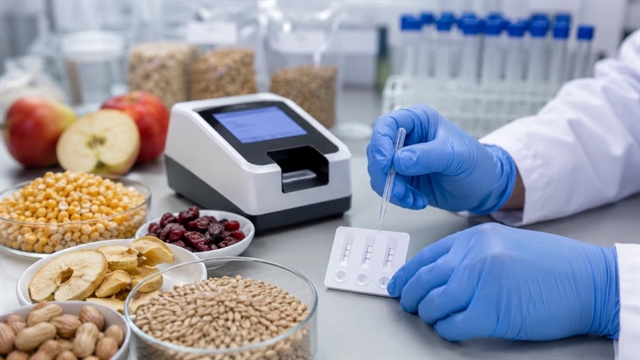
| Rapid testing for mycotoxins in food using test strips will help with food safety monitoring for high-risk sample categories such as cereals, nuts and dried fruits. VNA/VNS Photo |
HÀ NỘI — Vietnamese scientists have successfully developed a test strip for the rapid detection of three mycotoxins in food.
Instead of having to wait for the results of in-depth analysis in the laboratory, magnetic immunochromatography test strips can simultaneously detect three fungal toxins — Aflatoxin B1, Patulin and Ochratoxin A — in food at the initial screening stage.
Mycotoxins are a risk that is difficult to detect visually in food.
Early detection in samples with a risk of mycotoxin exposure will be key to supervising the safety of food and raw ingredients and preventing harm to public health.
Research into the characteristics of fungal toxin contamination of some foods, along with the manufacture of semi-quantitative test strips for rapid detection of the fungal toxins, has thus far gone in two main directions: surveying the current status of toxin contamination nationwide and developing a rapid testing tool.
The mission is chaired by the Military Medical Academy, with Associate Professor Dr Nguyễn Văn Chuyên in charge.
This project's outstanding result is the successful manufacture of semi-quantitative immunomagnetic chromatography test strips capable of simultaneously detecting Aflatoxin B1, Patulin and Ochratoxin A in food.
According to a report from the research team, 1,000 test strips were made.
The detection threshold for Aflatoxin B1 and Ochratoxin A reached 5 microgrammes per kg, while Patulin reached 10 microgrammes per kg.
Sensitivity and specificity criteria reached over 95 per cent.
Evaluation results at the National Institute for Food Safety and Hygiene Testing showed that the test strips achieved 100 per cent sensitivity and 100 per cent specificity for all three toxins.
The test results are also compared with high-performance liquid chromatography or liquid chromatography-mass spectrometry to check agreement.
Rapid screening in the field
One major feature of the system is that it also comes with a nanoparticle magnetic field measuring device designed and manufactured by the research team.
The device uses a tunnel-penetrating reluctance sensor combined with lock-in amplification, capable of detecting weak magnetic signals and giving results in about 8-12 minutes.
After a month of testing, the device operates stably and meets technical requirements.
With short analysis times, it can support rapid screening of at-risk food samples before moving on to in-depth quantitative methods.
This is especially useful for raw material testing, market surveillance, control at production facilities or situations where suspect samples need to be quickly identified.
In addition to equipment, the project also built a database on Aflatoxin B1, Patulin and Ochratoxin A contamination in foods in the northern, central and southern regions, creating more data to serve risk assessment and food safety supervision.
The research results create a foundation to continue perfecting the mycotoxin test strip technology to be compact, easy to use and reduce testing times, expanding the application of rapid testing tools in food safety monitoring in Việt Nam. VNS
Society
 Society
 Society
 Society
 Society
 Society
 Society
 Society
 Society
 Society
 Society
 Society
 Society
 Society
 Society