 Society
Deputy PM urges Việt Nam National University to lead in technology development
1.
|
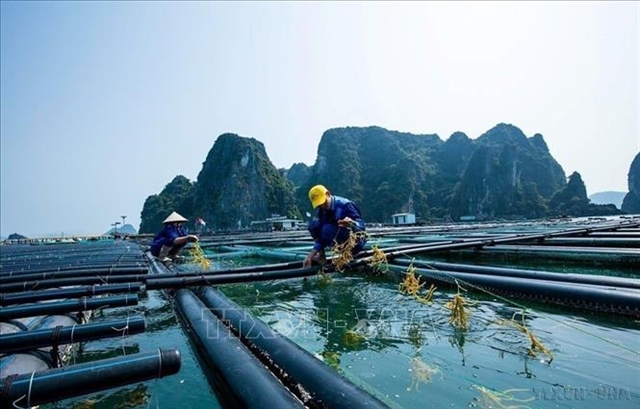
| STP Group’s marine aquaculture model at Phất Cờ Island, Quảng Ninh Province. VNA/VNS Photo |
HẠ LONG — Quảng Ninh Province has proposed adding more than 94,450 hectares to its marine aquaculture area, which would bring the total planned area for marine farming in the province to nearly 140,000 hectares.
According to the provincial Department of Agriculture and Environment, 45,146ha of sea area designated for aquaculture has been reviewed and incorporated into the Quảng Ninh Provincial Planning for the 2021–30 period approved by the Prime Minister under Decision 80/QĐ-TTg dated February 11, 2023.
The area is allocated across nine coastal localities, namely Quảng Yên, Hạ Long, Cẩm Phả, Vân Đồn, Cô Tô, Tiên Yên, Đầm Hà, Hải Hà, and Móng Cái.
Of the total, about 23,975ha is located within three nautical miles of the coast, 13,031ha between three and six nautical miles, and 8,240ha beyond six nautical miles.
Quảng Ninh is proposing to add 94,456.85ha in areas with potential for marine aquaculture development, including Móng Cái, Vĩnh Thực, Quảng Hà, Cái Chiên, Đường Hoa, Đông Ngũ, Hải Lạng, Cẩm Phả, and Vân Đồn.
If approved, the total planned marine aquaculture area would reach about 139,602.85ha, creating additional space for the development of concentrated farming zones using high-tech, industrial-scale methods. The province also plans to carry out a project on concentrated marine aquaculture development in a modern, industrial direction in key farming areas.
Alongside expanding development space, growing investment in marine aquaculture is creating a need to resolve procedures related to approval of investment policies and the allocation of sea areas.
According to the province, 132 applications for approval of investment policies for marine aquaculture projects have been submitted to the Public Administration Service Centre. Of these, the Department of Finance has received 105 applications and the Economic Zone Management Board 27.
Under the 2025 Law on Investment, which took effect on March 1, projects requesting the State to allocate sea areas are subject to procedures for approval of investment policies. In addition, some investor applications have not fully completed consultations with commune-level authorities, making it difficult to determine potential overlaps with other projects or the compatibility of proposed projects with the marine spatial allocation plan.
To address these obstacles, Quảng Ninh is finalising a map of its fisheries development plan, identifying the coordinates, boundaries and areas designated for marine aquaculture. It is also reviewing current sea use and handling cases in which sea areas are being used in violation of regulations.
At a regular September press briefing held by Quảng Ninh Province, Nguyễn Như Hạnh, deputy director of the provincial Department of Agriculture and Environment, said the locality would continue to decentralise the allocation of sea areas to organisations and individuals in accordance with regulations, while helping investors complete their applications and shortening administrative processing times.
By the end of August, Quảng Ninh’s aquaculture output was estimated at 90,604 tonnes, equivalent to 66.7 per cent of the annual target. August output alone reached about 12,820 tonnes, up 34.9 per cent year-on-year.
As of August 31, Quảng Ninh had allocated sea areas to 57 organisations covering 4,692.19ha and 807 individuals covering 517.66ha. — VNS
Society
 Society
 Society
 Society
 Society
 Society
 Society
 Society
 Society
 Society
 Society
 Society
 Society
 Society
 Society