 Society
Hưng Yên outlines three economic zones, two development corridors
1.
|
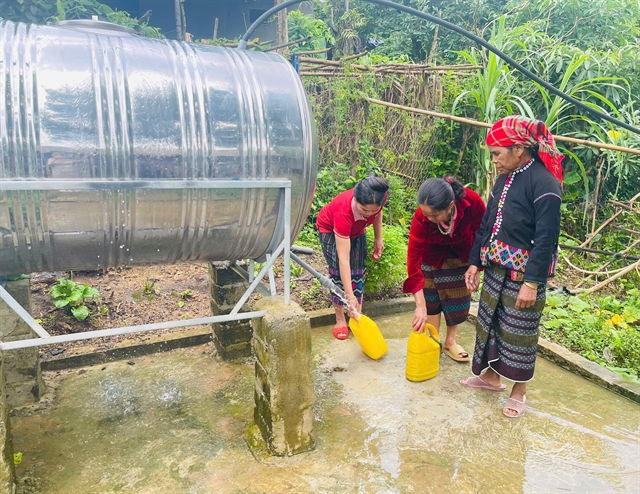
| Hồ Thị Tà Cơi (first right) and other women in Ba Tầng Village, A Dơi Commune, Quảng Trị Province find life easier with the gravity-fed water system. — VNS Photo Thu Trang |
Thu Trang
QUẢNG TRỊ — Hồ Thị Tà Cơi no longer has to travel too far to fetch clean water for her everyday life.
In the past, the 70-year-old Vân Kiều ethnic woman, like many other women in Ba Tầng Village, A Dơi Commune, Quảng Trị Province, had to walk about 500 metres to collect clean water.
“It was very hard for us, because the road was long, steep and difficult to travel," she said.
"On days with light rain we could still get some water. But on days with heavy rain, the stream water was too muddy, and we had no clean water to use.”
Since a gravity-fed water system was implemented as a micro-infrastructure model directly managed and operated by the community, lives have become much easier.
From using natural, unhygienic water sources, many households now have access to a more stable and assured water supply, contributing to improved living conditions and reducing the risk of disease.
“We now have a clean water source nearby, and can bathe, do laundry and cook. We are very happy,” Cơi said.
The gravity-fed water system falls within the framework of the 'Resilience First Programme'.
Funded by the Government of Ireland’s International Development Programme through the Embassy of Ireland in Hà Nội, the programme has been implemented by Plan International Việt Nam, CARE International in Việt Nam and the Research Centre for Community Development Initiatives (RIC).
It covers Quảng Trị, Phú Thọ and Tuyên Quang provinces, with a budget of around 1.4 million euros (US$1.6 million) per year.
In Quảng Trị, the programme has been operational since June 2022 and is expected to run until the end of September 2028, in the communes of A Dơi, Tân Lập, Lìa, Đakrông and Tà Rụt.
These are mountainous areas with large Pa Cô and Vân Kiều populations, high poverty rates and high vulnerability to natural disasters and climate change.
A highlight of the programme is its community-centred approach. Local people directly participate in identifying needs, selecting priorities, drawing up plans and operating local models.
According to Hồ Văn Cách, head of the self-management group for protecting the clean water system in Ba Tầng village, the self-management group has five members, who take turns inspecting and maintaining the facility.
“With the gravity-fed water system, villagers save travel time, life is less arduous, so everyone warmly welcomes it and feels very encouraged,” Cách said.
To date, the programme has supported 130 households to improve their livelihoods and enhance their resilience to climate change; 7,405 people have benefited from 42 climate-adaptation micro-infrastructure projects; and 19 schools have implemented safe and climate-adaptive school activities.
“The programme not only contributes to improving livelihoods and enhancing climate resilience for people in disadvantaged areas, but also creates conditions for communities to participate more proactively in the local development process,” Cách said.
Raising awareness
|
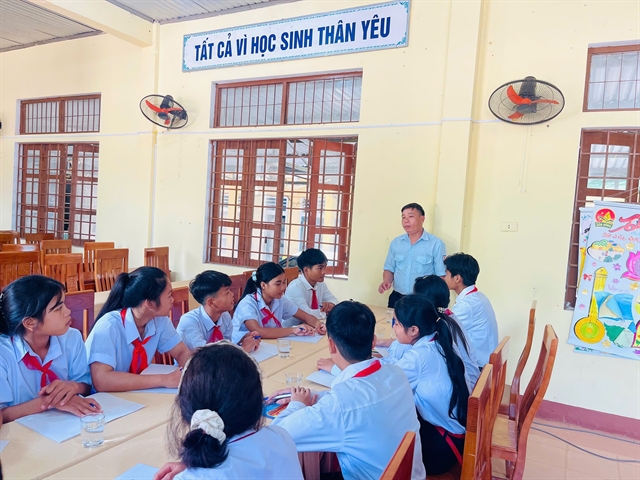
| Teacher Hồ Sĩ Phong guides a young leaders’ club with communication session on climate change at the Ba Tầng Ethnic Groups Boarding Primary and Junior Secondary School. — VNS Photo Thu Trang |
In A Dơi Commune, the Ba Tầng Ethnic Groups Boarding Primary and Junior Secondary School is one of 19 schools where safe and climate-adaptive school activities are being implemented – part of the Resilience First programme.
Many climate-adaptation initiatives, such as the Young Leaders Club and a waste-sorting model, are being effectively rolled out.
Nguyễn Xuân Bốn, vice-principal of the school, said that through the programme’s support, the school had raised awareness and skills among students.
“Teachers are very happy that the students are increasingly taking the initiative to participate in environmental protection, disaster response, and are becoming active ‘climate ambassadors’ within their families and communities,” Bốn said.
Quảng Trị’s climate is very harsh. The dry season is prolonged, while the rainy season occurs from August to December, with continuous rain.
It may be an interaction between the climates of Việt Nam and Laos, and this area is like a valley where clouds and rain accumulate. The daily activities of students as well as the economic livelihoods of local people face many difficulties.
Through the accompaniment of the Resilience First Programme, the school has built models for students to participate in activities. In particular, there is the experiential vegetable garden model, the waste-treatment model, and a circular model in which organic waste is turned into compost to care for plants in the nursery garden.
“The results obtained from the experiential vegetable garden mean that boarding students now have a supply of clean vegetables for daily use,” Bốn said.
“The knowledge that students learn through the young leaders’ clubs and through communication sessions on climate change gives students better experience and enables them to apply theory to the practice of activity models. That is a benefit the school highly values.”
Hồ Thị Ngoan, a Grade 9 student, said that previously she thought climate change wasn't a problem and that littering did not have any impact.
“After teachers guided and advised us, I realised that what I had done before was quite wrong," Ngoan said.
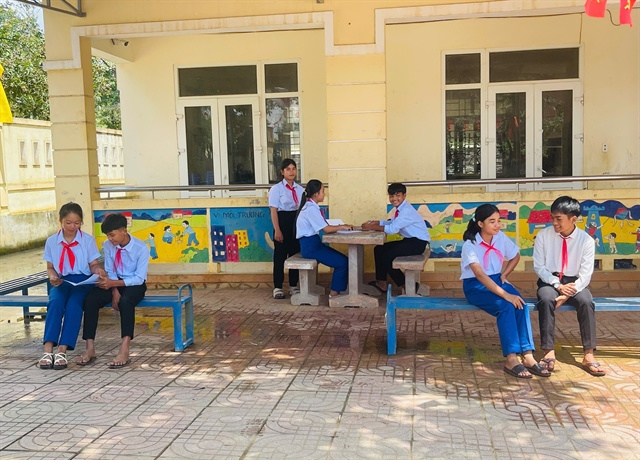
"I understand how important protecting the environment is. When we want to protect the environment, we must plant more trees and dispose of waste properly, sort our rubbish – for example, plastic waste is collected and sold to support students in difficult circumstances; organic waste such as leftover plants and vegetables is, under teachers’ guidance, put into pits to compost for 28 to 30 days to make fertiliser for the vegetable garden.”
Hồ Sĩ Phong, the teacher in charge of the Young Pioneers at the school, said that running the young leaders’ clubs at the school had brought high effectiveness.
“Through this club, students gain more knowledge and greater confidence," Phong said.
"In particular, they also become volunteers for the school and for the Pioneers’ Union. After participating in the club, they return to act as a bridge and pass on what they have learned to their classmates and other students in the school.
"This creates a very strong ripple effect, helping the school develop more students who will later become communicators.”
|
| Students hold discussions about rubbish classification at the Ba Tầng Ethnic Groups Boarding Primary and Junior Secondary School. — VNS Photo Thu Trang |
Long-term development
According to Lê Quỳnh Lan, country director of Plan International Việt Nam, at present, people in mountainous areas are simultaneously affected by multiple challenges such as natural disasters, climate change and global economic fluctuations.
The Government of Ireland is not only supporting long-term development programmes, but also standing with local people to overcome the aftermath of natural disasters and stabilise their lives.
Quảng Trị Province has also been gradually shaping appropriate directions for climate adaptation, helping people gain more opportunities to stabilise their lives.
Nguyễn Hồng Phương, deputy director of the Quảng Trị Department of Agriculture and Environment, said that Quảng Trị had been one of the localities most severely affected by climate change in the central region.
“In the province, most agricultural production remains small-scale, and many mountainous areas are still ‘lagging behind’ in terms of digital infrastructure,” she said.
"The accompaniment of international organisations, especially the Government and people of Ireland, is of great significance for the province’s development process.
“The support is not limited to emergency relief or livelihoods, but also contributes to strengthening community capacity, shaping policies and advancing sustainable development goals locally,” said Phương. — VNS
Society
 Society
 Society
 Society
 Society
 Society
 Society
 Society
 Society
 Society
 Society
 Society
 Society
 Society
 Society