 Society
SBV to curb property price inflation, enforce lending rate rules
1.
 phát biểu tại buổi hội thảo.jpg)
|
| Prof. Dr Michael Schart of Friedrich Schiller University Jena, Germany, delivers a plenary presentation on foreign language learning in the era of automated translation technology at the annual International Conference on German as a Foreign Language and German Studies held in HCM City from September 11-12. — Photo Courtesy of the organisers |
HCM CITY — Around 180 scholars and language educators from Việt Nam and other nations have gathered in HCM City to discuss the opportunities and challenges posed by artificial intelligence in language education at the annual International Conference on German as a Foreign Language and German Studies.
The two-day event was organised by the Association of German Teachers in Việt Nam and the Vietnamese-German University from September 11-12.
It focused on the theme "German as a Foreign Language and German Studies in South/Southeast Asia: Teaching, Research, and Networking in the Era of Artificial Intelligence."
This marks the second time the international conference series on German as a Foreign Language and German Studies has been held in southern Việt Nam after the 2019 edition.
The foreign delegates came from Germany, Austria, Japan, South Korea, India, Thailand, Russia, and other countries.

|
| Prof. Dr René Thiele, president of the Vietnamese-German University, addresses the opening session of the annual International Conference on German as a Foreign Language and German Studies on September 11. |
In his opening remarks, Prof. Dr René Thiele, president of Vietnamese-German University, said artificial intelligence is driving profound changes in education, particularly language learning.
Current AI models can assist with translation, generate and adapt learning materials, provide personalised feedback, and expand opportunities for practical language use, he said.
These advances require new teaching methodologies, while giving educators an opportunity to reflect on the fundamental value of foreign language learning, he said.
“The insights and discussions shared by experts and teachers during this conference will provide valuable perspectives and innovative approaches to teaching and learning German.”
Arik Jahn, deputy director of the Goethe-Institut in HCM City, said AI enables teachers to personalise feedback, develop tailored learning materials, and create simulated conversational scenarios that give learners more opportunities to practise.
“However, technology cannot entirely replace human educators. Teachers play a vital role in guiding learners to use language appropriately across different cultural contexts and subtle communicative nuances.”
The consensus that “AI is a supporting tool, not a replacement for teachers” remained a central message throughout the event.
During plenary sessions, international keynote speakers examined the impact of AI on language education from multiple perspectives.
Prof Dr Michael Schart from Friedrich Schiller University Jena in Germany addressed the changing significance of language learning in an era of automated translation technology.
“AI does not diminish the value of learning foreign languages, but rather encourages educators to focus on skills that cannot easily be automated, such as critical thinking, meaningful dialogue, and intercultural competence.”
Speakers from the University of Vienna in Austria, Nanzan University in Japan and Ludwig Maximilian University in Germany presented research on integrating cultural elements into foundational language training, developing learner-centred methodologies, and exploring the relationship between language acquisition, large language models, and AI agents.
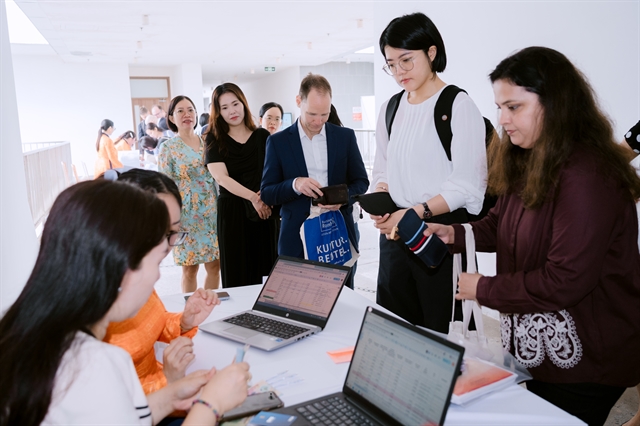
|
| International delegates and researchers complete registration at the Vietnamese-German University campus ahead of the conference sessions. |
Bridging research and classroom practice
Alongside the plenary sessions, the conference saw the tabling of nearly 50 academic papers in thematic sub-committees covering linguistics, literature and culture, translation, and German as a Foreign Language methodology.
Researchers examined the practical applications of AI, from automated error detection and assessment to literary translation, poetry, idioms, and learning-material design.
Several studies highlighted both the potential and limitations of AI in conveying cultural nuances when translating between Vietnamese and German.
Delegates from Thailand, India, and other Asian countries shared their experiences of using AI tools adapted to local educational contexts.
A key feature of the event was its focus on practical application.
Five interactive workshops were led by experts from major educational publishers and institutions on digital learning platforms, AI integration, textbook indigenisation for South and Southeast Asia, and career development for early-career educators.
Ultimately, the discussions underscored that the central question is no longer how many tasks AI can perform for teachers but how educators can best harness it to improve the quality of education.
As technology becomes increasingly sophisticated at processing language, foreign language learning remains essential to developing critical thinking, communication, and cross-cultural understanding, keeping human engagement at the heart of education. — VNS
Society
 Society
 Society
 Society
 Society
 Society
 Society
 Society
 Society
 Society
 Society
 Society
 Society
 Society
 Society