 Society
SBV to curb property price inflation, enforce lending rate rules
1.
|
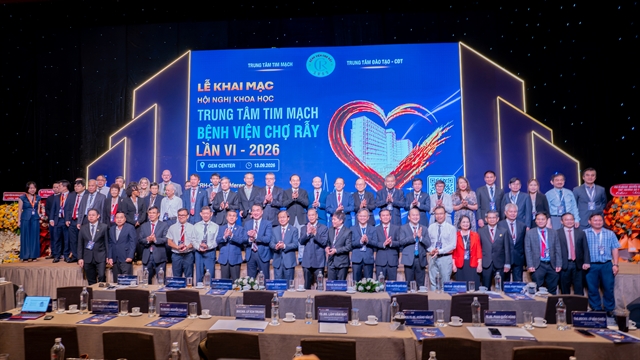
| More than 1,000 domestic and international cardiologists and healthcare experts gather at the 6th Scientific Conference of Chợ Rẫy Hospital’s Cardiovascular Centre held in HCM City on September 13. — Photo courtesy of the hospital |
HCM CITY — The latest breakthroughs and advanced technologies in cardiovascular care came under discussion at the 6th Scientific Conference of Chợ Rẫy Hospital’s Cardiovascular Centre held in HCM City on Sunday.
The annual event served as a major forum for expertise exchange and practical experience sharing, bringing together more than 1,000 domestic and international cardiologists and healthcare experts.
Speaking at the opening ceremony, Phạm Thanh Việt, director of Chợ Rẫy Hospital, said that cardiovascular diseases are the leading cause of death globally, accounting for nearly 19 million deaths each year.
In Việt Nam, an estimated 200,000 people die from cardiovascular diseases each year, representing one-third of all deaths, with three-quarters due to coronary heart disease and stroke.
He warned that cardiovascular diseases are increasingly affecting younger demographics, with a rising number of cases recorded in individuals under 30.
While patients previously received interventions only after symptoms appeared, modern medicine increasingly focused on early detection and personalised care, he said.
“Alongside advancements in science and technology, numerous modern devices and advanced techniques in cardiology are being put into practice. Consequently, the treatment of cardiovascular diseases is becoming increasingly effective,” he said.
According to Việt, Chợ Rẫy Hospital’s Cardiovascular Centre comprises seven specialised departments, creating favourable conditions to adopt advanced techniques.
The hospital is tasked by the Ministry of Health with providing professional training and technical support to healthcare facilities in the southern region.
Dr. Nguyễn Ngô Quang, director of the Administration of Science, Technology and Training under the Ministry of Health, hailed the Cardiovascular Centre for its development and significant contributions to medical examination, treatment, training, research, and the application of science and technology.
He emphasised that the presence of multi-disciplinary experts underscores the growing necessity of integrated, interdisciplinary approaches in managing cardiovascular conditions.
He hoped that the hospital would continue partnering with professional associations to host similar scientific events, providing lower-level medical facilities and healthcare personnel with opportunities to learn and adopt new techniques in cardiology.
The conference programme covered almost all fields of cardiology, featuring 200 scientific presentations delivered across 33 sessions, seven satellite symposia, and two live-demonstration cases.
It also expanded into emerging fields, including cardiovascular disease prevention, cardiovascular nutrition, minimally invasive interventions, and cardiac surgery in older adults. —VNS
Society
 Society
 Society
 Society
 Society
 Society
 Society
 Society
 Society
 Society
 Society
 Society
 Society
 Society
 Society