 Society
Việt Nam, Laos firms sign deals on property, smart farming projects
1.
|
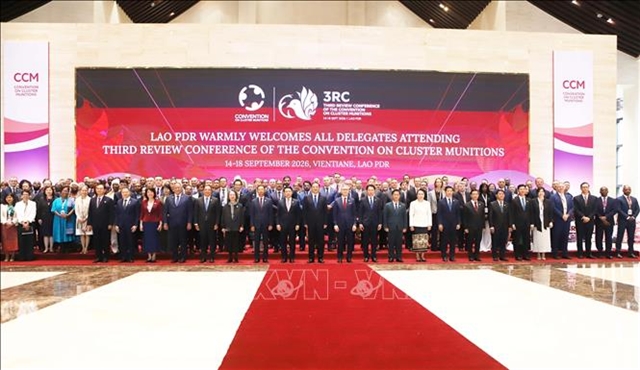
| Delegates at the Third Review Conference of the Convention on Cluster Munitions in Vientiane on Monday. VNA/VNS Photo |
VIENTIANE — Việt Nam supports the humanitarian goals of international conventions banning cluster munitions and anti-personnel mines as well as efforts to prevent their indiscriminate use, a Vietnamese official said at the Third Review Conference of the Convention on Cluster Munitions in Vientiane on Monday.
Deputy Minister of Foreign Affairs Nguyễn Thị Hoàng Vân, who led a Vietnamese delegation to the conference as an observer, said Việt Nam supports efforts to protect civilians from these weapons while respecting the legitimate right of every country to ensure national security, defence and self-defence in line with the UN Charter and international law.
She said Việt Nam has consistently promoted this position through multilateral mechanisms, including ASEAN and the United Nations.
During its two terms as a non-permanent member of the UN Security Council in 2008-2009 and 2020-2021, Việt Nam made war aftermath remediation one of the council's priorities. In April 2021, Việt Nam chaired an open debate on “Mine Action and Sustaining Peace: Stronger Partnerships for Better Delivery” and promoted the adoption of a UN Security Council presidential statement on the issue.
Sharing Việt Nam’s experience, Vân said the country has suffered heavily from wars and therefore deeply understands the pain and losses faced by countries affected by explosive remnants of war.
Around 17.61 per cent of Việt Nam’s land area, or 5.57 million hectares, remains contaminated by bombs, mines and other unexploded ordnance, she said.
Over the past five years, Việt Nam has stepped up mine action, clearing an average of 40,000 hectares a year, supporting victims and expanding risk education programmes in affected communities.
In June 2026, the Vietnamese Government adopted a national action programme for 2026-2045, setting out comprehensive measures to improve the legal framework, speed up the clearance of contaminated land and improve the lives of mine and bomb victims.
The Vietnamese delegation expressed its appreciation for the technical and financial support provided by development partners and international organisations, and called on the international community to continue prioritising resources for heavily affected countries in the region, including Việt Nam, Laos and Cambodia.
Việt Nam also praised Laos for its pioneering role in hosting the conference and expressed confidence that the Vientiane Action Plan 2027-2031 would guide joint efforts towards a safer world.
The conference, hosted by the Lao Government from September 14-18, is held under the theme “Accelerating progress towards a world free from the threat of cluster munitions”.
More than 800 delegates from over 120 countries, international organisations and regional bodies are attending the event.
Speaking at the opening, Lao Prime Minister Sonexay Siphandone stressed that millions of unexploded bombs remaining across Laos continue to threaten people’s lives and hinder socio-economic development. He called for stronger international cooperation to address the long-term humanitarian consequences of cluster munitions.
The conference is expected to adopt the Vientiane Capital Action Plan 2027-2031, focusing on three priorities: strengthening survey, clearance and risk education; providing comprehensive support for victims, including healthcare, rehabilitation, employment and social reintegration; and promoting international cooperation and predictable support for affected countries.
The conference marks 16 years since the first Meeting of States Parties to the Convention on Cluster Munitions was held in Vientiane in November 2010, when the international community adopted the first Vientiane Declaration and Vientiane Capital Action Plan. —VNA/VNS
Society
 Society
 Society
 Society
 Society
 Society
 Society
 Society
 Society
 Society
 Society
 phát biểu tại buổi hội thảo.jpg) Society
Society
 Society
 Society
 Society