 Society
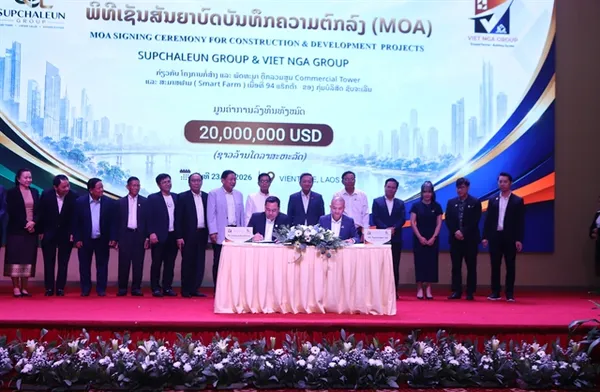
Việt Nam, Laos firms sign deals on property, smart farming projects
1.
|
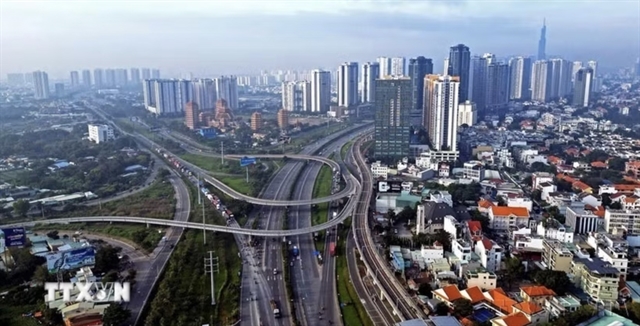
| A highway in HCM City. VNA/VNS Photo |
HÀ NỘI — The Politburo has issued a new resolution on developing regions and organising the nation's development space in the new era to boost inter-regional connectivity and take better advantage of local potential.
Resolution 27-NQ/TW notes that after more than three years of carrying out resolutions on socio-economic development, national defence and security in six regions, growth at that level has accelerated and inter-regional links have been strengthened, helping bring into play regional advantages.
However, several bottlenecks remain. Planning is still poorly coordinated, infrastructure has yet to meet requirements, economic corridors and industrial clusters have developed slowly and some growth poles have not fully played their role as drivers.
Regional connectivity also remains less effective than expected.
Against this backdrop, Resolution 27 places regional development at the centre of organising national growth, while making it a tool to restructure development space, allocate resources and enhance competitiveness.
The approach takes on particular significance following the recent restructuring of administrative units, which has expanded the scale of many localities and created better conditions for integrating urban, industrial, agricultural, marine, border gate and logistics spaces.
A key new feature of Resolution 27 is its shift from separate development by individual localities towards treating each region as an integrated ecosystem.
Under this approach, each locality will play a role based on its functions, potential and strengths, while connecting with others through value chains, infrastructure, labour, data and economic corridors.
This means that not every locality needs to develop every sector or pursue the same economic structure.
Resolution 27 identifies the development of strong, substantive and effective mechanisms for regional coordination, resource allocation and mobilisation as a key breakthrough.
For inter-regional projects, localities are expected to make decisions together, contribute capital and share responsibility and benefits.
Projects of national strategic significance must have a unified coordination mechanism and a single body responsible for implementation.
Resolution 27 therefore both introduces a new approach to development space and calls for changes in the allocation of resources, organisation of investment and assessment of growth efficiency.
When each locality makes full use of its strengths, growth poles genuinely fulfil their role as drivers and sufficiently strong coordination mechanisms connect resources, regional development space will no longer be merely the sum of individual local economies.
Instead, it will become an integrated whole capable of generating new momentum for national growth. VNS
Society
 Society
 Society
 Society
 Society
 Society
 Society
 Society
 Society
 Society
 Society
 Society
 Society
 Society
 Society