 Society

VCCI proposes revision for VAT regulations
1.
|
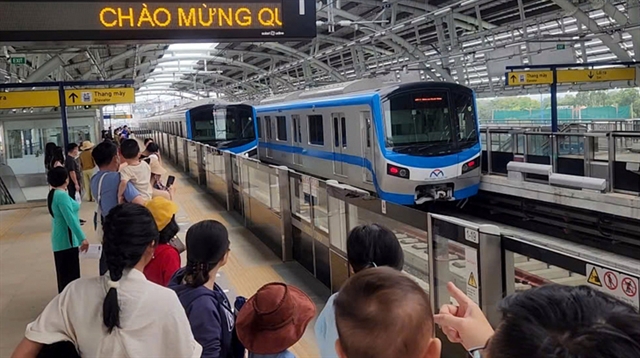
| Passengers board a train on Metro Line No. 1 in HCM City. Developing mass transit systems helps reduce reliance on private vehicles and reshape urban mobility in the city. — VNA/VNS Photos |
HCM CITY — Beyond expanding transit connectivity, HCM City is positioning its urban railway network as a spatial backbone to restructure its urban landscape, utilising Transit-Oriented Development (TOD) to transform infrastructure into a primary engine for long-term growth.
The city recently added two urban railway lines to its list of priority investments for 2026-30, bringing the total number of priority metro lines to eight with a combined length of 255 km.
This exceeds the target set in the Politburo’s Resolution No. 09-NQ/TW by 55 km, requiring breakthrough solutions to mobilise resources.
A new spatial development axis
To date, the city has commenced construction on three out of six priority projects under its previous 2026–30 portfolio.
The Steering Committee for the Development of Urban Railway Network recently agreed to add the Thủ Dầu Một – HCM City line and the Metro Line No. 2 extension (Tham Lương – An Hạ – North-West Urban Area) to the priority list for completion by 2030.
Under its master plan, the city aims to finish 255 km by 2030 and continue investing in seven additional lines to reach 532 km by 2035.
Work is being accelerated on Metro Line No. 2 (Bến Thành – Tham Lương and Bến Thành – Thủ Thiêm sections) and the Bến Thành – Cần Giờ line.
Investment procedures are also being expedited to break ground on four lines in the fourth quarter of 2026: Bình Dương New City – Suối Tiên, Phase 1 of Line 6 (Tân Sơn Nhất International Airport – Phú Hữu), Thủ Dầu Một – HCM City, and the Metro Line No. 2 extension.
Commenting on these plans, Dr Ngô Viết Nam Sơn, chairman of NgoViet Architects & Planners, said the city's target is extremely ambitious, while implementation speed remains a major challenge. Metro Line No. 1 (Bến Thành – Suối Tiên), spanning 19.7 km, took nearly 20 years to reach basic completion; meanwhile, the city now aims to complete 255 km in less than 10 years.
“TOD must be developed alongside metro lines to turn urban railways into new growth axes,” he said.
He recommended that planning, transport, finance, land, and environmental departments coordinate early to optimise land funds, site clearance, and capital, utilising digital platforms to capture added land value for public infrastructure reinvestment.
Huỳnh Văn Sinh from the HCM City Cadre Academy said this target stems from central policies, including the Politburo’s Resolution No. 31-NQ/TW, National Assembly Resolution No. 188/2025/QH15 on specific mechanisms for railway development, and the Politburo’s Resolution No. 27-NQ/TW dated August 28, 2026.
“Greater ambitions require higher accountability,” Sinh said. “Land use planning, population distribution, and land clearance capabilities must precede or proceed in parallel with infrastructure progress; otherwise, there is a risk of repeating the obstacles that delayed Metro Line No. 1 longer than originally scheduled. This is a lesson that must not be repeated on a 255-km scale.”
The HCM City Party Committee has asked the municipal People's Committee to urgently prepare a detailed plan for the eight priority projects up to 2030, while defining station locations and TOD zones for all 15 planned lines up to 2035.
|
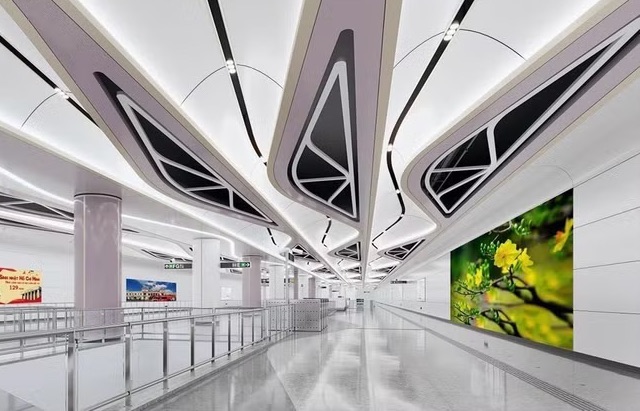
| An artist's perspective of Tao Đàn Station on Metro Line No. 2 in HCM City. The underground station is designed to integrate seamlessly with surrounding urban spaces. |
Mobilising large-scale resources
To fund 255 km of urban railways, the city will combine central and local budgets, public investment, public-private partnerships (PPP), and local bonds.
The Politburo’s Resolution No. 27-NQ/TW designates infrastructure as a strategic economic sector and calls for unlocking private capital and PPP models.
Sinh said public investment should lead main-line infrastructure, while private capital is mobilised through PPP for commercially viable stations and depots.
TOD serves as the key bridge: the State acquires clean land and provides infrastructure, while private investors develop housing and commercial services.
"This is a very clear division of labour: the State builds the infrastructure and creates clean land funds, while the private sector invests in profitable developments, with land value differentials captured to reinvest in the main metro line itself," Sinh said.
The newly passed Urban Development Law grants the HCM City People's Council authority to establish TOD policies, enabling a "using infrastructure to feed infrastructure" model.
Aligning TOD with the city’s master plan for 2021-30 with a vision to 2050 will expand urban corridors towards Thủ Đức, Bình Chánh, Hóc Môn, and Củ Chi, as well as connections to neighbouring areas like Bình Dương and Bà Rịa - Vũng Tàu.
Under Resolution No. 27-NQ/TW, HCM City is positioned as a national growth engine aiming to become an international financial hub.
Integrated metro and TOD developments are critical investments to bolster both municipal livability and long-term national competitiveness. — VNS
Society
 Society
 Society
 Society
 Society
 Society
 Society
 Society
 Society
 Society
 Society
 Society
 Society
 Society
 Society