 Society

Việt Nam, Laos firms sign deals on property, smart farming projects
1.
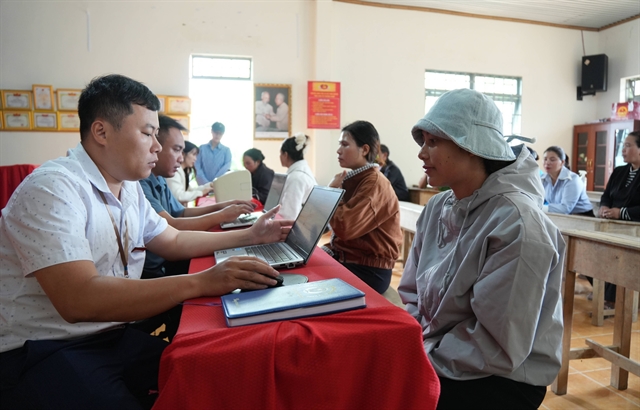 |
| Officials from Tà Năng Commune guide residents through legal and civil administrative procedures at a mobile public service centre set up in Tân Hạ Village. — VNA/VNS Photo Nguyễn Dũng |
LÂM ĐỒNG — Every Monday morning, Nguyễn Văn Tiệc gets up early and heads to the office, where he joins a group of commune officials carrying equipment to hamlets to set up mobile public administrative service points.
Tiệc is the deputy director in charge of the Tà Năng Commune Public Administrative Service Centre.
Nearly a dozen officials responsible for economics, culture, social affairs and public security, among other areas, stand ready to help hamlet residents complete administrative procedures.
Reels of electrical cable, laptops, printers and record books have become familiar items on every trip made by Tà Năng Commune’s mobile public administration team.
Tiệc explained that, as facilities vary from place to place, commune officials must bring all the necessary equipment to serve residents in remote hamlets.
“It is less difficult in the dry season. In the rainy season, it is extremely hard. This is especially true in remote hamlets far from the commune centre, such as Ma Bó and Chơ Rung, where access is difficult, infrastructure is limited and mobile signals are poor, making transactions and connectivity very challenging,” Tiệc said.
After arriving early at the cultural house in Tân Hạ Hamlet, one of Tà Năng Commune’s more remote hamlets, 56-year-old Cil Yũ K’Im eagerly waited for her turn to complete judicial and civil procedures.
While waiting, she received assistance from youth union members and volunteers, who helped check her documents and VNeID account.
After about 15 minutes of consultation and guidance from commune officials, K’Im completed the procedure to register permanent residence for a family member.
K’Im said she was pleased with the support provided by officials, which made it easier for her to complete the procedure.
In particular, setting up reception points in the hamlet meant residents no longer had to travel to the commune centre or wait in long, crowded queues. They could also finish the procedures early and return to work in their fields.
Not long ago, Ya Manh of Ma Bó Hamlet also received advice from the mobile administration team and quickly completed his application for his first land use rights certificate.
Ya Manh said his house was more than 20km from the commune centre. If residents had to make multiple trips, especially when their applications lacked documents, they would lose considerable time and effort.
Fortunately, when the mobile administration team came directly to the hamlet, officials helped him complete his application.
After years of waiting, he has now completed the procedures required to obtain a land use rights certificate.
“I am very happy. The officials provided detailed and enthusiastic guidance, and in the end, I only had to submit my application once,” Ya Manh said.
Closer relations with residents
The Tà Năng Commune People’s Committee began bringing administrative services to hamlets immediately after the two-tier local government model came into operation.
Held every Monday, the mobile administrative service rotates among the hamlets each month. On average, each session provides consultations and administrative services to about 200 residents.
The procedures most commonly carried out by residents concern personal records, judicial matters, civil status and land management.
Head of Tân Hạ Hamlet Cil K’Hạnh said that most administrative procedures were now conducted on digital platforms, but residents’ digital skills remained limited.
Having commune officials come directly to the hamlets to provide support therefore helps residents carry out procedures more smoothly.
“People are very happy, especially the elderly, vulnerable people and households that regularly work in upland fields. With commune officials coming to their localities to provide advice on administrative procedures, people do not have to travel far to the commune centre,” K’Hạnh said.
Following the local government reorganisation, Tà Năng Commune has eight hamlets and more than 13,600 residents, over 80 per cent of whom belong to ethnic minority groups.
Its large area and scattered population, particularly in remote areas and ethnic minority communities, make travel difficult. Roads are dusty in the dry season, while many sections become muddy during the rainy season, hindering residents’ access to public administrative services.
Nguyễn Vũ Linh Sang, chairman of the Tà Năng Commune People’s Committee, said the locality had brought public administrative services closer to residents because of these geographical challenges, helping them complete procedures more easily.
At the same time, closer contact with residents gives officials more time to show them how to use digital devices, provide step-by-step support and promptly address emerging needs and problems.
“Following the reorganisation, hamlet areas are larger while staffing is more limited. We are therefore continuing to expand the mobile model in coordination with Community Digital Technology Groups in the hamlets to support residents. The goal is to help people access and complete administrative procedures more quickly and conveniently,” Sang said.
In large, sparsely populated areas with significant travel difficulties such as Tà Năng, sending officials directly to residents has become a practical way to bridge the gap.
Trips to the hamlets allow officials to provide better guidance and support, enabling residents to become gradually more confident and proactive in the digital environment.
These commune officials are steadily bringing local government closer to the people, ensuring that administrative reform is felt through concrete and practical improvements in everyday life. — VNS
Society
 Society
 Society
 Society
 Society
 Society
 Society
 Society
 Society
 Society
 Society
 Society
 Society
 Society
 Society