 Sci-Tech

National conference maps out comprehensive diplomacy at new height
1.
 |
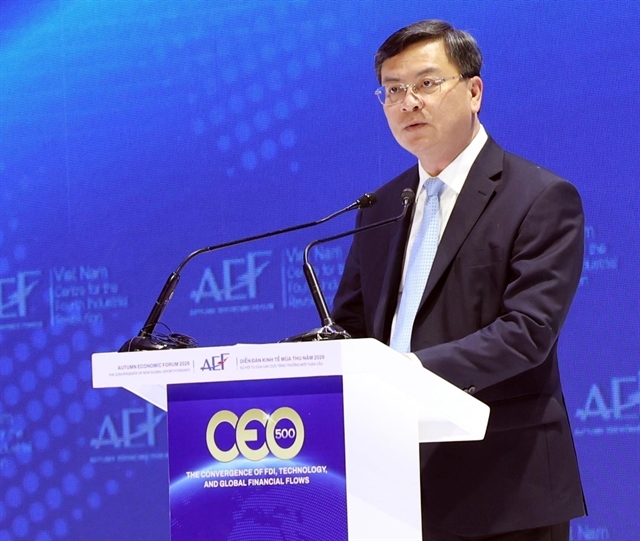
| Nguyễn Anh Tuấn, director of the Việt Nam National Multi-Project Chip Coordination Centre, speaks at the opening of the workshop. — Photos courtesy of the Ministry of Science and Technology |
HÀ NỘI — For Việt Nam, developing specialised semiconductor chips is seen as a promising way to build on existing strengths and gradually move deeper into the global semiconductor value chain.
The issue was discussed at a workshop on Challenges and Solutions for Developing Specialised Semiconductor Chips in Việt Nam held in Hà Nội on September 10, which was organised by the Việt Nam National Multi-Project Chip Coordination Centre under the Ministry of Science and Technology's Department of Information Technology Industry.
The workshop brought together experts and leading domestic and international semiconductor companies, including Geleximco and Qualcomm.
A major opportunity, but no easy path
Nguyễn Anh Tuấn, director of the Việt Nam National Multi-Project Chip Coordination Centre, said that amid increasingly intense global technology competition, the semiconductor industry is no longer simply a high-value economic sector, but has also become a foundation for technological self-reliance, national security and economic competitiveness.
Việt Nam's Government has set a clear direction in this field. Resolution 57-NQ/TW places science, technology, innovation and digital transformation at the centre of the country's strategic breakthroughs, while calling for the gradual mastery of semiconductor technologies.
The Government's Decision 1018/QĐ-TTg on the strategy for developing Việt Nam's semiconductor industry to 2030 refers to specialised chips. Decision 21/2026/QĐ-TTg further identifies semiconductor chip technology and specialised chip products as strategic technologies and products to be prioritised for development.
Turning these ambitions into reality, however, will require Việt Nam to overcome a series of barriers involving technology, markets, investment and the supporting ecosystem.
Specialised semiconductor chips are designed to perform specific tasks rather than serve as general-purpose processors. They are used in AI cameras, Internet of Things (IoT) devices, robots, unmanned aerial vehicles, telecommunications systems, power electronics, smart grids and security equipment.
Their value lies less in mass production than in their ability to optimise performance, reduce energy consumption and meet the precise requirements of individual products.
This makes specialised chips a potentially suitable area for Việt Nam, where a domestic chip design workforce has emerged alongside a strong electronics industry and sizeable markets in telecommunications, AI, electric vehicles, energy and digital transformation.
If successful, Vietnamese companies could not only increase the value added for domestic electronics products, but also gradually take control of critical stages such as chip design, verification, testing and integration, areas that account for significant value in the semiconductor supply chain.
Breaking the commercialisation deadlock
 |
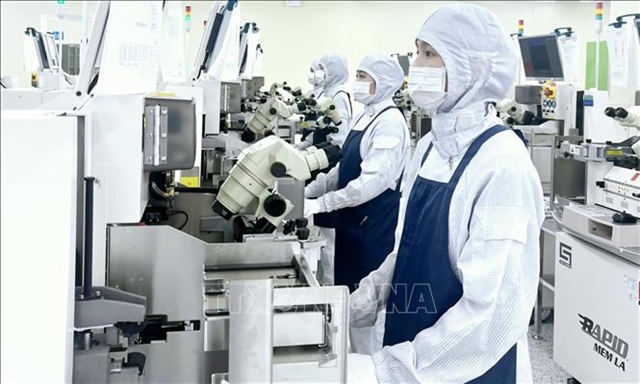
| Delegates attend a workshop on challenges and solutions for developing specialised semiconductor chips in Việt Nam. |
Despite the opportunities, the distance between a chip design and a commercially viable product remains considerable, Tuấn said.
One of the biggest challenges is the high cost of research and development (R&D). Chip designers need access to electronic design automation tools and licensed intellectual property (IP) libraries, which require substantial investment. Even a single tape-out – the process of sending a completed chip design for manufacturing – can cost millions of US dollars and carries the risk of technical failure.
The manufacturing chain presents another challenge. Việt Nam does not yet have a fully integrated ecosystem covering design, fabrication, packaging, testing and quality certification.
Companies with small orders can find it difficult to access international packaging and testing services at reasonable costs. Once a prototype is produced, software development, circuit board integration, reliability assessment and incorporation into a final product can require considerable additional time and resources.
An even more fundamental problem is the 'first customer' dilemma. Companies are reluctant to invest before securing a customer, while customers are often unwilling to purchase a chip before it has been proven in real-world applications.
This creates a cycle that can leave promising projects stuck at the research stage rather than reaching commercial production.
A shortage of highly skilled personnel is another constraint. Chip designers, testing engineers, materials specialists and packaging experts remain in short supply compared with the industry's growth, requiring long-term training programmes closely aligned with business demand.
Policy must help create the market
The most important solution is to develop a complete ecosystem rather than provide fragmented support to individual companies.
Under the Ministry of Science and Technology's development direction, a list of around 20 groups of specialised chips is expected to be issued for priority State procurement. The list will focus on areas such as AI, edge computing, next-generation telecommunications, sensors, IoT, power electronics and hardware security.
Such a list would provide companies with clearer market signals, helping them determine where to focus research and investment.
More importantly, the State plans to establish a comprehensive support programme covering research, design, pilot production, testing and commercialisation.
Rather than focusing solely on research funding, the new approach would seek to share risks with businesses during the early stages while assessing projects against specific technical outcomes.
A potentially transformative measure would be to use public investment projects, national digital-transformation programmes and major infrastructure projects as 'first customers' for Vietnamese-designed chips.
This could provide the push companies need to get through the most difficult stage of commercialisation while maintaining strict quality requirements.
At the same time, standards, testing laboratories, certification mechanisms and reliability assessments need to be developed to give Vietnamese chip products a stronger foundation for competing both domestically and internationally.
International cooperation, domestic capability
No country can achieve complete self-reliance across the entire global semiconductor value chain. What matters is developing control over critical capabilities, including system architecture, design, verification, testing data and the ability to choose partners within the supply chain.
That was also a key point highlighted by participants at the workshop.
Cooperation with major technology corporations such as Qualcomm and other international companies should therefore go beyond attracting investment. It should also provide access to knowledge, development experience, product development methodologies and advanced training.
Alongside high-quality foreign direct investment, closer links between foreign companies and Vietnamese enterprises will be essential to strengthen domestic capabilities.
At the workshop, An Chen, Qualcomm's Vice President of Technology and R&D, said the company was expanding its R&D centres in Việt Nam to bring together four areas: AI, semiconductors, software and systems engineering.
Rather than focusing solely on contract manufacturing, Qualcomm aims to help train engineers capable of mastering the end-to-end integrated circuit design process, from front-end architecture and logic to back-end layout and tape-out, with the longer-term goal of developing the capability to design complex systems-on-chip.
Geleximco, meanwhile, is advancing investment procedures for a chip manufacturing plant in Hưng Yên, with construction expected to begin in November and commercial products targeted for early 2028.
The group has pledged to prioritise the testing and integration of control chips, sensors and power chips designed by Vietnamese engineers into its electric vehicles and broader industrial ecosystem.
Such an approach could help address the 'first customer' problem facing domestic chip developers by creating real-world applications for locally designed components.
Another key link in the ecosystem will be the Việt Nam National Multi-Project Chip Coordination Centre, which will provide shared infrastructure for design tools and IP libraries, laboratories, pilot manufacturing and testing, while connecting chip-design companies with manufacturers of end products.
The centre is expected to significantly reduce the cost, risk and time required to take a chip from the laboratory to the market.
The development of Việt Nam's semiconductor industry will undoubtedly remain challenging. But with a clear direction, stronger policies and coordinated support from the State, businesses and international partners, specialised chips could become a high-value sector, strengthening technological self-reliance and helping Việt Nam move further up the global semiconductor value chain. — VNS
Sci-Tech
 Sci-Tech
 Sci-Tech
 Sci-Tech
 Sci-Tech
 Sci-Tech
 Sci-Tech
 Sci-Tech
 Sci-Tech
 Sci-Tech
 Sci-Tech
 Sci-Tech
 Sci-Tech
 Sci-Tech
 Sci-Tech