 Business Beat

SBV to curb property price inflation, enforce lending rate rules
1.
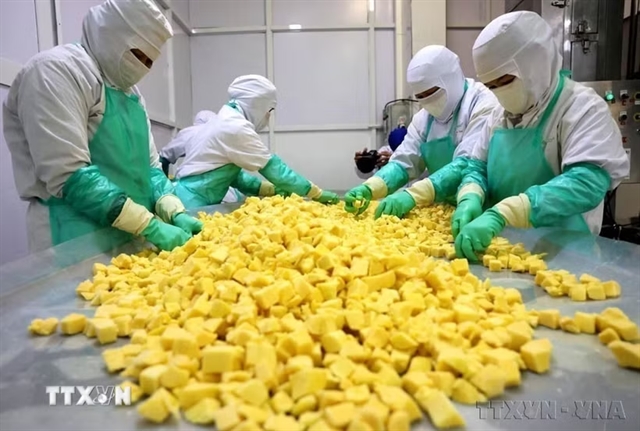 |
| Mangoes are sorted before being packed at the plant of An Giang Fruit-Vegetables & Foodstuff Joint Stock Company (ANTESCO) in An Giang Province, for export to Australia as well as North American, European and Asian markets. — VNA/VNS Photo |
Compiled by Yến Vy
As the European Union (EU) continues to tighten and update its regulations, Vietnamese businesses and producers are increasingly required to adapt proactively, starting at the production stage.
The EU is an important export market for Việt Nam’s agricultural, forestry and fishery products, offering significant advantages under the EU-Vietnam Free Trade Agreement (EVFTA).
However, it is also a highly demanding market, with stringent requirements on food safety, pesticide residue levels, animal and plant quarantine, and import conditions.
According to Ngô Xuân Nam, deputy director of the Vietnam SPS, the EU maintains stringent regulations on maximum residue levels (MRLs) for pesticides.
The EU has issued around 90 notifications concerning changes to food safety regulations since the beginning of this year.
More recently, it issued seven notifications on adjustments to maximum residue levels for a range of active substances. Several substances currently permitted for use in Việt Nam could see their allowable residue levels reduced to as low as 0.01–0.05 parts per million (ppm).
The changes directly affect a number of Vietnamese products that are widely exported to the EU, including chili peppers, bell peppers, mangoes, tea, coffee and peppercorns. Lower MRLs could therefore have a direct impact on production practices and exporters’ ability to meet EU requirements.
Nam noted that two of the active substances covered by the seven latest EU notifications are currently permitted for use in Việt Nam. While Vietnamese regulations may allow residue levels of up to 10 ppm, the EU is expected to impose limits of just 0.01–0.05 ppm for certain products, including mangoes and tomatoes.
Meeting domestic regulations, therefore, does not necessarily mean that a product complies with EU requirements.
Exporters must ensure compliance throughout the production process, from selecting appropriate active substances and determining application rates and timing to observing pre-harvest intervals, so that products meet the MRLs of the destination market.
The new EU regulations are expected to be published on March 1 next year, and take effect 20 days later. Việt Nam will have roughly six months to prepare and adjust production and control procedures. This is a relatively short timeframe, particularly for commodities with long production cycles.
Việt Nam currently has four product groups subject to EU border-control frequency requirements including bell peppers, dragon fruit, durian and okra. The EU reviews the inspection frequency for each product group and country every six months.
The EU has also published a list of groups of harmful organisms that are subject to border controls. Fruit flies, for example, have been detected in Vietnamese pomelos. The Vietnam SPS has recommended that relevant authorities and businesses strengthen pest-control measures at production areas if they are to expand exports of this product.
The EU, at the same time, is reducing border checks on certain processed foods considered to pose a low level of risk, including processed cereals, French fries, processed fruit and vegetables, and sauces. This could create opportunities for Vietnamese businesses to increase the share of processed products in their exports, Nam said.
Proactive adaptation key to maintain market access
According to Trần Văn Công, agricultural counselor at the Vietnamese mission to the EU, the EU imports around US$35 billion worth of agricultural, forestry and fishery products annually and is one of Việt Nam’s three largest markets for these product groups.
While most tariff lines under the EVFTA have essentially been reduced, giving Vietnamese goods a significant advantage in accessing the European market, tariff preferences alone cannot be fully leveraged unless products meet increasingly stringent food safety and quarantine requirements, he said.
For products of animal origin, the EU continues to adjust residue limits for certain substances and regulations governing the list of products eligible for import. Việt Nam is currently working to secure greater access to the EU market for meat, milk and dairy products, eggs and egg products, in addition to product groups that have already been approved for export.
Notably, the EU is preparing to roll out the electronic system for agricultural non-customs formalities (ELAN), which is expected to be fully implemented in 2028.
The system is designed to digitalise the issuance, management and verification of non-customs documentation, enabling real-time verification, reducing the use of paper documents and potentially shortening customs clearance times.
To ensure compatibility with ELAN, Việt Nam has approximately 18 months to accelerate the digitalisation of agricultural data and standardise documentation and management procedures.
Updates to EU regulations need to be addressed in a coordinated manner by regulators, businesses and producers, said Công.
Companies should not only understand the rules currently in force but also closely monitor upcoming changes so they have sufficient time to adjust their operations, he added.
The situation calls for a shift from a mindset of “inspection for export” to “control for export-compliant production.” For commodities facing high risks from pesticide residues or harmful organisms, controls need to begin at the production area, with proper use of agricultural inputs, traceability and pre-harvest monitoring.
The EU’s continuous tightening of standards presents challenges but also encourages Việt Nam’s agricultural sector to improve quality and reorganise production toward greater transparency, safety and sustainability.
Proactively monitoring regulatory changes, adjusting production practices and accelerating digitalisation will be critical for Vietnamese agricultural products to maintain their market share, maximise the benefits of the EVFTA and expand their presence in the EU market. — VNS
Business Beat
 Business Beat
 Business Beat
 Business Beat
.jpg) Business Beat
Business Beat
 Business Beat
 Business Beat
 Business Beat
 Business Beat
 Business Beat
 Business Beat
 Business Beat
 Business Beat
 Business Beat
 Business Beat