 Business Beat



Việt Nam, China seek stronger substantive parliamentary cooperation
1.
 |
| Customers at a Vietcombank branch in HCM City. — VNA/VNS Photo |
Compiled by Lê Văn Châu
HCM CITY — After a prolonged period at low levels, lending rates at banks have begun to edge up again, placing a heavier burden on borrowers, both individuals and businesses.
Amid ongoing tensions in the Middle East, which have driven up logistics and input costs for manufacturers, rising capital costs are further amplifying financial pressure, forcing many firms to stretch resources to sustain operations.
After one year at a preferential interest rate, a mortgage taken by Nguyễn Thanh and his wife in HCM City’s Tân Phú Ward from a bank shifted to a floating rate in November 2025.
While the rate had previously stood at 6.9 per cent, it rose to 11.9 per cent following the adjustment. Three months later, it was revised again to 12.8 per cent.
The rapid increase in borrowing costs within a short period has raised concerns for the couple, especially as interest rates may continue to trend upward.
The pressure is not limited to retail borrowers; manufacturing enterprises are also facing similar challenges as lending rates are being adjusted upward across the board.
Nguyễn Đình Tùng, general director of Vina T&T Group, said tensions in the Middle East are having serious repercussions for agricultural exports, particularly supply chain disruptions and sharp increases in maritime transport costs.
At the same time, businesses are also grappling with rising bank lending rates and higher input costs, he said.
The market had already recorded tighter credit limits by the end of 2025, and lending rates have continued to rise since early this year, he said.
Loans that previously carried interest rate of around 6 per cent are now at 8 per cent, and are likely to rise further.
Phùng Quốc Mẫn, chairman of the Handicraft and Wood Industry Association of HCM City (HAWA), said the interest rate pressure is brutal.
Lending rates for businesses are 11-12 per cent while previously they could borrow at 6-7 per cent.
HAWA officials said this poses a challenge to businesses.
Policymakers should consider appropriate measures to help enterprises access funds at more reasonable costs to ensure production and business activities remain unaffected, he said.
The surge in logistics costs has driven up input prices across supply chains, magnifying the financial pressure.
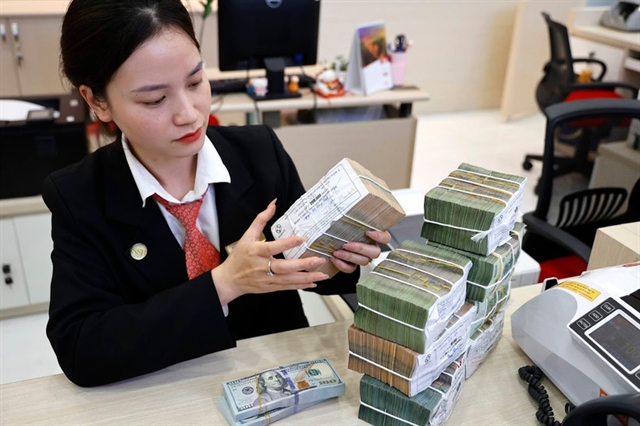 |
| Businesses face growing difficulty in accessing affordable loans amid sharply rising lending rates. — Photo vietnamplus.vn |
When capital demand becomes the key driver
Đinh Đức Quang, director of financial markets at UOB Việt Nam, said the upward trend in interest rates began in the third quarter of 2025 across both the interbank and deposit markets.
This has been driven by strong credit demand, he said.
He added that liquidity has also been affected by other factors, notably foreign investors’ selloff in the stock market through 2025 and early 2026, leading to capital outflows.
Besides, stricter revenue management policies for household businesses and individuals have begun to affect money circulation in the banking system, and requires time to adjust.
Huỳnh Duy Sang, director of financial markets at Asia Commercial Joint Stock Bank, said current interest rate movements mainly reflect strong credit demand rather than the liquidity stress seen in 2022, when the market was affected by disruptions linked to corporate bonds.
The key requirement now is to control credit flows to ensure funds are directed towards production activities and priority sectors and not speculative activities, he said.
Proper allocation of capital would help curb interest rate spikes and support overall market stability, he said.
In practice, the quarterly management of credit growth and a stronger focus on credit quality in recent years suggest that regulators are moving in the right direction, he said.
When capital flows are properly controlled and channelled into productive sectors, interest rates will have more room to stabilise.
More importantly, after a prolonged period of monetary easing, there is limited room to maintain low interest rates, particularly amid global economic uncertainties.
Policymaking must therefore balance growth objectives with inflation and exchange rate considerations.
Phạm Hồng Hải, general director of Orient Commercial Joint Stock Bank, said the current lending rate pressures also stem from rising funding costs, but noted that current fluctuations may be seasonal.
As public investment disbursement accelerates and capital returns to the economy, systemic liquidity is expected to improve, easing pressure on interest rates and exchange rates, particularly in the second half of the year.
External factors, if they ease in the near term, could also help reduce pressure on inflation, interest rates and exchange rates.
The key challenge for policymakers in the coming period is not only to maintain reasonable interest rates, but also to allocate capital efficiently, ensuring both economic growth and stability. — VNS
Business Beat
 Business Beat
 Business Beat
 Business Beat
.jpg) Business Beat
Business Beat
 Business Beat
 Business Beat
 Business Beat
 Business Beat
 Business Beat
 Business Beat
 Business Beat
 Business Beat
 Business Beat
 Business Beat