 Business Beat



Sorry, Tây Hồ, technically
1.
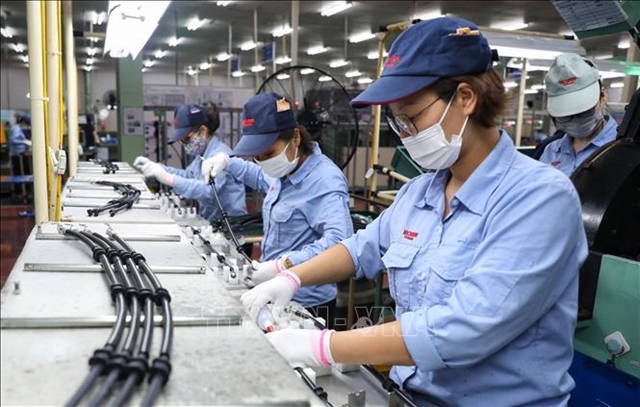 |
| Workers at a manufacturing plant in Việt Nam. Industrial production continues to underpin economic growth in many localities. — VNA/VNS Photo |
Compiled by Mai Hương
A new growth race is taking shape across Việt Nam, but this time it is not just about which province expands the fastest.
The latest gross regional domestic product (GRDP) figures reveal a deeper shift in the way the country is managing its economy, with localities increasingly expected to become independent growth engines rather than simply implementing centrally assigned policies.
In the first half of 2026, nine out of 34 provinces and cities recorded GRDP growth of more than 10 per cent, showing strong momentum among localities with industrial advantages, modern infrastructure, expanding investment, rising export and recovering tourism.
Hà Tĩnh led the country with growth of 12.79 per cent, followed by Ninh Bình at 11.44 per cent, Hải Phòng at 11.33 per cent and Quảng Ninh at 11.11 per cent.
Hưng Yên, Bắc Ninh, Phú Thọ, Tây Ninh and Thái Nguyên also joined the double-digit growth group, mainly driven by manufacturing, industrial production, infrastructure development and new investment projects.
The performance gap among localities, however, has become increasingly visible.
While industrial centres continued to accelerate, provinces that rely heavily on agriculture or traditional industries faced more pressure from weather conditions, input costs, market fluctuations and the absence of large-scale investment projects.
The country’s two biggest economic hubs continued to provide a stable foundation for overall growth.
HCM City expanded by 8.55 per cent in the first six months and contributed nearly 22 per cent to national GDP growth, while Hà Nội grew by 8.22 per cent and contributed 11.7 per cent.
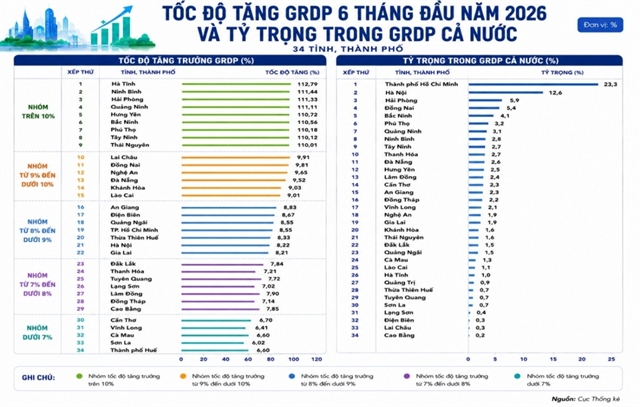 |
| An infographic shows GRDP growth rates and the contribution of Việt Nam's 34 provinces and cities to the national economy in the first half of 2026. — Source: National Statistics Office |
Beyond the numbers, economists say the latest GRDP results highlight a more important trend: Việt Nam is moving towards a new model of economic governance where growth responsibility is becoming more clearly defined at the local level.
The Government recently issued Resolution No 168/NQ-CP and Resolution No 169/NQ-CP, updating growth scenarios and assigning specific targets to provinces and cities following the restructuring of administrative units.
The new approach requires local authorities to build monthly and quarterly growth scenarios, identify new drivers and address bottlenecks instead of relying only on traditional advantages.
For the first time, growth management has been linked to a broader accountability framework, covering not only GRDP expansion but also income levels, the digital economy, innovation capacity, labour productivity, human development and environmental indicators.
Economists describe this as a transition from a target-setting mechanism to a more performance-based governance model.
Associate Professor Nguyễn Thường Lạng from the National Economics University said the move reflected a more flexible approach to economic management, allowing targets to be adjusted according to each locality’s capacity and development potential.
“Localities will have to actively seek new growth drivers and maximise their own advantages," he said.
"When responsibility is quantified, management will become more decisive and more effective."
Significant timing
The restructuring of administrative boundaries has created larger development spaces for many provinces, opening opportunities to form stronger industrial clusters, improve regional connectivity and attract higher-quality investment.
For business communities, this could create a new wave of competition among localities – not only in attracting foreign direct investment but also in improving administrative efficiency, infrastructure and support for private enterprises.
Đậu Anh Tuấn, deputy secretary-general of the Vietnam Chamber of Commerce and Industry (VCCI), said larger administrative units offered advantages in terms of market scale and economic linkages, but they also required a different approach to supporting businesses.
Digital transformation in public services, faster administrative procedures and closer engagement with enterprises would become increasingly important, especially for small- and medium-sized businesses, he said.
According to Tuấn, the effectiveness of the new growth model will depend largely on implementation at the grassroots level, where companies interact most frequently with local authorities.
“Businesses and household businesses work with commune and ward authorities more often than with provincial leaders," he said.
"Therefore, service quality and the spirit of supporting businesses at the grassroots level will determine how effectively policies are brought into reality."
However, experts warn that turning growth targets into reality will not be easy.
Lê Duy Bình, director of Economica Vietnam, said GRDP growth should not become the only measure of local success.
While higher growth remains important, he said the ultimate objective should be improving growth quality and ensuring long-term sustainability.
A comprehensive evaluation system should also consider the quality of the investment environment, private sector development, infrastructure, human resources, public services, healthcare, education and environmental standards.
 |
| Students attend an information technology class at Lạng Sơn Ethnic Minority Boarding High School. — VNA/VNS Photo Anh Tuấn |
According to experts, the biggest challenge for the new governance model lies in implementation capacity.
Many localities still lack strong data systems and analytical tools needed to build realistic growth scenarios.
Another challenge is regional coordination. Growth cannot be viewed as the responsibility of individual provinces alone. Without effective coordination mechanisms, competition among localities could lead to fragmented investment and inefficient use of resources.
The third risk is excessive focus on short-term targets.
Experts warn that pressure to achieve high GRDP numbers could encourage some localities to prioritise rapid expansion over productivity, innovation and sustainability.
That means Việt Nam’s new growth strategy will require not only ambitious targets but also stronger monitoring systems and better policy execution.
The message from the Government’s latest resolutions is that every locality must accelerate. But in the next phase of development, the winners of the provincial growth race may not simply be those with the highest GRDP figures.
They will be the localities capable of building better institutions, creating a more favourable business environment, attracting quality investment and turning economic expansion into sustainable prosperity. — VNS
Business Beat
 Business Beat
 Business Beat
 Business Beat
 Business Beat
.jpg) Business Beat
Business Beat
 Business Beat
 Business Beat
 Business Beat
 Business Beat
 Business Beat
 Business Beat
 Business Beat
 Business Beat
 Business Beat