 Business Beat



Int’l cooperation helps address nuclear power workforce shortages
1.
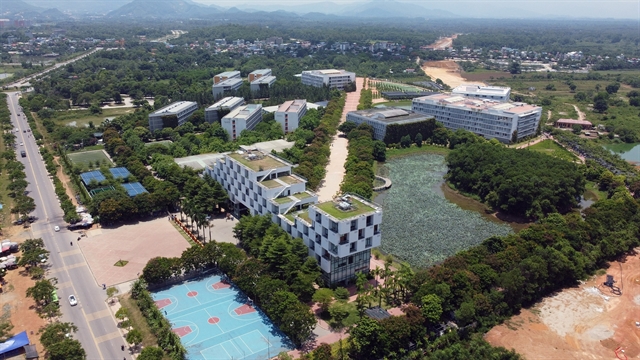 |
| A corner of Hoà Lạc Hi-Tech Park, Hà Nội. Hà Nội has introduced a regulatory sandbox framework that allows new technologies, products, services and business models to be tested in a controlled environment. — VNA/VNS Photo Huy Hùng |
Compiled by Mai Linh
HÀ NỘI — Hà Nội has unveiled a sweeping package of incentives, including regulatory sandboxes and funding covering up to 100 per cent of eligible costs, as the capital accelerates efforts to turn science, technology and innovation into major engines of economic growth.
The move forms part of the city's ambition to sustain double-digit growth and raise per capita income to US$12,000-13,000 by 2030 by building a more knowledge-based and technology-driven economy.
The effort took a major step forward on June 2 when the municipal People's Council approved four resolutions aimed at tackling longstanding regulatory, financial and infrastructure barriers that have constrained the city's innovation ecosystem and slowed the commercial application of scientific research.
The package of preferential policies comes as city leaders seek stronger contributions from science, technology and innovation to support Hà Nội's long-term development goals.
“The preferential policies aim to create favourable conditions for universities, research institutes, businesses, investors and intermediary organisations to participate in the innovation ecosystem,” said Cù Ngọc Trang, director of Hà Nội's Department of Science and Technology.
At the heart of the package is a regulatory sandbox framework that will allow new technologies, products, services and business models to be tested in a controlled environment.
Many technology initiatives have struggled to move from development to commercial application as regulations have not kept pace with rapid technological advances, creating uncertainty for businesses and investors.
Under the new framework, Hà Nội will establish clear criteria covering participation, testing periods, approval procedures and risk-monitoring mechanisms, alongside processes for approving, extending, modifying or terminating pilot programmes based on performance and compliance.
Projects accepted into the sandbox may receive financial support covering between 50 per cent and 100 per cent of eligible costs. Participants will also gain access to public data, infrastructure and assets required for testing and development.
Municipal authorities said the framework is expected to create a more flexible regulatory environment in which innovative ideas can demonstrate their effectiveness before wider deployment.
One of the most notable incentives allows successful pilot projects to receive priority consideration for public procurement contracts, government orders and state-funded assignments.
Analysts said the mechanism could help narrow the gap between research and commercialisation, a challenge that has long limited the economic impact of scientific research in Việt Nam.
Alongside the sandbox framework, the city also approved policies to support scientific and technological infrastructure, innovation facilities and digital transformation projects.
Despite hosting around 2,300 science and technology organisations, 221 science and technology enterprises, 14 national key laboratories and more than 65 per cent of the country's leading scientists, Hà Nội continues to face gaps in research, testing and technology-transfer infrastructure, which remains fragmented and unevenly developed.
To address the issue, the city will provide support covering between 30 per cent and 100 per cent of investment, upgrade and operating costs during the first three years for qualifying facilities. Organisations involved in science, technology and digital transformation projects will also gain access to preferential lending programmes.
City authorities expect the incentives to encourage the development of shared research laboratories, testing centres, incubators, technology exchanges and digital platforms while reducing costs for businesses seeking research and evaluation services, particularly small and medium-sized enterprises (SMEs) and start-ups.
From research to market
 |
| Training at Hà Nội College of High Technology. Hà Nội has introduced referential policies to create favourable conditions for universities, research institutes, businesses, investors and intermediary organisations to participate in the innovation ecosystem. — VNA/VNS Photo Diệu Thuý |
While the first two resolutions focus on improving the regulatory environment and strengthening innovation infrastructure, another seeks to address a longstanding challenge in Việt Nam's research sector: turning scientific discoveries into commercial and practical applications.
The new framework places greater emphasis on research outcomes and real-world impact.
Under the policy, Hà Nội will expand the scope for direct assignment of key science and technology projects beyond existing national regulations, giving the city greater flexibility to support initiatives aligned with local development priorities.
Projects proposed by businesses that provide matching funds of at least 50 per cent, or those that address major challenges facing the city using technologies developed and owned by the businesses themselves, may be eligible for direct assignment.
The city will provide support covering up to 100 per cent of the costs of purchasing, leasing and operating equipment used in priority science and technology projects.
The city is also introducing a results-based funding mechanism under which research organisations will be allowed to retain unspent portions of allocated funding after successfully completing projects, rather than returning the remaining budget to the State.
Officials said the mechanism is intended to provide greater flexibility in resource management while encouraging more efficient use of research funding.
The resolution also addresses the issue of research results that remain unused after completion. Scientific outputs that are not being utilised may be transferred without compensation to organisations capable of applying them, helping to ensure publicly funded research delivers broader economic and social benefits.
In addition, Hà Nội will cover up to 50 per cent of technology transfer costs in priority sectors, a measure expected to encourage businesses to adopt new technologies and accelerate the commercialisation of research outcomes.
City authorities said the measures would help shorten the journey from laboratory research to market application while reducing the number of completed projects that fail to progress beyond the pilot stage.
The fourth resolution establishes a framework governing expenditure norms for science, technology and innovation activities financed through the city budget. The framework creates a unified spending system across municipal and local levels, providing a clearer legal basis for budgeting, implementation and financial oversight.
Commenting on the city's draft science, technology and innovation plan for 2026-30 at a workshop on June 3, Lê Xuân Rao, chairman of the Hà Nội Union of Science and Technology Associations, said Hà Nội continues to face significant challenges, including traffic congestion, environmental pollution, population pressures, infrastructure constraints and labour productivity that has yet to match the city's potential.
It is critical for Hà Nội to focus science and innovation efforts on addressing major urban challenges such as traffic congestion, environmental pollution and digital transformation while identifying strategic technologies and flagship sectors where the city holds competitive advantages, such as artificial intelligence, semiconductors, biotechnology and environmental technologies, Rao said.
Tô Duy Phương, chairman of the Hà Nội Foundry and Metallurgy Association, said the capital should prioritise strategic industries capable of generating breakthrough growth rather than spreading resources too thinly across multiple sectors.
He also called on the city to provide stronger support for scientists, entrepreneurs and technology firms pursuing innovative projects while expanding venture capital funds and increasing research orders linked to market demand and production needs. — VNS
Business Beat
 Business Beat
 Business Beat
 Business Beat
.jpg) Business Beat
Business Beat
 Business Beat
 Business Beat
 Business Beat
 Business Beat
 Business Beat
 Business Beat
 Business Beat
 Business Beat
 Business Beat
 Business Beat