 Business Beat


SCEX completes level 4 information system security assessment, moving closer to official operations
1.
|
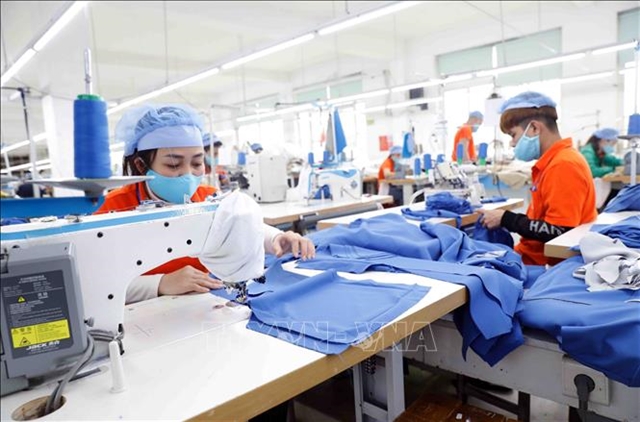
| The US’s new policy, effective from July 24 this year, has altered the competitive landscape in the global textile and garment supply chain. — VNA/VNS Photo |
Compiled by Thu Hà
Exporters of key industries are shifting from reactive to proactive approaches, preparing for multiple scenarios to readily adapt to changing circumstances of the global trade to maintain market share and sustain export momentum.
General Director of the Vietnam Textile and Garment Group (Vinatex) Cao Hữu Hiếu has directed Vinatex’s member companies to be ready to operate in many scenarios regarding orders, raw materials, exchange rates, and logistics for the last five months of 2026, instead of only a single scenario.
According to Hiếu, as the export landscape has changed, businesses can no longer operate according to a fixed plan. Preparing for multiple scenarios is no longer an option, but a condition for retaining orders and market share.
This is because multiple changes are occurring simultaneously. Trade policies are constantly shifting; logistics costs remain high; exchange rates and raw material prices are volatile; while purchasing power in many major markets is recovering slower than expected. Retaining orders is difficult, but maintaining profitability is even more challenging.
In particular, he noted, the additional tariffs under Section 301 of the US are creating a significant variable. According to Vinatex, the US’s new policy, effective from July 24 this year, has altered the competitive landscape in the global textile and garment supply chain.
Besides the tariff, businesses must also consider MFN tariffs, additional tariffs, the origin of raw materials, and shifting order trends.
Notably, while retail clothing sales in the US increased slightly, import value decreased, and inventory levels remained almost unchanged, indicating that actual purchasing power has not yet recovered.
In the last five months of the year, businesses need to closely monitor order developments, raw materials, exchange rates, and logistics; proactively secure supply sources, control inventory, prioritise high-value orders, and prepare orders for 2027, he said.
Given this situation, competitive advantages must be reassessed in each industry and at each link in the value chain. Therefore, Hiếu said that Vinatex requires its market researchers to precede business operations. All analyses must be translated into decisions about the market, customers, products, and pricing. Businesses must thoroughly understand each segment and the sensitivity of demand to price.
And this is no longer just the story of the textile industry. Other key export sectors, from seafood and wood to agricultural products are all having to adjust their strategies. A rapid adaptation is considered a key to maintain market share, sustain growth and lay the foundation for 2027.
Lê Hằng, deputy secretary general of the Vietnam Association of Seafood Exporters and Producers, believes that the most important thing now is no longer price competition, but the ability to adapt.
According to Hằng, in the short term, export businesses will inevitably have to share some of the tariff costs with importers, while also facing greater pressure in order competition. However, in the medium and long term, Việt Nam's seafood advantage will no longer be primarily determined by import tariffs.
Instead, the capacity for deep processing, development of value-added products, compliance with labour, environmental, and traceability standards, and the ability to adapt to new trade policies will be the decisive factors.
“The additional tariffs under the Section 301 will certainly make the competitive environment in the US market more intense. But as competitors also face their own challenges, opportunities still belong to businesses that adapt quickly, proactively restructure their markets, and invest in value-added products,” Hằng said.
Facing similar pressures, the wood industry is also changing its approach. For many years, the advantage of wood exporting businesses mainly came from production capacity and competitive costs. But in the face of new fluctuations in the international market, the current challenge has expanded to building a sustainable supply chain and increasing the value of each product.
According to industry experts, to enhance competitiveness, exporting businesses need to strengthen the link between processing and raw material sources, expand the use of legally sourced wood, and participate more deeply in the carbon credit market. This is not only a requirement to meet the standards of importing markets, but also an opportunity to increase the value of the entire wood industry chain.
Competitive advantage no longer lies primarily in low prices, but in adaptability in deep processing, product innovation, meeting green standards, controlling the supply chain and diversifying markets to maintain export momentum. — BIZHUB/VNS
Business Beat
 Business Beat
 Business Beat
 Business Beat
 Business Beat
.jpg) Business Beat
Business Beat
 Business Beat
 Business Beat
 Business Beat
 Business Beat
 Business Beat
 Business Beat
 Business Beat
 Business Beat
 Business Beat