 Society

Spouses of Vietnamese, Swiss leaders visit Hà Nội University of Pharmacy
1.
|
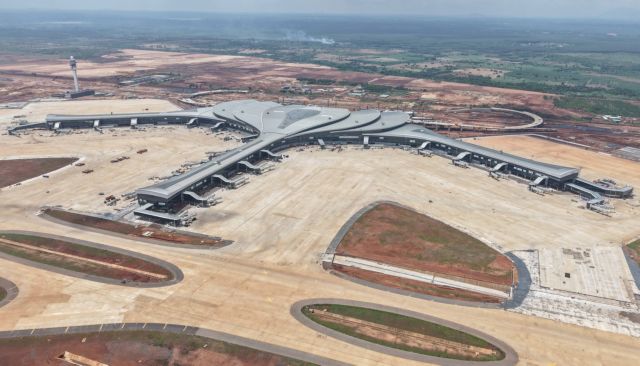
| Ongoing construction at Long Thành International Airport with commercial operations set for December 2026. — VNA/VNS Photo |
HÀ NỘI — Việt Nam will implement a three-phase transition of international flight operations from Tân Sơn Nhất International Airport to the new Long Thành International Airport beginning on December 1, seeking to minimise disruption to airlines and passengers by synchronising the move with global aviation scheduling cycles.
The Civil Aviation Authority of Việt Nam (CAAV) has just endorsed a phased transition plan proposed by the Airports Corporation of Việt Nam (ACV), saying the approach reflects consultations with airlines, airport operators and government agencies, while allowing adequate time for operational preparations.
The roadmap is intended to coincide with the International Air Transport Association (IATA)'s seasonal scheduling system, under which airlines worldwide publish winter and summer timetables months in advance.
Under the plan, Long Thành will begin commercial operations on December 1, 2026.
During the first phase, from December 1, 2026, until the end of the 2026–27 northern winter schedule on March 27, 2027, airlines will be encouraged – but not required – to operate international passenger and cargo services from Long Thành based on their commercial needs.
The second phase, covering the 2027 summer schedule from March 28 to October 29, will see all long-haul international passenger and cargo flights transferred to Long Thành.
In the third phase, beginning with the 2027–28 winter schedule on October 30, 2027, nearly all remaining international flights will move to the new airport, with the exception of Vietnamese carriers operating short-haul routes of less than 1,000km.
According to the CAAV, airlines have consistently called for an early announcement of the final operating plan, together with a clear transition timetable aligned with the completion of airport infrastructure, customs and immigration facilities, aviation services and supporting transport links.
Đào Xuân Hoạch, deputy director general of the CAAV, said the phased approach would ensure continuity and safety while allowing Long Thành's capacity to increase gradually in line with project completion and operational readiness.
"The proposed transition is designed around international flight scheduling cycles, the construction progress of Long Thành Airport and the need to maintain stable operations across southern Việt Nam's airport network during the transition period," he said.
The authority also said it is studying a mechanism to preserve historical slot allocations at Tân Sơn Nhất for airlines transferring services to Long Thành, in accordance with Vietnamese regulations and international practice. Such a measure would provide greater certainty for airlines while encouraging an orderly migration to the new airport.
To further support the transition, the Ministry of Construction has instructed ACV to announce preferential airport service charges at Long Thành to encourage airlines to establish new routes and relocate existing operations.
The CAAV noted that operating from two airports during the transition would inevitably increase costs for airlines, requiring them to reorganise networks and allocate staff and equipment across both facilities.
For passengers, authorities stressed that the success of the dual-airport system will depend on the timely completion of road connections, the launch of public transport services and comprehensive passenger information.
The CAAV has asked ACV to prepare detailed operational plans for each phase of the transition and work closely with airlines, aviation service providers and government agencies to ensure safe and efficient operations.
The regulator will conduct reviews after each stage to identify operational or safety issues before progressing to the next phase.
The Ministry of Construction has also urged authorities in HCM City and Đồng Nai Province to accelerate construction of transport links to Long Thành, including five local bus routes within Đồng Nai and 10 interprovincial routes connecting the airport with Hồ Chí Minh City and neighbouring provinces.
ACV, the Vietnam Air Traffic Management Corporation (VATM), airlines and aviation service providers have also been instructed to complete staffing, equipment, information technology systems, operational trials and emergency exercises ahead of Long Thành's commercial opening.
Long Thành International Airport with capacity at 100 million passengers a year is envisioned as Việt Nam's principal international aviation gateway once fully developed, easing congestion at the overcrowded Tân Sơn Nhất and strengthening the country's role as a regional aviation hub. — VNS
Society
 Society
 Society
 Society
 Society
 Society
 Society
 Society
 Society
.jpg) Society
Society
 Society
 Society
 Society
 Society
 Society