 Society

Việt Nam, Singapore promote cooperation through Party-to-Party channel
1.
|
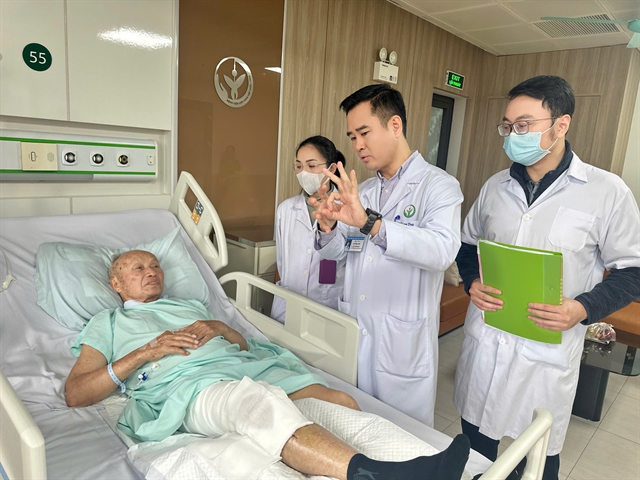
| Vũ Trung Trực (second, right), Deputy Head of the Department of Maxillofacial Surgery and Plastic & Aesthetic Surgery under the hospital, examines the patient after surgery. — Photo benhvienvietduc.org |
HÀ NỘI — Doctors at the Việt Đức University Hospital in Hà Nội have successfully treated a chronic knee injury that had remained unresolved for more than half a century in an 85-year-old veteran, following an eight-hour microsurgical procedure involving multiple specialist teams.
The successful surgery not only demonstrated the hospital's advanced clinical expertise but also reflected its profound gratitude to those who had devoted and sacrificed themselves for the nation, the hospital said.
The patient, identified as N.D.T., 85, is from the north-central province of Thanh Hóa.
While serving on the southern battlefield during the resistance war against America, he sustained a gunshot wound from a submachine gun, which shattered his kneecap and caused extensive soft-tissue damage around the knee.
Owing to the limited medical resources available during wartime, the injury could not be fully treated.
More than 50 years later, the old wound continued to discharge fluid, causing persistent pain and severely affecting his mobility and daily activities.
Before being admitted to the hospital, his family had sought treatment through various medical facilities, but none had been successful.
Following a comprehensive assessment, specialists diagnosed the patient with loss of the patella and chronic fistulising inflammation of the patellar tendon caused by the wartime ballistic injury, a rare and highly complex condition that had persisted for decades.
An exceptionally challenging case
Vũ Trung Trực, Deputy Head of the Department of Maxillofacial Surgery and Plastic & Aesthetic Surgery under the hospital, said both the patient and the injury presented an exceptionally challenging case.
To eradicate the chronic infection and improve both mobility and quality of life, the patient required an extensive operation involving radical removal of all infected tissue, followed by reconstruction using healthy, well-vascularised tissue.
In elderly patients, free-flap transfer with microsurgical vascular anastomosis is generally not the preferred option.
Although the patient had no underlying medical conditions, the quality of his blood vessels, affected by advanced age, required careful evaluation before microsurgery could be considered.
Following multidisciplinary consultations involving specialists in Plastic and Reconstructive Surgery, Orthopaedic Trauma, Anaesthesiology and Intensive Care, the team initially agreed to reconstruct the defect using a pedicled flap from the patient's ipsilateral thigh.
A contingency plan involving a free flap with microsurgical vascular anastomosis was also prepared should the first approach prove unfeasible.
During surgery, however, doctors discovered that the blood vessels around the injured area had undergone severe structural changes and atherosclerosis, making the pedicled-flap technique impossible.
The surgical team was therefore forced to proceed with the second option, harvesting the flap completely and reconnecting the blood vessels under an operating microscope.
This proved to be the most technically demanding stage of the procedure.
The atherosclerotic vessel walls had separated into two layers, making vascular anastomosis extremely difficult and significantly increasing the risk of thrombosis.
Without highly precise microsurgical techniques performed by an experienced team, the patient could have faced flap failure or even limb necrosis.
The eight-hour operation was carried out through close coordination among multiple specialist departments.
Following the surgery, the patient received intensive monitoring and comprehensive postoperative care, including close observation of both his overall condition and the transferred flap, regular wound dressing and cleaning, medication, and rehabilitation therapy.
His recovery has progressed well.
Doctors confirmed that the blood vessels had been successfully reconnected and that the injury, which had persisted for more than five decades, had been completely resolved.
After completing rehabilitation, the patient has regained near-normal mobility. — VNS
Society
 Society
 Society
 Society
 Society
 Society
 Society
 Society
 Society
 Society
 Society
 Society
 Society
 Society
 Society