 Life & Style

Việt Nam, Singapore promote cooperation through Party-to-Party channel
1.
|
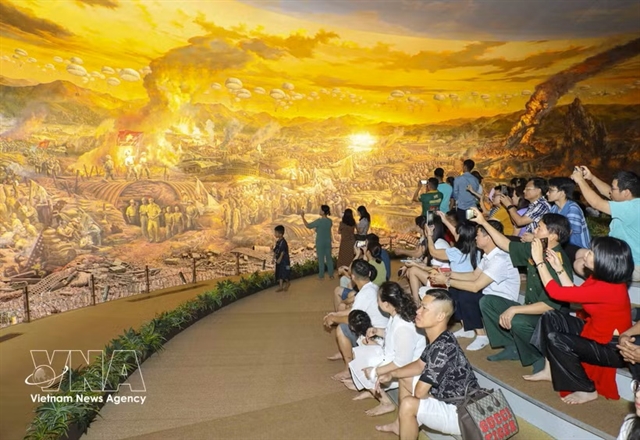
| Visitors admire the panoramic painting depicting the Điện Biên Phủ Campaign at the Điện Biên Phủ Victory Museum. — VNA/VNS Photo |
ĐIỆN BIÊN — Tourism in Điện Biên is stepping into a new chapter, with visitor numbers and revenue climbing steadily after years of investing in infrastructure and promoting its rich historical and cultural heritage.
To turn its potential into a competitive advantage and make tourism a key economic sector, the northwestern province has adopted a number of important resolutions designed to create fresh momentum for tourism to develop in a professional, sustainable, and culturally distinctive manner.
Support for key community-based tourism villages
Điện Biên is home to distinctive cultural attractions. The province boasts the renowned Điện Biên Phủ battlefield heritage site, as well as a diverse ecosystem including Pá Khoang Lake, Mường Phăng Forest, U Va hot springs, and the Mường Thanh rice field, alongside the rich cultural heritage of 19 ethnic groups.
In 2025, Điện Biên welcomed more than 1.45 million visitors, generating total tourism revenue of about VNĐ2.65 trillion (about US$101.44 million). The growth continued in the first six months of 2026, with nearly 1 million visitors and revenue of almost VNĐ1.8 trillion, up around 20 per cent year-on-year.
However, bottlenecks remain. Many community-based tourism villages still lack adequate infrastructure, while numerous homestay operators do not have sufficient resources to renovate accommodation facilities or improve services. Promotion and digital transformation remain limited, while tourism products lack depth and have yet to achieve the competitiveness commensurate with their potential.
Recognising these shortcomings, in June this year, the provincial People's Council issued a resolution introducing a range of policies to support tourism product development, covering infrastructure, products, human resources, communications, promotion, and digital transformation.
Notably, the province has, for the first time, established a support mechanism for key community-based tourism villages. Beneficiaries include not only village management organisations but also homestay operators, businesses, cooperatives, households, and individuals engaged in tourism activities.
The support policies are expected to help address grassroots infrastructure needs, including investment in roads within tourism villages, reception houses, lighting systems, public toilets, and public internet access. They also provide support for developing OCOP goods, experiential tourism products, tourism promotion, and digital transformation.
Homestay operators can receive assistance for renovating accommodations, purchasing equipment, and improving surrounding landscapes. They can also access preferential loans through the Vietnam Bank for Social Policies to expand their businesses.
Trần Hải Hà, Director of the provincial Department of Culture, Sports and Tourism, said Điện Biên also plans to promote public-private partnerships and mobilise social resources for tourism development. It will strengthen links with tour operators, airlines, localities in the northwestern region, and international markets through the Điện Biên Airport and Tây Trang International Border Gate.

|
| A tour guide introduces visitors to exhibits at the Điện Biên Phủ Victory Museum. — VNA.VNS Photo |
Making digital content creators beneficiaries of tourism policies
Another notable feature of the resolution is that for the first time, the province has included digital content creators among the beneficiaries of tourism development support policies.
Encouraging people with an in-depth understanding of local culture to tell the stories of their homeland themselves is considered a response well suited to modern communication trends. Under the policy, individuals and organisations meeting requirements concerning their period of operation and the quantity and quality of promotional products will receive financial support to improve the quality of their digital content.
Nguyễn Nam Khánh, one of the first digital content creators in Điện Biên, said the new policy is not only a financial incentive but also a recognition of those who help promote their homeland.
The assistance, he added, would enable content creators to invest in better equipment, improve image quality, and produce more engaging content showcasing Điện Biên’s landscapes, culture, and people to visitors at home and abroad. — VNA/VNS
Life & Style
 Life & Style
 Life & Style
 Life & Style
 Life & Style
 Life & Style
 Life & Style
 Life & Style
 Life & Style
 Life & Style
 Life & Style
 Life & Style
 Life & Style
 Life & Style
 Life & Style