 Society
Việt Nam, Singapore promote cooperation through Party-to-Party channel
1.
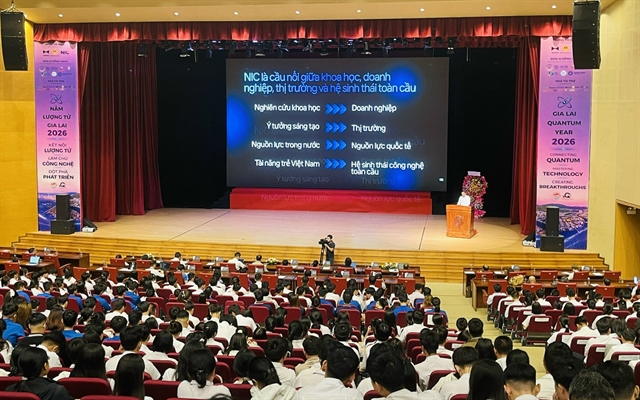 |
| Deputy Director of the Vietnam Innovation Center (NIC), Dr. Võ Xuân Hoài delivers remarks at the Symposium on Fundamentals of Quantum Computing & Semiconducting Technologies in Gia Lai Province on Monday. — VNS Photos Khánh Chi |
GIA LAI — In an age when human beings are witnessing a powerful transformation of quantum technology from the laboratory to practical applications, quantum computers are capable of solving problems that would take current supercomputers thousands of years to complete.
That was the message from Deputy Director of the Vietnam Innovation Center (NIC), Dr Võ Xuân Hoài, speaking on July 27, at the Symposium on Fundamentals of Quantum Computing & Semiconducting Technologies entitled Vietnam Quantum Roadshow on Monday, which kicks off a series of the Gia Lai Year of Quantum 2026 in Gia Lai Province.
The symposium aims to popularise quantum computing knowledge among students in natural sciences and technology, including mathematics, physics, chemistry, engineering and Information Technology.
“If artificial intelligence is changing the way we work, quantum technology is expected to transform how we compute, transmit information, and explore the natural world," he said in his opening address.
"Many nations have identified quantum as a strategic technology of the 21st century, investing tens of billions of dollars to secure a competitive advantage for the future.” Hoài opened his speech.
Quantum communication opens the door to near-absolute security, while quantum sensors enable measurement with unprecedented precision in healthcare, energy, aerospace and defence. Quantum technology is no longer a story of the distant future; it is becoming a new technological foundation for economic growth, innovation, and national competitiveness, said Hoài.
For Việt Nam, this is a pivotal moment, he added. The Party and State have identified science, technology, innovation, and digital transformation as the key drivers of national development. Within the list of strategic technologies, quantum technology has been designated as a top priority for the coming period.
“However, to master quantum technology, we cannot simply purchase equipment or import technologies," he said.
"More importantly, we must build a robust innovation ecosystem - a collaborative environment where universities, research institutes, businesses, investment funds, start-ups, and regulatory bodies work together to transform knowledge into tangible value."
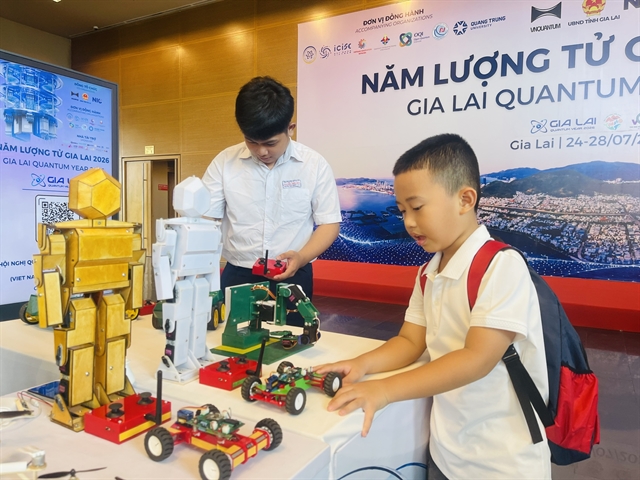 |
| Robot models are on display within the framework of the Gia Lai Quantum Year 2026. |
Deputy Director of the Provincial Department of Science and Technology, Phan Hồ Giang, stated that the Poliburo’s Resolution No 57-NQ/TW has identified the development of science and technology, innovation, and digital transformation as top strategic breakthroughs and the core driving force for rapid and sustainable national development.
Among these, quantum science, quantum computing, and semiconductor technology are considered core technologies that play a decisive role in national competitiveness and will shape the world's technological future for decades to come.
“Gia Lai chooses to proactively keep pace with the times," Giang said.
"Quantum science and semiconductors are no longer distant concepts confined to academic laboratories; they are becoming the keys to opening doors of new knowledge for the younger generation and creating breakthrough momentum for the local socio-economic development.”
According to the official, the organisers aim to making quantum science and semiconductors more accessible and easier to understand through public lectures, helping students and the community grasp fundamental concepts, prominent achievements, and practical application potential; establishing a direct connection between Gia Lai’s youth and leading scientists to create opportunities for dialogue and ignite a passion for scientific research; and linking the VNQuantum and the NIC with the local education system to lay the foundation for training programmes, research cooperation, and long-term high-quality human resource development.
Jointly held by Vietnam’s National Quantum Technology Network (VNQuantum), Gia Lai Province and NIC, the event brings together experts and researchers from various domestic and international institutions, featuring presentations that range from theoretical foundations to the practical applications of quantum technology.
Path to quantum technology
Highlights include the talk on the distinctions between quantum and classical information by Associate Professor Dr Đinh Trung Hòa from Troy University in the US, in which he emphasised that while classical information relies on distinct states that can be easily read or duplicated, quantum information is fundamentally different and why quantum technology is set to define the next era of innovation.
In his presentation, Quantum Key Distribution (QKD): Principles, Protocols, and Experimental Demonstrations, Dr Vũ Quang Minh from the Hà Nội-based Posts and Telecommunications Institute of Technology identified QKD as the core technology of quantum communications.
QKD allows two entities to establish a secret key with a security level guaranteed by the laws of quantum mechanics. Unlike traditional cryptographic systems, which rely on assumptions regarding an attacker’s computational power, QKD exploits quantum properties to detect eavesdropping and ensure the absolute security of the distributed key.
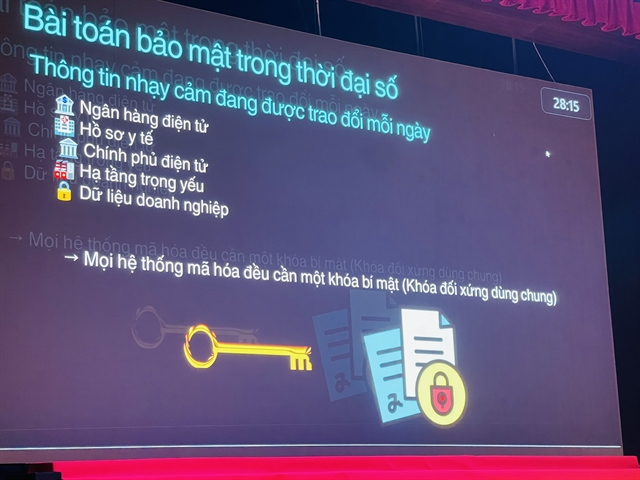 |
| The sensitive information exchanged daily, including e-banking transactions, medical records, e-government services, critical infrastructure and corporate data is highlighted by Dr Vũ Quang Minh from the Hà Nội-based Posts and Telecommunications Institute of Technology. |
Addressing security in the digital age, Dr Minh highlighted the sensitive information exchanged daily, including e-banking transactions, medical records, e-government services, critical infrastructure, and corporate data. Every encryption system requires a secret key; therefore, securing these keys is vital for overall information security.
According to Dr Minh, with current classical computing technology, breaking these keys would take millions of years. However, Professor Shor’s algorithm has demonstrated the immense theoretical potential of quantum computers to crack encryption in just hours or days. This advancement in qubit-based computing has led to two primary security solutions: Post-Quantum Cryptography (PQC) and Quantum Key Distribution (QKD). — VNS
Society
 Society
 Society
 Society
 Society
 Society
 Society
 Society
 Society
 Society
 Society
 Society
 Society
 Society
 Society