 Society

Ambassador pledges every effort to promote Việt Nam–Sweden ties
1.
|
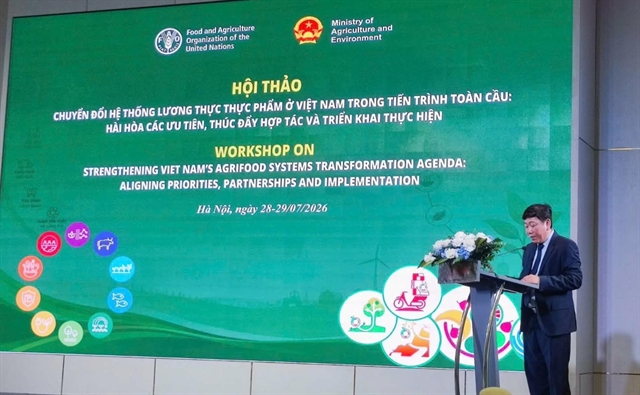
| Nguyễn Đỗ Anh Tuấn, director of the Ministry of Agriculture and Environment's International Cooperation Department, speaks at the workshop in Hà Nội on Tuesday. — VNS Photo Tố Như |
HÀ NỘI — Agricultural officials met with representatives from the Food and Agriculture Organisation (FAO) in Hà Nội on Tuesday to discuss the improvement of Việt Nam’s agricultural and food system.
The two-day workshop, held by the Ministry of Agriculture and Environment, focuses on transforming Việt Nam’s agrifood system to be in line with global standards using the FAO’s Global Roadmap.
The roadmap is an action framework designed to help countries ensure food and nutrition security amid constant climate change, while controlling carbon emissions to make sure global warming stays within limits.
It is built on 10 key areas and outlines about 120 priority actions, creating an integrated yet flexible reference framework that countries can adapt to their own conditions and development goals.
Speaking at the conference, Nguyễn Đỗ Anh Tuấn, director of the ministry’s International Cooperation Department, stressed that transforming the agrifood system to be adaptive to climate change was a crucial task in the current context.
Instead of just focusing on increasing production, Việt Nam needed to aim to create more value through a green, safe, low-emission and resilient food system, he said.
"This is a crucial foundation for enhancing the competitiveness of the agricultural sector, while contributing to the country’s sustainable development goals," said Tuấn.
To achieve these goals, the ministry had been focusing on five key tasks, which are modernising its governance models, developing circular economic models for the food system, managing resources effectively, digitising the sector, and promoting a ‘green’ transition towards carbon neutrality (with ‘net zero’ emissions).
The ministry had also studied the FAO roadmap, which is highly compatible with the goals set out in the national action plan for transforming the food system until 2030, promulgated in the Prime Minister’s Decision No. 300/QĐ-TTg in 2023, Tuấn said.
These goals range from increasing farmers' incomes, improving nutrition and food safety, to promoting ecological production, reducing greenhouse gas emissions, enhancing traceability and digital transformation of the sector.
“Implementing the roadmap will help Việt Nam connect domestic development goals with international commitments, and also attract resources, technology and collaborative initiatives to accelerate the food system’s transformation,” he said.
Vinod Ahuja, FAO representative to Việt Nam, welcomed the ministry’s decision to adopt the roadmap, adding that priorities should be identified as the adoption progresses to avoid wasting financial resources and institutional capacity.
“It is necessary to identify actions that can generate dual benefits, such as promoting growth while increasing farmers' incomes, or enhancing crops’ resilience while improving their nutrition and protecting the environment,” he said.
Each action needed to be planned with a clear implementation timeline, designated lead agency and coordinating units, their existing capacity and gaps that need to be filled, as well as finances and an outline of tasks in order of importance, said Ahuja.
Cao Đức Phát, former Minister of Agriculture and Rural Development, expressed his hope that an action programme to implement the FAO roadmap would be issued as soon as possible, focusing on helping Việt Nam review and improve policies on reducing food loss, food waste and carbon emissions.
Việt Nam is one of the pioneering countries in Asia-Pacific that promotes the transformation of the food system through a national action plan, the establishment of multi-stakeholder partnerships for the transformation, and the implementation of many pilot models at the local level.
An effective application of the FAO roadmap will help the country mobilise resources and leverage international cooperation to reach its food security, adapt to climate change and progress towards sustainable development by 2050. — VNS
Society
 Society
 Society
 Society
 Society
 Society
 Society
 Society
.jpg) Society
Society
 Society
 Society
 Society
 Society
 Society
 Society