 Society
84 individuals investigated for transnational online frauds
1.
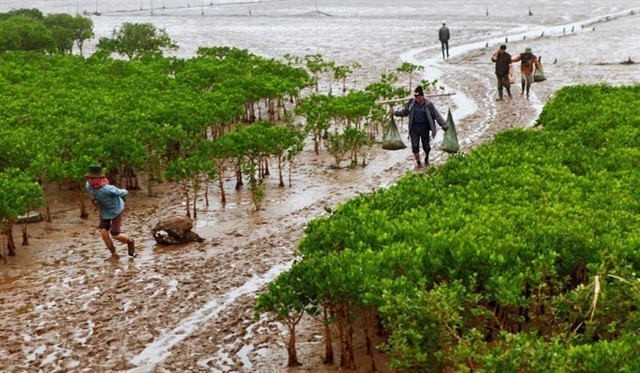 |
| Local residents harvest fish and other aquatic resources near the mangroves in Xuân Thủy National Park, Ninh Bình Province. — VNA/VNS Photo Lâm Khánh |
NINH BÌNH — By balancing mangrove forest conservation with the development of green livelihoods, Xuân Thủy National Park in Ninh Bình Province has helped thousands of people living in its buffer zone secure sustainable incomes while protecting one of Việt Nam's most valuable wetland ecosystems.
Located at the Ba Lạt estuary where the Hồng (Red) River meets the sea, Xuân Thủy National Park is Việt Nam's first Ramsar site – a wetland of international importance, as listed in a global environmental treaty – and one of the country's richest coastal ecosystems. Its vast mangrove forests, tidal flats and abundant aquatic resources support exceptional biodiversity while providing livelihoods for thousands of local residents through aquaculture, fishing and ecosystem-based services.
Making a living from the wetlands
Drawing on the natural advantages of the park's wetlands and mangrove forests, local communities have developed livelihood models that work in harmony with nature.
For more than three decades, Trịnh Văn Đoàn's family has lived in Giao Minh Commune, where they manage 7.5 hectares of extensive aquaculture ponds. Their integrated farming system combines black tiger shrimp and mud crab cultivation with the seasonal harvesting of naturally occurring aquatic species, including shrimp and other estuarine seafood.
The extensive farming model takes advantage of the area's natural conditions, requiring relatively low investment while minimising the use of industrial feed and chemicals. Healthy ecosystems and stable water quality allow aquatic species to thrive naturally, generating annual profits worth hundreds of millions of đồng after production costs.
Beyond aquaculture, many households have diversified into products closely linked to the wetland ecosystem. Beekeeping beneath mangrove forests has emerged as one of the most successful examples, generating stable incomes while encouraging forest protection.
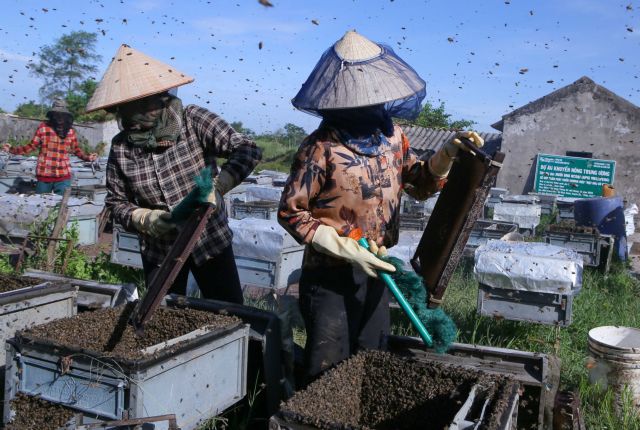 |
| Beekeepers prepare to harvest honey at an apiary in Xuân Thủy National Park, Ninh Bình Province. — VNA/VNS Photo Công Luật |
In Xuân Hồng Commune, Phạm Thanh Sơn manages around 380 honeybee colonies. When he entered the profession in 1996, he was among the pioneers of commercial beekeeping in the area.
Thanks to the abundant blossoms provided by the mangrove ecosystem, his bees produce distinctive, high-quality honey. Each year, his family supplies between 16 and 20 tonnes of honey to markets across the country, making it their primary source of income.
“The success of beekeeping depends heavily on the natural environment, especially healthy mangrove forests,” Sơn said. “When the forests are well protected and flowers are abundant, the bees remain healthy and produce both higher yields and better-quality honey.”
Today, more than 20 households around Xuân Thủy National Park keep nearly 6,000 bee colonies, producing around 120 tonnes of honey each harvesting season. Average annual earnings exceed VNĐ1 million per hive, while larger operations managing between 300 and 500 colonies have created stable employment for local workers.
According to Vice Chairman of the Giao Minh Commune People's Committee Nguyễn Viết Sự, ecosystem-based livelihood models have become an important source of stable jobs and income for local residents.
The commune has worked closely with Xuân Thủy National Park to promote sustainable production methods that combine economic development with environmental protection. Local authorities have encouraged environmentally friendly farming, responsible use of natural resources and greater public awareness of biodiversity conservation.
Protecting forests, protecting livelihoods
As Việt Nam's first Ramsar site and one of Southeast Asia's earliest internationally recognised wetlands, Xuân Thủy National Park is home to extensive mangrove forests, rich mudflats and habitats supporting hundreds of rare plant and animal species. These ecosystems also form the economic foundation for thousands of households living in surrounding coastal communities.
According to the park's management board, conservation efforts have faced increasing pressure from resource exploitation, climate change, sea level rise and more frequent extreme weather events.
Park authorities believe biodiversity conservation cannot be separated from local livelihoods. Instead, environmental protection and economic development must reinforce each other.
To achieve this, the park has implemented a wide range of livelihood support programmes for residents in buffer-zone communities. These include promoting extensive aquaculture, mangrove beekeeping, seasonal fishing, ecotourism and other conservation-based services.
These initiatives not only provide reliable incomes for local people, but also reduce pressure on natural resources in the park's strictly protected core zone.
Community awareness has also become a central component of conservation efforts. Regular outreach programmes focus on biodiversity protection, migratory bird conservation, illegal fishing prevention and mangrove forests safeguarding.
Through these activities, local residents have gained a deeper understanding of the vital role wetlands play in economic development, environmental protection and climate change adaptation.
Phạm Vũ Ánh, the park's deputy director, said local communities are the most closely connected to natural resources on a daily basis, making their participation essential to long-term conservation success.
“Conservation can only succeed when local people see tangible benefits from protecting forests and natural ecosystems,” he said.
“When livelihoods are secure, communities become stronger partners in conservation. That support is crucial to preserving the outstanding ecological value of Xuân Thủy's coastal wetlands, while laying the foundation for a greener and more sustainable future.” — VNS
Society
 Society
 Society
 Society
 Society
 Society
 Society
 Society
 Society
 Society
 Society
 Society
 Society
 Society
 Society