 Society

Việt Nam, Denmark issue joint statement on establishment of Comprehensive Strategic Partnership
1.
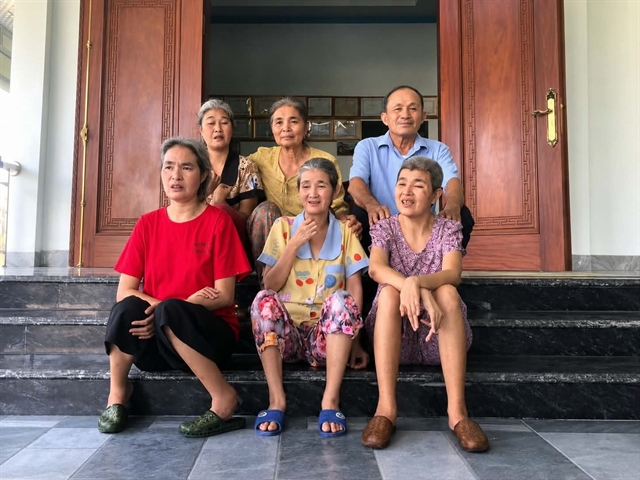 |
| Lê Đình Dểnh and his wife, Nguyễn Thị Đàn, with their four children, all of whom were affected by Agent Orange, at their home in Quảng Trung Commune, Thanh Hóa Province. — VNA/VNS Photo Viết Tôn |
HÀ NỘI — More than half a century has passed since the war for national liberation and reunification, but the scars left by that conflict on the bodies of wounded veterans and victims of chemical agents are still present, bearing testimony to its enduring aftermath.
These are wounds that do not bleed, but they are painful and persistent through generations. Agent Orange (AO)/dioxin, the chemical weapon that the US military sprayed over Việt Nam, continues to erode the health and spirit of thousands of families.
Visiting the family of veteran Lê Đình Dểnh in Quảng Trung Commune in Thanh Hóa Province, people are deeply moved by their long struggle with the devastating consequences of Agent Orange.
Back in 1972, a young Dểnh joined the South Vietnamese liberation forces and fought on the fierce battlefields of Bến Cát, Tây Ninh, Bình Phước, National Highway 13 and even Cambodia.
"Back then, we lived in deep forests. All the trees were dead from the defoliants. We lived, ate, drank and bathed in water from the streams, but we had no idea of the lurking danger," he said.
After the country was liberated and peace returned, Dểnh was discharged and returned to his home in Thanh Hóa. In 1980 he married Nguyễn Thị Đàn, who had also been a youth volunteer during the war.
Their joy was complete when their first daughter, Lê Thị Thơm, was born healthy in 1983.
Tragedy, however, began with the later births. The next three daughters – Lê Thị Thu, Lê Thị Thêm and Lê Thị Gái, born in 1985, 1987 and 1993 – all were born with severe disabilities. All four daughters were affected by AO, growing up with illness, poor health and intellectual disabilities.
At 68, an age when Đàn might expect to rely on her children and grandchildren, the reality is the opposite.
Carrying a basin to wash her children's hands and feet, Đàn choked with emotion.
"It is so hard. Many times I watch my children laugh or cry for no reason, fight over food and sleep, and my heart aches. At those times I can only comfort them and try to calm them so they smile."
A second battle
Despite mounting difficulties, with support from the authorities the children have received social welfare benefits that have eased the family's financial burden.
Although the family is poor, Dểnh has always been a model member of the local community. During the campaign to build new-style rural areas, he voluntarily donated land to widen a village road.
Hoàng Công Thủy, vice chairman of Quảng Trung People's Committee, said, "Dểnh’s family is a bright example of resilience and dedication to the community."
Dểnh is now a war invalid. At an age when he should be enjoying his later years, he faces another battle – the struggle with the devastating legacy of Agent Orange in his own home.
The story of Nguyễn Quyết Chiến, 73, is equally heartbreaking.
Enlisting in 1972 and fighting in the southeast, Chiến never imagined that the devastating effects of Agent Orange would follow him into peacetime and be passed down to his children and grandchildren.
Discharged and back home in 1981, Chiến and his wife had three children, all of whom suffered the effects of Agent Orange. Their eldest son, Nguyễn Quốc Việt, can still look after himself to some extent, but the second son has nearly lost the ability to do so, while their daughter also lives with severe disabilities.
Painfully, that suffering did not stop with the second generation but has spread to the third – Chiến's grandchild is also affected by Agent Orange.
Bỉm Sơn Ward currently has 101 victims of AO/dioxin, with figures that shock: 13 people have cancer, 26 people are second-generation victims, and eight are third-generation victims. Some families have all three generations suffering from blindness, deafness or muteness, or mental illness, making their lives a daily struggle.
Standing together
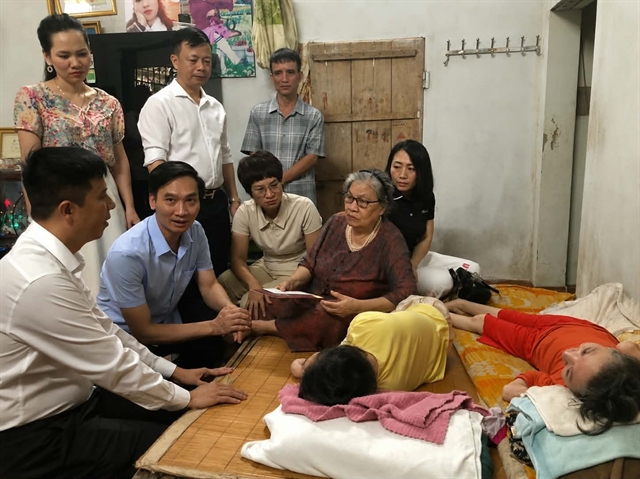 |
| Philanthropists present gifts to the family of Hoàng Thị Gấm in Đông Hương Ward, Thanh Hóa Province. Her two daughters, Nguyễn Thị Anh, 49, and Nguyễn Thị Hương, 42, are Agent Orange victims. — VNA/VNS Photo Viết Tôn |
According to Dương Văn Huệ, chairman of the Thanh Hóa Association for Victims of Agent Orange, the province has more than 11,500 AO victims.
Understanding their great losses, the Thanh Hóa Province Association for Victims of Agent Orange and local authorities have carried out many practical activities to support victims over the years, and the provincial association has become a solid refuge for those affected.
Over the past 20 years the association has raised more than VNĐ103.6 billion (US$3.9 million) for the Agent Orange Victims Support Fund.
From these resources, more than 730 homes belonging to victims have been built or repaired. A proud achievement is that there are now no households with direct Agent Orange victims living in temporary or dilapidated houses.
Care for health has not been neglected.
More than 1,700 wheelchairs and walking frames have been donated, and over 11,000 people have received free medical examinations and medicine.
At gatherings marking Việt Nam Agent Orange Disaster Day on August 10 each year, gifts and warm words of encouragement have helped strengthen the resolve of affected families.
Recently, a programme providing free medical examinations and medicine, organised by the Bỉm Sơn Ward Association for Victims of Agent Orange, has further demonstrated the close attention paid by local authorities.
Enduring hope
According to Đầu Thanh Tùng, vice chairman of Thanh Hóa People's Committee, the locality has consistently instructed authorities at all levels to regard caring for Agent Orange victims as a priority.
Tùng called on associations to innovate their approaches, closely monitor each family's circumstances, and provide practical support.
"We must not only offer material assistance but also fight for justice for victims, help them integrate into the community and build better lives," he said.
The journey to heal the wounds of Agent Orange is long, requiring persistence and the compassion of the whole society.
Families such as those of Lê Đình Dểnh and Nguyễn Quyết Chiến are living proof of the strength of national spirit. They sacrificed their youth for the country and now deserve continued care, support and protection from society.
Perhaps the pain caused by war can be eased, even if only a little, when they know they are not alone.
The companionship of the State, social organisations and generous hearts is the most precious medicine for those wounds that do not bleed, helping them heal, little by little, while allowing hope to take root once again on the land once scarred by war. — VNS
Society
 Society
 Society
 Society
 Society
 Society
 Society
 Society
 Society
 Society
 Society
 Society
 Society
 Society
 Society