 Society

Private conglomerates expand economic contributions through jobs, taxes and investments
1.
|
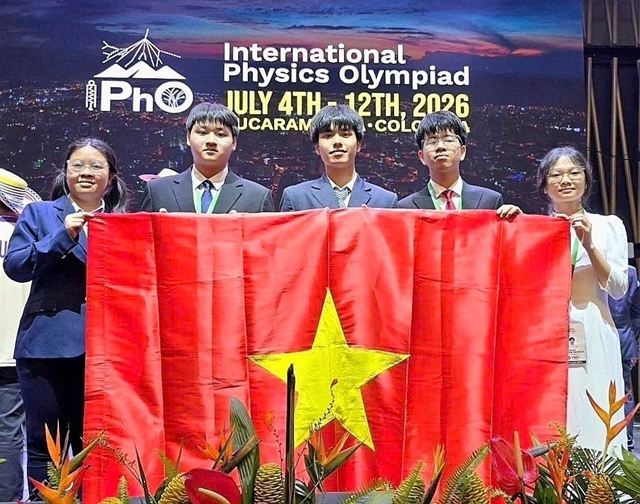
| Members of the Việt Nam team at the 2026 International Physics Olympiad in Columbia. From left: Vũ Nguyên Nguyên, Tạ Ngọc Minh, Nguyễn Nhật Minh, Lê Duy Khánh and Nguyễn Thị Bích Ngọc. — VNA/VNS Photo |
HÀ NỘI — Việt Nam has finished among the top seven teams at the International Physics Olympiad this year with four gold and one silver medals, the Ministry of Education and Training announced on Saturday.
This is also Việt Nam’s best result at the competition so far.
The team was made up of five high school students from Hà Nội, Thanh Hóa, Bắc Ninh and Ninh Bình provinces.
The gold medal winners are Vũ Nguyên Nguyên, grade 11, from Hà Nội-Amsterdam Specialised High School, Nguyễn Nhật Minh, grade 11, from HUS High School for Gifted Students, as well as Tạ Ngọc Minh, grade 12, from Bắc Ninh Specialised High School and Nguyễn Thị Bích Ngọc, grade 12, from Lê Hồng Phong Specialised High School in Ninh Bình.
Lê Duy Khánh, grade 11, from Lam Sơn Specialised High School in Thanh Hóa, won a silver medal.
The two students from Hà Nội achieved a perfect score on the theory test, which is also a first-time result for the Việt Nam team.
The overall results were the best in recent years, with the country’s previous highest achievements in the competition being two gold and three silver medals in 2024.
This year’s results demonstrated the solid knowledge, critical thinking and problem-solving skills of Vietnamese students in one of the most demanding international science competitions for high school students, according to the education ministry.
With three out of five team members in grade 11, they showed the potential and depth of Việt Nam’s physics students, which is a foundation for discovering and nurturing young scientific talents, the ministry said.
The 56th International Physics Olympiad took place in Bucaramanga, Santander Province, Colombia from July 4 to 12, with the participation of 381 outstanding high school students from 85 countries and territories.
Candidates were comprehensively assessed on physics knowledge, analytical thinking, problem-solving abilities and practical skills during two exams, one theoretical and one experimental, lasting five hours each. — VNS
Society
 Society
 Society
 Society
 Society
 Society
 Society
 Society
 Society
 Society
 Society
 Society
 Society
 Society
 Society