 Society

Social, rental housing prices must be regulated: PM
1.
ĐÀ NẴNG — The Ministry of Health on Friday reaffirmed its role as the lead agency in child drowning prevention, pledging to work closely with ministries, sectors, local authorities and international partners to strengthen prevention efforts.
The commitment was made at an inter-sectoral workshop in Đà Nẵng, which brought together representatives from the Ministry of Education and Training, the Ministry of Culture, Sports and Tourism, the Ministry of Public Security, the Ministry of Agriculture and Environment, as well as experts, researchers, local authorities and international organisations.
The workshop aimed to comprehensively review the outcomes of child drowning prevention efforts in recent years and identify appropriate solutions for the next phase.
 |
| Participants at the workshop in Đà Nẵng on Friday. — Photos courtesy of the organisers |
In his opening remarks, Associate Professor, Dr Nguyễn Tri Thức, deputy minister of Health, noted that over recent years the Ministry of Health, together with other ministries, sectors, localities and international organisations such as the World Health Organisation (WHO) and the Campaign for Tobacco-Free Kids (CTFK), had worked effectively to implement the Prime Minister’s Decision No. 1248 approving the National Programme on Child Injury Prevention for 2021–30, alongside the Child Drowning Prevention Project for 2018–25 supported by CTFK.
However, he also highlighted major challenges. Việt Nam’s dense network of rivers and waterways, extensive coastline, and vulnerability to climate change and natural disasters continue to heighten drowning risks.
Meanwhile, public awareness remains limited in some communities, family supervision is insufficient, and many children, particularly those in rural, remote and mountainous areas, still lack essential water safety and survival skills.
“Child drowning prevention is not only a health issue. It is also an issue related to education, child protection, environmental safety, disaster preparedness, community development, and social justice,” said Meheret Melles-Brewer, Team Lead for Healthy Lifestyles and Environment at the WHO Country Office in Việt Nam.
“Every child has the right to grow up safely, to learn, to play, and to develop. Drowning is entirely preventable, and every sector and every unit plays an important role in the successful implementation of child drowning prevention in Việt Nam,” she stressed.
She also noted that climate change, flooding and urbanisation are increasing children’s exposure to water-related risks, underscoring the need to integrate drowning prevention into national priorities on disaster risk reduction and climate change adaptation.
Representing the Campaign for Tobacco-Free Kids (CTFK) in Việt Nam, Đoàn Thị Thu Huyền emphasised: “As weather patterns become increasingly extreme, the risk of drowning is likely to become even more severe, particularly in rural areas and communities frequently affected by natural disasters. Therefore, drowning prevention should be recognised not only as a public health issue but also as a matter of sustainable development and children’s rights.”
Drawing on implementation experience, she proposed six recommendations for the Ministry of Health and relevant ministries, sectors and localities: integrating child drowning prevention into local socio-economic development and child protection plans; establishing clear national standards on the content, duration and qualifications of safe swimming instruction; ensuring sustainable investment in infrastructure and accessibility, particularly in remote areas; maintaining and strengthening local implementation teams; establishing post-training monitoring mechanisms that assess retained skills rather than simply counting the number of participating children; and recognising sustainability as the result of coordinated efforts among government agencies, the education and health sectors, families, communities and the private sector.
Representatives from the Ministry of Education and Training said the ministry had advised the Prime Minister to issue Decision No. 1717/QĐ-TTg, dated December 31, 2024, approving the Programme on Strengthening Drowning Prevention Knowledge and Skills for Students for 2025–35. For the first time, the ministry has also introduced a nationally standardised curriculum and teaching materials for safe swimming instruction.
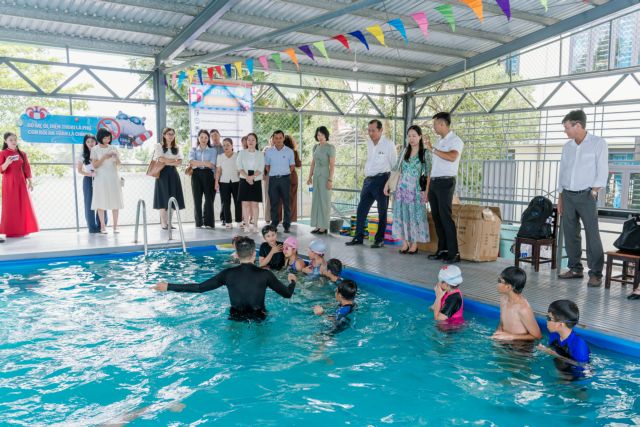 |
| A swimming class in Phạm Hồng Thái Primary School in Đà Nẵng. |
However, statistics as of June 15, 2026, collected from all 34 provincial departments of Education and Training, show that significant challenges remain. Only 11.64 per cent of schools (2,919 out of 25,090) have swimming pools, while 41.01 per cent of students are able to swim. On average, each school has only 0.57 teachers certified to teach swimming.
The ministry attributed these shortcomings mainly to limited funding for infrastructure development and insufficient social investment, particularly in remote and disadvantaged areas.
Representatives from the Ministry of Culture, Sports and Tourism said the ministry plans to introduce a three-level assessment framework for children's swimming proficiency while expanding community sports and cultural facilities to provide more safe recreational spaces for children, especially in rural and mountainous areas.
Associate Professor, Dr Phạm Việt Cường from the Centre for Injury Policy and Prevention Research under the University of Public Health said that the short-term success of intervention projects does not automatically translate into long-term health outcomes without institutionalisation. Children's safe swimming skills, he noted, can decline by nearly 50 per cent within six months if they are not regularly practised and reinforced.
Drawing on international experience and domestic models in Đồng Tháp, Quảng Trị and Huế, he proposed five key solutions: strengthening institutional arrangements and ensuring sustainable funding through regular state budget allocations rather than project-based financing, combined with co-financing mechanisms and private-sector participation; integrating safe swimming into the formal school curriculum with rigorous competency standards, including the ability to swim 25 metres and tread water or float for 90 seconds, taught by trained and certified instructors; optimising swimming infrastructure through the use of smart or mobile pools in remote and flood-prone areas and shared facilities among neighbouring schools; developing a comprehensive data system to support region-specific interventions; and establishing regular training, refresher courses and periodic skills assessments under a structured implementation roadmap. — VNS
Society
 Society
 Society
 Society
 Society
 Society
 Society
 Society
 Society
 Society
 Society
 Society
 Society
 Society
 Society